
When I was a first-year PhD student, many years ago, a respected professor told a class of my fellow PhD students that the modal number of citations to a political science article is zero. At the time, this was a shocking statement. You mean, all of the effort we put into publishing our articles… and we can expect that they will be cited by no one? Our work will have such little impact that no one at all will deem it worthy of a reference?
At the time, I found this very discouraging. My classmates and I agreed. There was something ominous about this statement, the idea that our work would count for nothing and leave no mark on the discipline or the world around us. It also implies that those few authors whose work is getting cited are unusual, and special. It enforced feelings of deference towards the more successful authors around us, and disdain for those whose work we could expect would not last. We could expect to be not even citable.
After a couple of years and a couple of publications, though, I started to rethink this claim. I don’t have any articles that have zero citations. Some articles get lots of citations, but every article gets at least a couple dozen, right? There was no way to know for sure, but I had the sense that the claim was absurd. The modal number of citations for a political science article is zero? Come on, now. Less than 10 I would believe, but no possible way that it is zero.
I put these thoughts aside for a couple of decades, but recently I came across that old saw again. I have since learned that it is an academic urban legend. I have also learned that others—most notable David Samuels, in a 2011 PS article—have debunked this claim using data. But still the claim persists as an urban legend, and a particularly cruel one at that, dismissive as it is of the potential contributions and impact of early career scholars looking for their first publications.
The Samuels piece encouraged me to think more deeply about the problem, and to look for data. Happily, OpenAlex makes it easy to analyze article citation data. We can update the Samuels analysis for a new era using much better data that incorporate books as well as articles.
With the assistance of Claude to interface with the OpenAlex API, I pulled citation data from 40 political science journals from 2000-2025. These journals come from across the subfields. See here, sorted alphabetically by abbreviation:
| AJPS | American Journal of Political Science |
| APSR | American Political Science Review |
| ARPS | Annual Review of Political Science |
| BJPS | British Journal of Political Science |
| CONST | Constellations |
| CP | Comparative Politics |
| CPS | Comparative Political Studies |
| CPT | Contemporary Political Theory |
| EIA | Ethics & International Affairs |
| EJIR | European Journal of International Relations |
| EJPT | European Journal of Political Theory |
| ES | Electoral Studies |
| ETH | Ethics |
| HPT | History of Political Thought |
| IO | International Organization |
| IS | International Security |
| ISQ | International Studies Quarterly |
| JCR | Journal of Conflict Resolution |
| JoD | Journal of Democracy |
| JOP | Journal of Politics |
| JPART | Journal of Public Administration Research and Theory |
| JPP | Journal of Political Philosophy |
| JPR | Journal of Peace Research |
| LSQ | Legislative Studies Quarterly |
| PA | Political Analysis |
| PB | Political Behavior |
| PC | Political Communication |
| POL | Polity |
| PoP | Perspectives on Politics |
| POQ | Public Opinion Quarterly |
| PPA | Philosophy & Public Affairs |
| PPE | Politics, Philosophy & Economics |
| PRQ | Political Research Quarterly |
| PSQ | Political Science Quarterly |
| PSRM | Political Science Research and Methods |
| PT | Political Theory |
| RIPE | Review of International Political Economy |
| RIS | Review of International Studies |
| RoP | Review of Politics |
| WP | World Politics |
There are good reasons to think that OpenAlex data undercounts citations, and it probably is worse for citations from books than from journals (and we all know that book citations count). But let’s proceed anyway.
First, I’ll look at how many times articles are cited. I’ll plot the median number of citations, alongside the 10th-90th and 25th-75th percentiles, by journal (facets) and publication year (x-axis). Facets are sorted by the total number of citations in that journal. I also exclude any short article that is less than 5 pages long in order to remove comments, book reviews, and other such material. Here is what we get:
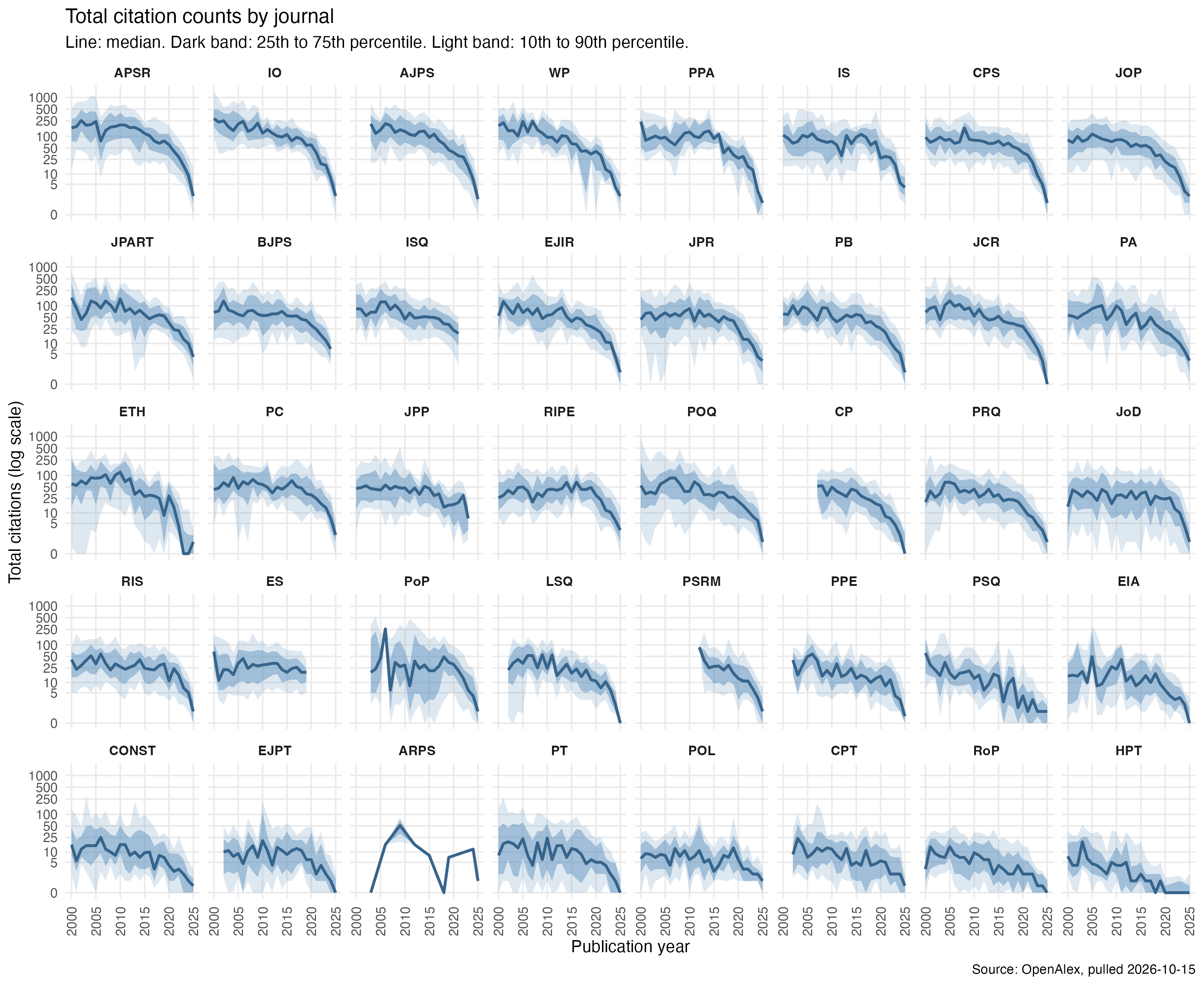
However you slice it, and regardless of political science subfield, most papers are cited more than zero times! (There is something funky about the ARPS data, but it doesn’t matter for these purposes.) Total citations decline over time, but that is because recent articles have less time to collect citations.
The message is, if you publish in any of these journals, you can expect that your articles will be cited more than zero times. Phew. You are unlikely to be publishing articles that earn zero engagement.
So much for that urban legend that the modal number of citations for a political science article is zero, right? So, because we are curious, what is the modal number of citations in these data? Let’s calculate it:
Modes <- function(x) {
ux <- unique(x)
tab <- tabulate(match(x, ux))
ux[tab == max(tab)]
}
Modes(cites$cited_by_count)
[1] 0
Wait. What happened?
As it turns out, that old saw is annoyingly precise. It does not say that the average article gets zero cites, nor does it say the median article gets zero cites. It says that the modal article gets zero cites.
The mode of a variable is, roughly, the most common value of that variable. For continuous data, a mode is a local maximum. For discrete data, a mode is the most frequently observed value of that variable. If I take a sample from a normal distribution, the mode will be near the mean of that distribution. If I have 10 pieces of fruit, and 7 of them are apples, then the modal piece of fruit is an apple. If I have 100 pieces of fruit, and all of them are different except for that I have two durians, then the modal piece of fruit is a durian.
The trick is, citation counts are count variables: sorta like continuous variables, but technically discrete. The number of citations that an article has is a positive integer: it is 0, 1, 2… There is no article that has -2 citations, and no article that has 8.5 citations. It is common for the distribution of a count variable to have a mode of zero, as in the Poisson distribution, even if their mean and median are much higher than zero.
If you treat the modal number of citations to a political science article is zero literally, this statement is not asking what is the average number of citations, or the expected number of citations. It is, what is the number of citations that is the most common number? As it turns out, that number is indeed zero.
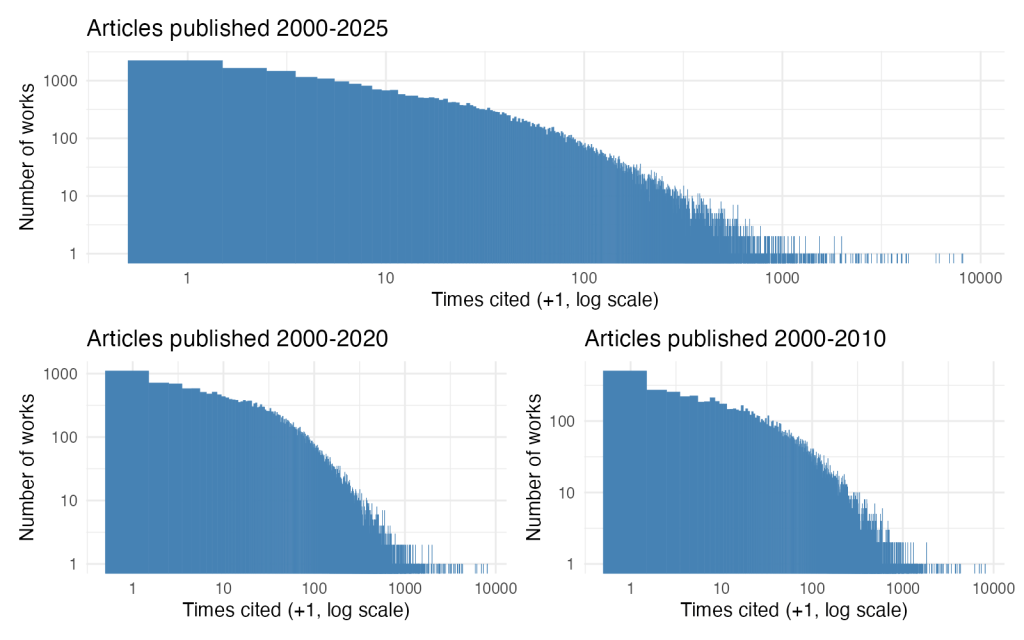
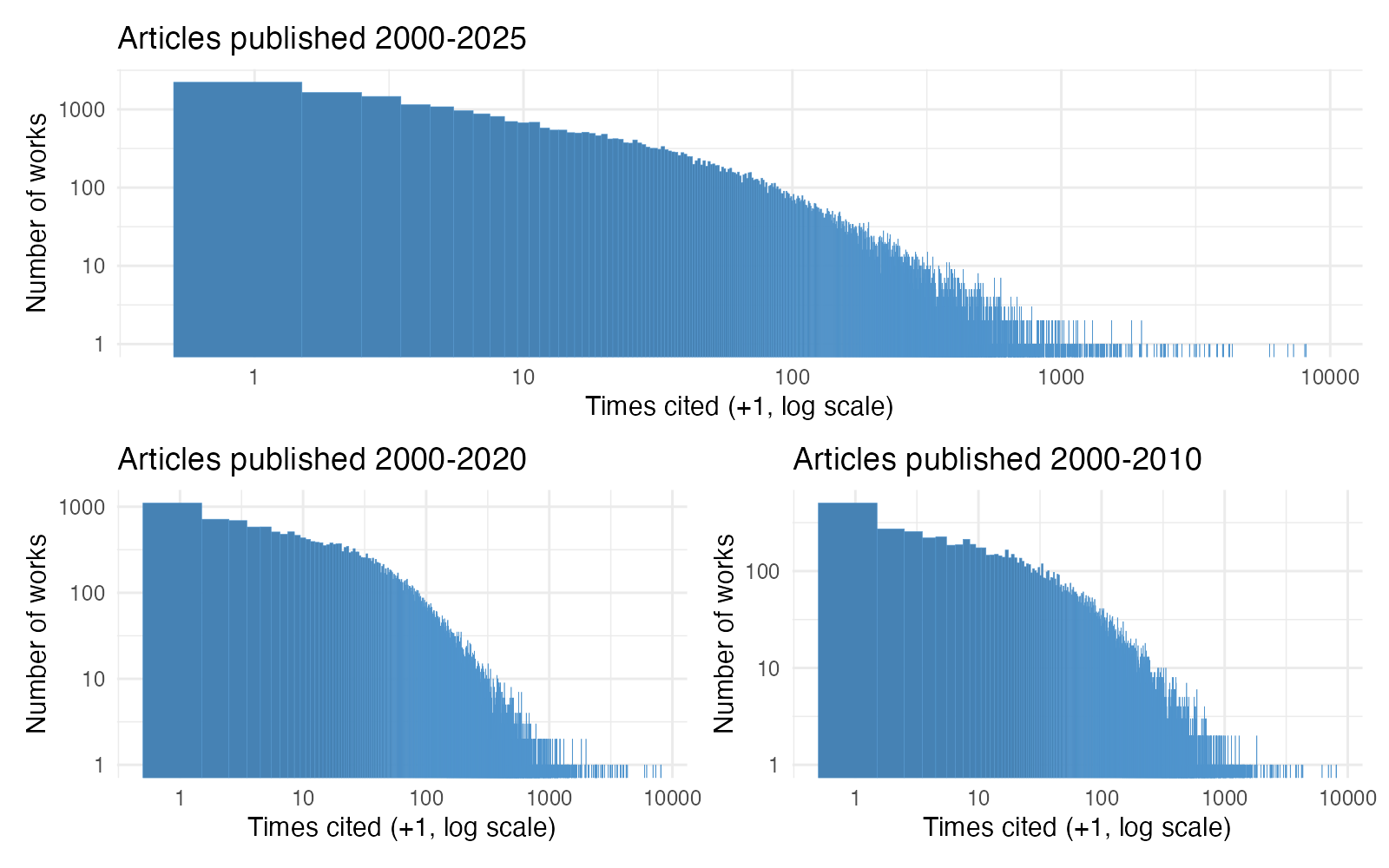
The plots below are histograms of citation counts, showing the frequency of each observed citation count for all articles.* As you can see, the most common unique number of citations for any article actually is zero (i.e., log 1). There are many, many more articles that have greater than zero citations; to visualize them all, we need logarithmic scales. But importantly, the modal number of citations is zero even if you are looking that articles that are more than 15 years old. It really is an accurate statement.
The reason why it is surprising is that in natural language, we don’t really interpret the modal number so literally. We interpret it as something like an expectation of a continuous variable, rather than the typical value of a discrete variable that has an infinite number of possible values. Because citation counts are numeric, you can calculate summary statistics:
summary(cites$cited_by_count)
Min. 1st Qu. Median Mean 3rd Qu. Max.
0.00 7.00 26.00 70.98 73.00 8123.00
This shows us that at least 75% of all articles have 7 or more citations, and that the median number of citations is 26: half of articles have more, half have less.
One way to see how the mode of a count variable is weird is to “bin” the citation data: 0, 1-10, 11-20… instead of 0, 1, 2… If we do that, the data look a lot more reasonable:
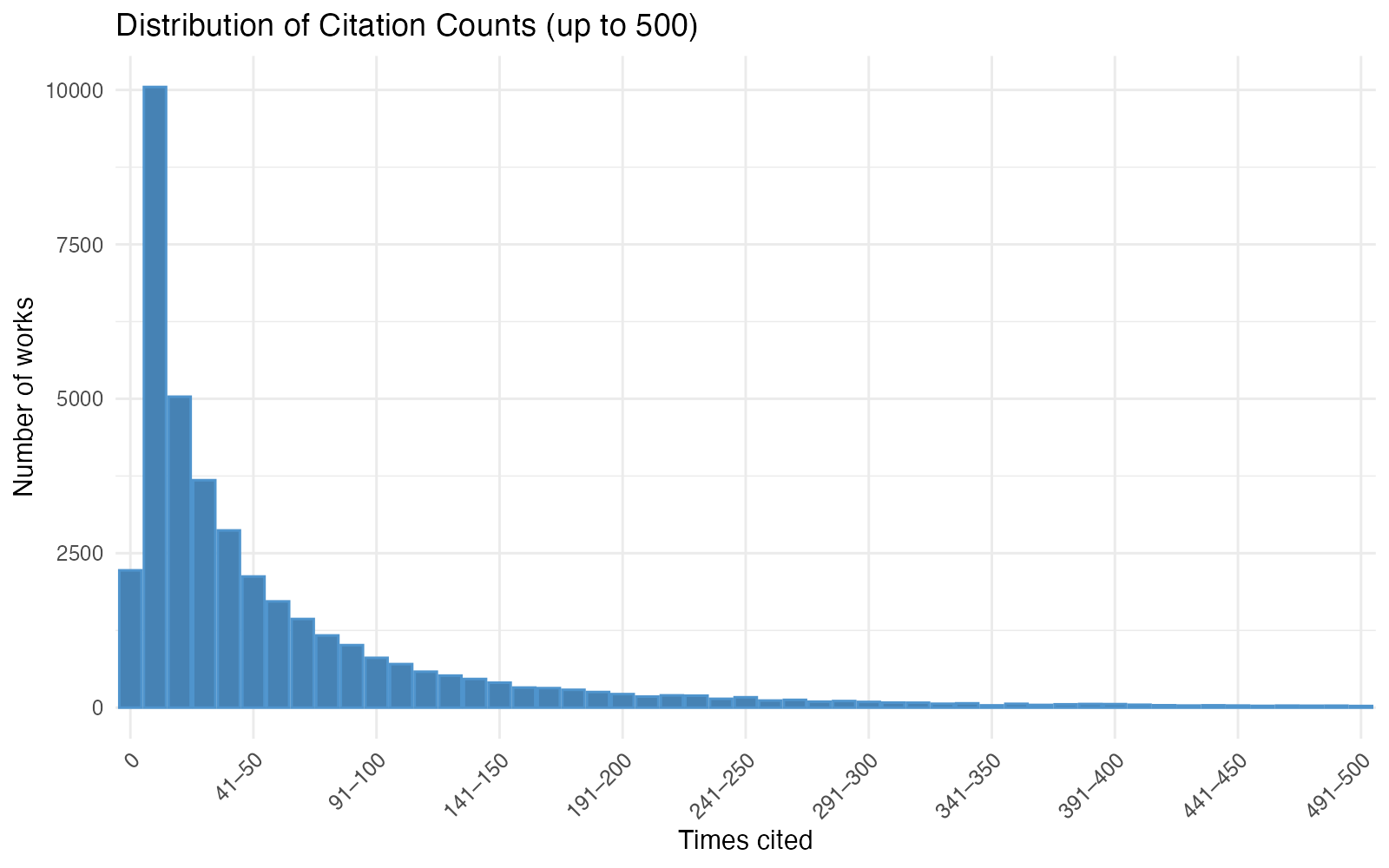
So it really is true that the modal number of citations to an article is zero, but this isn’t really that significant. There are more articles with exactly zero citations than there are articles with exactly 21 or exactly 640 or exactly 7234 citations. But we don’t really care about those comparisons, and we should not treat them as discouraging. The modal number of citations to a political science article is zero is true, but most political science articles have more than zero citations is also true.


Leave a Reply