

Last summer, I tried to use generative AI models to create interesting maps of Southeast Asia. My results were disappointing on the whole, and led me to the skeptical conclusion that commercially available generative AI models were not great at fact-based spatial reasoning (even if it is very good at other things).
But that was 2025. Now it’s 2026.
So less than a year later, I’m back to considering whether generative AI can create maps of interesting things in Southeast Asia. Inspired by my own continuing obsession with the the region’s linguistic complexity—so many language families, such interesting spatial variation both across space and by altitude—we return to the case of drawing a map of the world’s major language families in Southeast Asia, something which probably exists but does not exist online and certainly not in the format which I need it.
In August 2025, just ten months ago, the best I could obtain was this figure, which is hilarious and wrong in dozens of different ways. It cost US$20 and was generated by manually prompting o4-mini-high for about half an hour.

Generative AI has changed a lot in the intervening year. The advances are pretty staggering. I didn’t know what “agentic AI” meant in June 2025; in June 2026 I work with Claude Code in my terminal, and read endless commentary on how to herd my agents. But most critically, the most advanced and expensive AI tools that were available to me in June 2025 have been surpassed by several new generations of models.
In June 2026, for the same US$20, I am able to work with Claude Fable 5, which Anthropic bills as its most powerful and advanced consumer-facing product:
Fable 5’s capabilities exceed those of any model we’ve ever made generally available. It is state-of-the-art on nearly all tested benchmarks of AI capability, showing exceptional performance in software engineering, knowledge work, vision, scientific research, and many other areas. The longer and more complex the task, the larger Fable 5’s lead over our other models.
In true Silicon Valley fashion, Anthropic also teases us a little bit by warning us that Fable 5 might be a little bit dangerous!
Releasing a model this capable comes with risks. Without safeguards, Fable 5’s capabilities in areas like cybersecurity could be misused to cause serious damage.
I don’t think my light usage will endanger national security or the survival of the human species, but I guess it’s a waiting game right now.
So now for the big reveal. Here is what I can now make using Claude’s most advanced AI model ever:
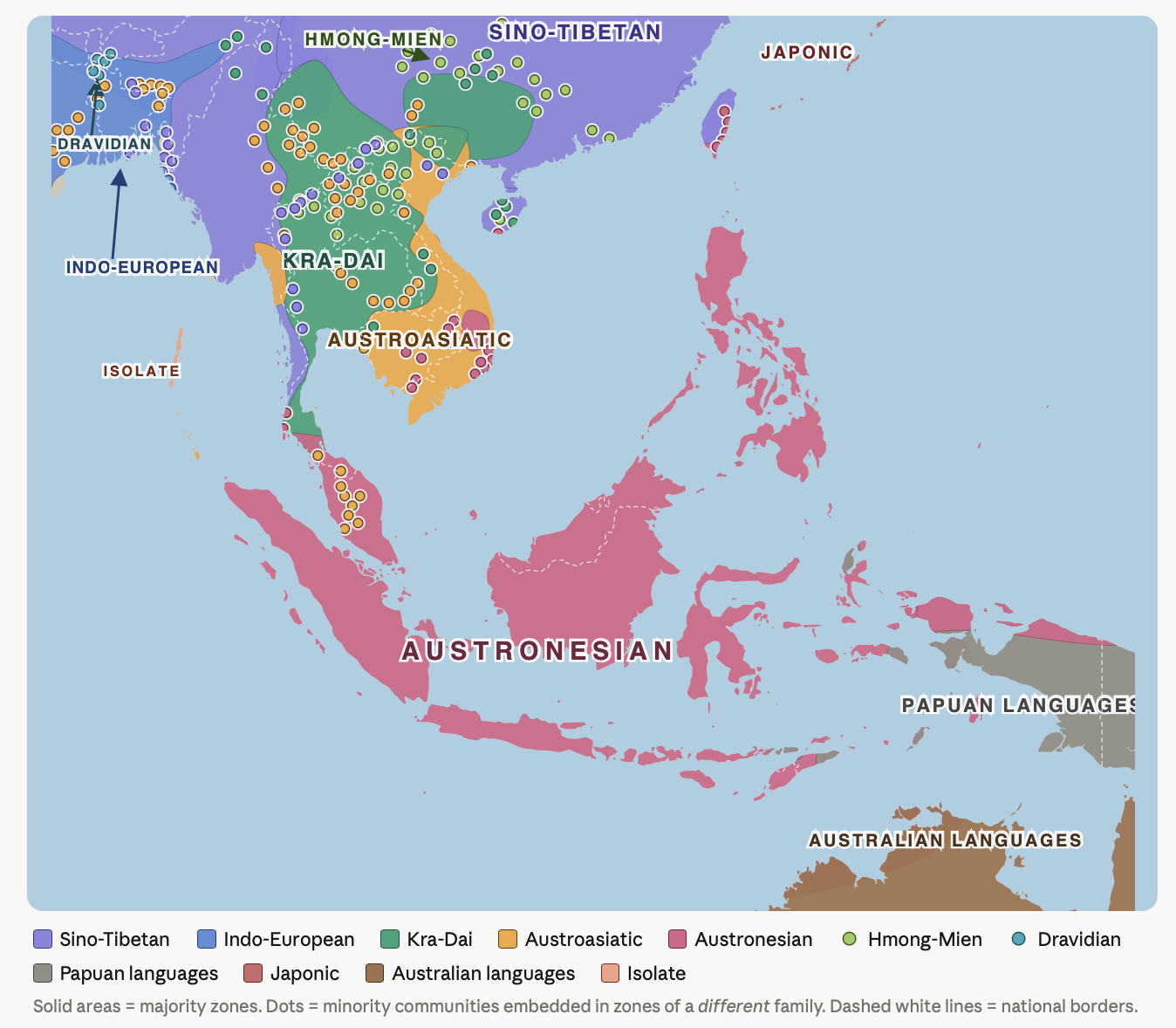
This is good. It is, in fact, really good. The colors group linguistic areas by major language family, every label is legible and spelled correctly, and the shaded areas correspond to the locations in which these languages are spoken with a pretty high degree of precision. This is impressive. I can, and will, use this when I teach Southeast Asian politics, and that was the purpose of this exercise in the first place.
With that said, the details and the process of generating this map may be of some interest. First, the details:
- Fees: To make this map, I had to pay US$20 for my Claude Fable 5 subscription. Free versions of Claude, like other AI models, are still wholly unable to create something like this.
- Time: It took about 24 hours to make this map. Partially this can be explained by limits on Claude messages; I could have made this in less time had I paid even more for a the most premium subscription.
The costs associated with creating such a map—in terms of money and time—will decline over time as ever more powerful AI models replace current ones. In a year, I bet I will be able to do this for free.*
The process is perhaps more interesting. Put very directly, the first attempts at this map contained major errors. Among the list of things that I had to manually explain through repeated prompting:
- Rhade, Jarai, and several others are large minority languages in Vietnam’s Central Highlands.
- The northern provinces of Vietnam are home to speakers of Kra-Dai languages, like the Tày and Nùng.
- Assamese does not extend into Myanmar/Burma (an error in earlier versions).
- Within China, Austroasiatic languages are not spoken in most of coastal Guangxi (an error in earlier draft versions), but they are widely spoken in some parts of Yunnan.
- Mon languages in Myanmar/Burma are located primarily in Mon State and northern regions of Tanintharyi Region, not in the south (as in earlier draft versions).
- There are speakers of Dravidian languages in Bhutan and Assam.
- Tsat is an Austronesian language on Hainan.
Moreover, I had to manually supply information on groups and their geographic locations:
- Maps of the Hmong-Mien and Austroasiatic language families.
- Lists and geographic locations for ethnic groups and minority language communities in Bangladesh, Cambodia, China, India, Indonesia, Laos, Myanmar, and Vietnam. These came from Wikipedia and Ethnologue.
Other tweaks included explaining that Papuan and Australian are not language families, but rather geographic designations for non-Austronesian languages in the eastern and southern reaches of the map; replacing “Tai-Kadai” with “Kra-Dai” in the label, and removing extraneous labels and text with errors.
All of that tells me, and should tell you, that the latest generative AI models are incredibly powerful. But they are also still meaningfully limited. They need guidance for factual accuracy and fidelity in representation. Because maps are models, not territories, an exercise such as this is bound to be imprecise, implying a tradeoff in clarity versus precision. If the goal is to show roughly where major language families are in Southeast Asia, advanced AI models can do it. If the goal is to illustrate the quirks and the details, you must supervise. It remains way too easy for the results produced by AI to be authoritatively wrong.
It remains an open question whether I could have printed out a blank map, colored it in with help from Wikipedia, and scanned it to produce roughly the same result more quickly and cheaply. But make no mistake: Claude’s map is very accurate, and it is also beautiful.
NOTES
* I will set myself a reminder for 12 months from now, and will report back.


Comments
One response to “AI Generated Maps of Southeast Asia Are Here”
Tom — fascinating! And as you suspected the process of your uncovering it almost as interesting as the result.
Andrew