Category: Teaching

  • AI Generated Maps of Southeast Asia Are Here

    AI Generated Maps of Southeast Asia Are Here

    Last summer, I tried to use generative AI models to create interesting maps of Southeast Asia. My results were disappointing on the whole, and led me to the skeptical conclusion that commercially available generative AI models were not great at fact-based spatial reasoning (even if it is very good at other things).

    But that was 2025. Now it’s 2026.

    So less than a year later, I’m back to considering whether generative AI can create maps of interesting things in Southeast Asia. Inspired by my own continuing obsession with the the region’s linguistic complexity—so many language families, such interesting spatial variation both across space and by altitude—we return to the case of drawing a map of the world’s major language families in Southeast Asia, something which probably exists but does not exist online and certainly not in the format which I need it.

    In August 2025, just ten months ago, the best I could obtain was this figure, which is hilarious and wrong in dozens of different ways. It cost US$20 and was generated by manually prompting o4-mini-high for about half an hour.

    Generative AI has changed a lot in the intervening year. The advances are pretty staggering. I didn’t know what “agentic AI” meant in June 2025; in June 2026 I work with Claude Code in my terminal, and read endless commentary on how to herd my agents. But most critically, the most advanced and expensive AI tools that were available to me in June 2025 have been surpassed by several new generations of models.

    In June 2026, for the same US$20, I am able to work with Claude Fable 5, which Anthropic bills as its most powerful and advanced consumer-facing product:

    Fable 5’s capabilities exceed those of any model we’ve ever made generally available. It is state-of-the-art on nearly all tested benchmarks of AI capability, showing exceptional performance in software engineering, knowledge work, vision, scientific research, and many other areas. The longer and more complex the task, the larger Fable 5’s lead over our other models.

    In true Silicon Valley fashion, Anthropic also teases us a little bit by warning us that Fable 5 might be a little bit dangerous!

    Releasing a model this capable comes with risks. Without safeguards, Fable 5’s capabilities in areas like cybersecurity could be misused to cause serious damage.

    I don’t think my light usage will endanger national security or the survival of the human species, but I guess it’s a waiting game right now.

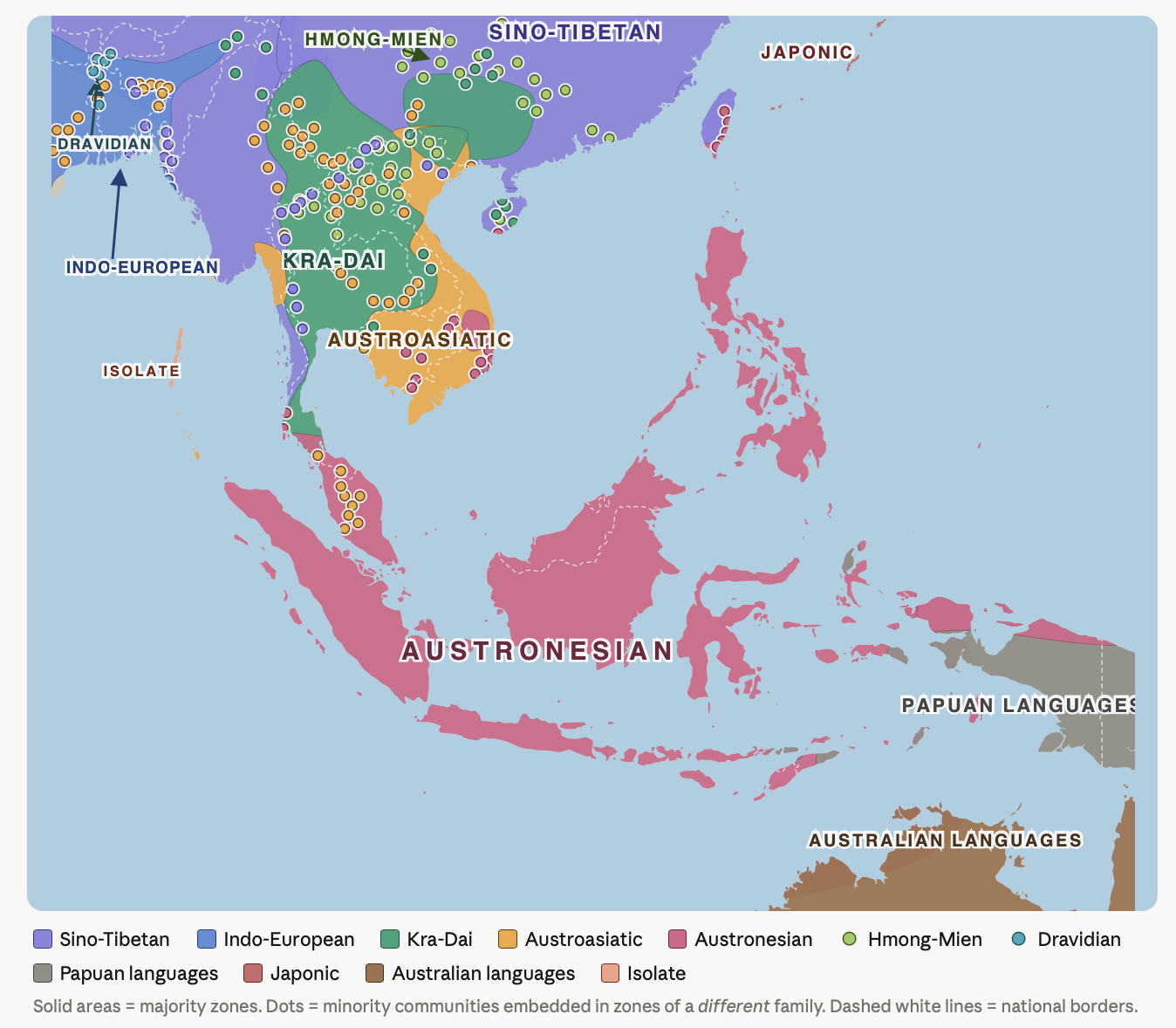
    So now for the big reveal. Here is what I can now make using Claude’s most advanced AI model ever:

    This is good. It is, in fact, really good. The colors group linguistic areas by major language family, every label is legible and spelled correctly, and the shaded areas correspond to the locations in which these languages are spoken with a pretty high degree of precision. This is impressive. I can, and will, use this when I teach Southeast Asian politics, and that was the purpose of this exercise in the first place.

    With that said, the details and the process of generating this map may be of some interest. First, the details:

    • Fees: To make this map, I had to pay US$20 for my Claude Fable 5 subscription. Free versions of Claude, like other AI models, are still wholly unable to create something like this.
    • Time: It took about 24 hours to make this map. Partially this can be explained by limits on Claude messages; I could have made this in less time had I paid even more for a the most premium subscription.

    The costs associated with creating such a map—in terms of money and time—will decline over time as ever more powerful AI models replace current ones. In a year, I bet I will be able to do this for free.*

    The process is perhaps more interesting. Put very directly, the first attempts at this map contained major errors. Among the list of things that I had to manually explain through repeated prompting:

    • Rhade, Jarai, and several others are large minority languages in Vietnam’s Central Highlands.
    • The northern provinces of Vietnam are home to speakers of Kra-Dai languages, like the Tày and Nùng.
    • Assamese does not extend into Myanmar/Burma (an error in earlier versions).
    • Within China, Austroasiatic languages are not spoken in most of coastal Guangxi (an error in earlier draft versions), but they are widely spoken in some parts of Yunnan.
    • Mon languages in Myanmar/Burma are located primarily in Mon State and northern regions of Tanintharyi Region, not in the south (as in earlier draft versions).
    • There are speakers of Dravidian languages in Bhutan and Assam.
    • Tsat is an Austronesian language on Hainan.

    Moreover, I had to manually supply information on groups and their geographic locations:

    • Maps of the Hmong-Mien and Austroasiatic language families.
    • Lists and geographic locations for ethnic groups and minority language communities in Bangladesh, Cambodia, China, India, Indonesia, Laos, Myanmar, and Vietnam. These came from Wikipedia and Ethnologue.

    Other tweaks included explaining that Papuan and Australian are not language families, but rather geographic designations for non-Austronesian languages in the eastern and southern reaches of the map; replacing “Tai-Kadai” with “Kra-Dai” in the label, and removing extraneous labels and text with errors.

    All of that tells me, and should tell you, that the latest generative AI models are incredibly powerful. But they are also still meaningfully limited. They need guidance for factual accuracy and fidelity in representation. Because maps are models, not territories, an exercise such as this is bound to be imprecise, implying a tradeoff in clarity versus precision. If the goal is to show roughly where major language families are in Southeast Asia, advanced AI models can do it. If the goal is to illustrate the quirks and the details, you must supervise. It remains way too easy for the results produced by AI to be authoritatively wrong.

    It remains an open question whether I could have printed out a blank map, colored it in with help from Wikipedia, and scanned it to produce roughly the same result more quickly and cheaply. But make no mistake: Claude’s map is very accurate, and it is also beautiful.

    NOTES

    * I will set myself a reminder for 12 months from now, and will report back.

  • Comparative Politics Needs Area Studies, and Area Studies Needs Comparative Politics

    If you were a graduate student in political science between 1990 and 2010 or so, you probably experienced some heated debates about the future of area studies and its role in the discipline. This was a time of revolutionary entrepreneurs were advancing rational choice theory as a unified framework for the social sciences, and quantitatively-oriented scholars were developing a hegemonic language for understanding qualitative scholarship within the standard positivist template.

    At the same time, area studies in the United States and around the world was under attack, the first in many “crises of area studies” since around 1990. Political scientists were some of the main participants in the so-called “area studies wars” (see here and here and here and many other pieces). As you click on those links, you can see how connected these two developments were: rational choice theory and quantification were part of the intellectual ferment of the area studies debates. And the language was one of not just tension or disagreement, but conflict: area studies wars, scholars and perspectives on the retreat or under siege, a rational choice revolution with an intellectual vanguard, and so forth.

    Many early career researchers during this time faced pressures—either subtle or explicit—to declare their partisan loyalties either to social science or to area studies. At issue was not just what individual scholars would choose to do, but where they stood on the broader discipline’s commitment to creating knowledge of a particular form. My favorite illustration of this perspective is a point made by Gary King in 1996:

    the professional goal of all scientists should be to attempt to demonstrate that context makes no difference whatsoever.

    Read that piece in its entirety if you don’t believe me (PDF); King’s argument is sincere and thoughtfully articulated, and you cannot just dismiss it out of hand.

    If you were a professional scientist, then, King is suggesting that your goal is not just to ask whether context matters, but to prove that it does not. What is the role of an area specialist in such a world? To demonstrate that their specialize knowledge of context is irrelevant for political science.

    Time has marched on since the 1990s, and the discipline of political science has evolved. The rational choice revolution was mostly unsuccessful, with the revolutionaries putting down their weapons (just as the inclusion-moderation thesis would predict). The next intellectual revolution—the credibility revolution—has created its own revolutionary vanguard. Graduate students today do not face quite the same hostility towards area-specific knowledge. I do not know anyone who would argue in 2025 that the professional goal of the comparativist should be to demonstrate that context does not count.

    So what of the relationship between comparative politics and area studies? In a new working paper just released as an APSA preprint, Jordan Gans-Morse, Daniel Gingerich, and I take up this question, revisiting old debates and arguments in light of these and other developments in the social sciences and in area studies itself. Our argument relies on a comprehensive analysis of article data from major journals in political science from 1980-2020, and an original survey of political scientists conducted in 2022-23. Here is the abstract:

    We revisit the sharp divide that emerged in the 1990s between area studies advocates and methodologically oriented political scientists. We argue that tensions between political science and area studies are neither intrinsic nor static, but instead evolve in tandem with theoretical and methodological trends, as well as with broader political and technological developments. Drawing on an original survey of American Political Science Association members and analysis of roughly 4,500 articles in leading journals, we identify four shifts in the discipline: from a theoretical to an empirical orientation; from cross-national datasets to country- and region- specific studies; from macro- to micro-level analyses; and from descriptive to causal inference. We also document evolving patterns in language training, fieldwork, methods use, and data collection. Our findings suggest that political science and area studies are increasingly compatible and well-positioned for reconciliation, but that the state of area studies is fragile and the subfield of comparative politics must support it.

    We began this research years ago, long before the current administration set out to dismantle area studies expertise in the United States.* Our argument, though, speaks to the current moment as well. We write,

    As university models are being reevaluated around the world, the future vitality of area studies departments, programs, and infrastructure are in question; comparativists must recognize that the future of comparative politics as we currently know it depends on robust area studies institutions….

    For area studies within comparative politics to thrive, though, the discipline as a whole must reward engagement with area studies, aligning comparativists’ professional incentives as political scientists with the needs of area studies communities. One concrete measure is for political science departments to reward scholars equally for their service to area studies as to political science. Another is for APSA and other political science associations to formally recognize scholars who help promote interdisciplinary collaboration or institution building that sustains or strengthens area studies…

    Coauthoring is now the norm among quantitatively oriented scholars. But this model must be extended to reward collaboration with country experts, including local scholars from the region being studied, not as research assistants or informants or raw data collectors (as in some of the more extreme division-of-labor proposals from the 1990s) but as full and equal partners in the research enterprise. Rather than a hierarchical model of collaboration that privileges disciplinary expertise, the appropriate model is horizontal in nature, with all participants deserving of full credit for their contributions.

    We hope that our perspective can renew scholarly focus on the essential role of area studies for research and policy, for political science and for other disciplines as well.

    NOTE

    * Non-U.S. scholars might want to tut-tut about the sorry state of higher education funding for area studies in the U.S., but area studies is under threat and facing major cuts in funding in the U.S., Europe, Australia, Japan, and every other advanced industrial democracy. Find me an exception; I’ll wait here.

    Only China is expanding its area studies funding, as Gerhard Hoffstaedter argues in a recent piece. And note Hoffstaedter’s use of war terminology: “Continuing to cut area studies while China expands them amounts to intellectual disarmament.”