Category: Research

  • Tolerance in Indonesian Islam (New Paper)

    It’s almost time for the annual meeting of the American Political Science Association, which means it’s time for new APSA papers. Jeremy Menchik and I have recently completed ours, entitled “Islam, Identity, and the Organizational Roots of Political Tolerance.” You can click that link for the SSRN version; below is the abstract.

    The growing literature on tolerance has struggled to understand its social foundations. In this paper we argue theoretically, and show empirically, that religious organizations play a central role in shaping tolerance towards religious minorities. Drawing on a rich survey of 1000 elites from three large Muslim organizations in Indonesia, we demonstrate that Muslims elites’ willingness to tolerate Christians depends on the social situation, and we identify distinct patterns of tolerance in the domains of politics, the public sphere, residential segregation, demonstration, education, and religion. We then demonstrate that organizational membership, in and of itself, does not explain attitudes of political tolerance; instead, organizational identification does. Among those elites whose organizational ties are weak relative to their identification with their faith or with Indonesia, organizational membership does not explain tolerance. Our argument provides structure to the complex interactions among organizations, identities, and tolerance in the Muslim world.

    It is interesting to see how Indonesia’s mass Muslim organizations do and do not differ. Here is one particularly illustrative figure:
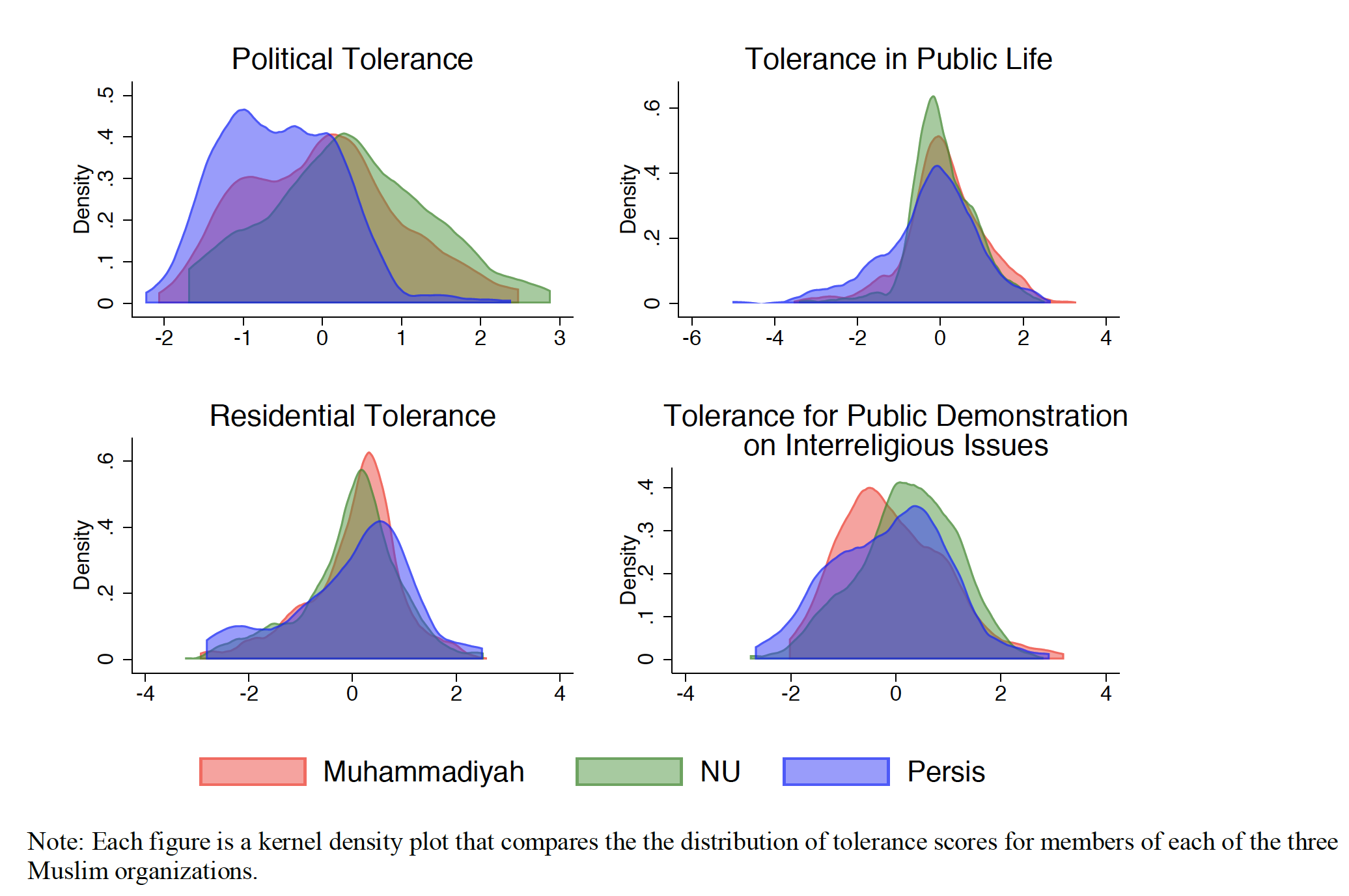
    There is lots more in the paper to chew on. It will also prove interesting—well, perhaps to a subset of readers—to mull over our massive number of interaction tests in light of this recent post on interactive hypotheses by Andrew Gelman. Our is an argument that depends on interactions among identity and organizational membership, and we learn as much from the “non-findings” as from the findings.

  • Author Autonomy and Single Blind Review

    The journal Political Analysis recently switched from double-blind to single-blind peer review. After some criticism and pushback on social media, the editorial board released a statement explaining their decision further and committing to studying the possible consequences of this shift.

    The basic argument for single-blind peer review is that double-blind peer review is a sham and everybody knows it:

    1. The Internet provides a quick and easy way to often identify authors. Indeed, the American Economic Association used to have a double-blind system for its journals, but in 2011 switched to single blind because it was so easy to identify authors. And, an in-house analysis of PA at Caltech by graduate students suggested that they were able to identify almost all of the articles for which they were given only a title and abstract.
    2. Authors often deliver their papers at conferences prior to submitting for publication. These paper deliveries, especially in political methodology, are often made at smaller and more intimate conferences resulting in increased recognition of the author’s manuscript after submission.
    3. Authors often are connected to specific research questions and specific data sets and when these data sets appear in a manuscript they are clear cues as to whose research it is.
    4. Science is inherently a public enterprise and subfields are often fairly small and interactions between scholars within a subfield are very likely. These community interactions increase the likelihood that authors and reviewers will know one another.
    5. Identifying references left out of a paper often provide another heuristic for identifying the author(s).

    I agree with all of these points—because they are prepended with the word “often.” The idea is that because double-blind review is often single-blind review, it might as well simply be journal policy to make it single-blind review. There are also some additional comments about how guaranteeing anonymity costs time and resources (a good point which I hadn’t considered before), and how science journals have single-blind review also (OK).

    But a policy of single-blind review decisively removes any author control over anonymity in peer review. And although those five points listed above are all “often” true, an author can still guarantee anonymity if s/he so desires.

    It just so happens that I have a timely personal anecdote that can illustrate the issue of author autonomy in single-blind peer review. This article, recently published (in First View format), went through the editorial process at Political Analysis under the previous editorial team, and therefore under the double-blind peer review process. And this was quite important to me. I deliberately did not share any working paper version online, nor did I present it at any workshop or conference. The only way that a reviewer could have known that I was the author was if s/he was one of the six or seven people who received a copy of it from me via email.

    It may be that on average, single-blind peer review does not change the way that the review process works, for the very reasons that the editorial board mentions in their letter. But the cost is borne by any author who, like me, prioritizes anonymity in the peer review process. An unanswered question is, regardless of actual reviewer behavior, should authors be allowed to choose anonymity? My position is that the benefits of mandating single-blind peer review as standard for all manuscripts are outweighed by the costs borne by authors who wish to maintain the autonomy to choose otherwise.