Category: Research

  • GE15 in Malaysia: Party Politics in Flux, but Ethnic Structure Still Dominates

    Malaysians went to the polls two days ago in the country’s 15th General Elections, which for the first time pitted three coalitions against one another. As I described last week, this multipolar political system dramatically increases the complexity of party politics in what is already a highly complex political system. But by taking careful look at how coalitions nominate various parties—given the ethnic structure of Malaysian politics in peninsular Malaysia—you can see the continuing role of ethnicity in shaping political competition.

    The preliminary results are in, and they are a devastating blow to the old guard in Malaysian politics. The United Malays National Organisation, long the most dominant party in Malaysian politics and one of the most durable authoritarian political parties in the world, is now only the fifth largest political party in the country.

    PartyCoalitionSeats
    PAS (Pan-Malaysian Islamic PartyPerikatan Nasional (PN)44
    DAP (Democratic Action Party)Pakatan Harapan (PH)40
    PKR (People’s Justice Party)Pakatan Harapan (PH)31
    Bersatu (Malaysian United Indigenous Party)Perikatan Nasional (PN)28
    UMNO (United Malays National OrganisationBarisan Nasional (BN)26

    There is a lot more to say about these other parties, but the basic result is that the Pakatan Harapan coalition won the most seats, but not enough to form a majority. As of the time that I am writing this, there are rumors that Perikatan Nasional (dominated by an Islamic party and a Malay nationalist party) could form a government with Barisan Nasional (still dominated by UMNO). This outcome, if it comes to pass, would mean that Malaysia’s ruling government would be an Islamist-Malay nationalist coalition, and the opposition will be a multiethnic and multifaith coalition.

    I must emphasize that that coalition, if it forms, requires the support of some parties in East Malaysia. This same is true for nearly any governing coalition. East Malaysian party politics is fascinating and complex, but by and large it does not follow the same logic of ethnic political competition found in peninsular Malaysia. That peninsula-style ethnic politics must coexist with East Malaysia-style party politics is a fundamental feature of Malaysian politics, and no account of Malaysian politics can ignore it.

    Nonetheless, we can still look through the results on the peninsula to get a sense of how ethnicity structures Malaysian politics. Below, I plot some results based on preliminary data that I have scraped from The Star, analyzed using the data that Seb Dettman and I have pulled together. We can use these data to see how the three coalitions fared across peninsular Malaysia’s 164 parliamentary constituencies (there are 165 in total, but 1 election is delayed for a couple weeks due to the death of a candidate).

    What I have done here is to compare the vote share for each coalition with the bumiputera population share within that constituency. Blue points are where the coalition in question lost; red points are where they won. In the bottom left corner, I have predicted the probability that each coalition wins based solely on its bumiputera population share.*

    Viewed this way, the results of GE15 are not confusing: the deep structure of peninsular Malaysian politics jumps right out. There is one coalition that fares well in non-Malay majority constituencies. And the other two fare well in Malay-majority constituencies. The battleground is the mixed constituencies on the peninsula with 20-40% non-bumiputera populations. It is true that the BN and UMNO have had a lousy result, but their voters have evidently swung to PN. Put simply, a BN-PN coalition makes perfect sense as the latest coalitional manifestation of ethnic politics in Malaysia. That is why those rumors are swirling.

    There is a lot more to be written about these results. But one point that I wish to emphasize is that a BN-PN coalition would indeed represent a lot of continuity in Malaysian politics, but the role of PAS as the largest party in PN is special and important. PAS is an Islamist party; a large majority of Malaysian Muslims are Malays (and all Malaysian Malays are Muslims). It has historically been opposed to UMNO, although not always. But as I have been hinting for about a decade now in various unpublished essays (see e.g. here [PDF]), what I call Malaysia’s “ethnic order” creates incentives for politicians to capture an alignment of Malay and Muslim interests. As I wrote in that piece,

    as Malaysia’s ancillary institutions reinforce Islam’s constitutive role in Malayness, they provide an alternative basis for political mobilization

    That is my interpretation of is happening in Malaysian politics right now. That said, the latest news is that BN is meeting with Pakatan Harapan tomorrow morning (Malaysia time). Watch this space for more.

    NOTE

    * These results come from a simple multinomial logistic regression where the outcome is the winning coalition, and bumiputera population share is the sole predictor. More sophisticated analyses with many more predictors produce the same qualitative results.
  • Two-Party Democracies with One Anti-Pluralist Party Are Rare

    Here is a question: around the world, how often is it that you find a political system in which the following conditions are true?

    1. there are two main political parties of roughly the same size
    2. they compete in democratic elections
    3. one of those parties is an openly and explicitly anti-pluralist party

    You’d imagine that given the many varieties of democracy that exist around the world, we should be able to find lots of configurations of political systems. Some with many parties, some with few; some with big anti-pluralists parties, some without such parties; and so forth. But some configurations are more or less common than others, and this one is particularly relevant because it is the configuration that characterizes U.S. politics in 2022.

    I was prompted to think of this question in particular by a discussion with some old college friends about the state of U.S. politics. This was spurred by comments about how the Democratic Party right now is variously “shambolic,” “weak,” “incompetent,” “naive,” and “divided.” These all might be true descriptions of the party, but my take is rather different. That is, it is hard to be a catch-all party of the center-left when there is no catch-all party of the center-right on the other side of the aisle.

    By this, I mean that the Democratic Party right now is the party that has to represent the biggest of tents, from libertarians who despise the incompetence, racism, corruption, and mendacity of the contemporary GOP to progressives who seek to move American capitalism in a more social democratic direction—and everyone in between. No wonder it’s hard to unite around a platform, a message, and a national strategy. There is something in the Democratic Party coalition that can annoy everyone.

    Before I proceed, one might object to my characterization of the GOP above. Sorry, conservative friends, but the institutional GOP is no longer a moderate party with a plausibly centrist platform. I could show you data on asymmetric polarization, or I could show you this tweet.

    This tweet is still up given everything that those three have said and done over the past several weeks. This isn’t some talking head conservative “just asking questions,” this is an official account of the opposition party in the United States right now. It is no longer within the bounds of normal democratic political discourse. It is, however, normal political discourse in the U.S. in 2022.

    Although the invocation of Trump (a seditionist who tried to violently overthrow a democratic election less than 24 months ago), Kanye (an explicit and unapologetic anti-Semite), and Elon (a thin-skinned billionaire with poor impulse control and some awful takes on the war in Ukraine) can be understood narrowly in the terms I just used, it is more productive to think more abstractly about what the GOP represents right now. It is now an anti-pluralist party. It is a party that no longer respects the will of the American people to determine their own political future—unless, of course, they happen to favor the GOP. In the U.S. today, democratic citizenship is a partisan affair.

    This position isn’t universally held by all Republicans, but it is also no longer a fringe position in the party anymore, and it’s not just something that happens in purple states. I mean, the GOP candidate for the governor of the State of New York tried to disenfranchise my parents because Pennsylvanians voted for Biden in 2020.

    With these points in mind, the question I posed at the beginning of this post is more interesting. Are situations like the U.S. in 2020 normal? Are they stable? What are the comparable cases out there like U.S. politics right now?

    To answer this question, I’m going to do a little bit of exploratory data analysis using two data sources maintained by the V-Dem project. The first is the V-Party dataset, which evaluates the platforms and structures of political parties around the world for the past hundred years or so. The second is the core V-Dem dataset, which evaluates the level of democracy (measured in a variety of ways using pretty sophisticated tools) around the world over an even longer time scale.

    From the V-Dem dataset, I can calculate two important pieces of data that capture conditions (1) and (3) above. First, I can calculate whether or not any country in any year has a roughly two-party system by looking at the legislative seat shares of all parties in that country in that year, and applying the standard formula to calculate the Effective Number of Legislative Parties. If there are two parties of equal size, then this will be 1 / (.52 + .52) = 2. Call a party system a “two-party system” if ENLP is between 1.75 and 2.25.

    Second, I can use their data to capture how anti-pluralist each party in the legislature is. V-Party defines this as answering the question “To what extent does the party show a lacking commitment to democratic norms prior to elections?” and calculates this by aggregating a series of sub-indicators in a measurement model, with the raw data coming from multiple expert coders. This ranges from 0 (not at all) to 1 (to the greatest extent possible).

    From V-Dem, I can find the third piece of information I need, for condition (2). I will use their electoral democracy index, derived from a similar measurement model applied to expert-coded data that seeks to capture the following idea:

    The electoral principle of democracy seeks to embody the core value of making rulers responsive to citizens, achieved through electoral competition for the electorate’s approval under circumstances when suffrage is extensive; political and civil society organizations can operate freely; elections are clean and not marred by fraud or systematic irregularities; and elections affect the composition of the chief executive of the country. In between elections, there is freedom of expression and an independent media capable of presenting alternative views on matters of political relevance. In the V-Dem conceptual scheme, electoral democracy is understood as an essential element of any other conception of representative democracy — liberal, participatory, deliberative, egalitarian, or some other.

    This also ranges from 0 (not at all democratic) to 1 (fully democratic in this specific sense).

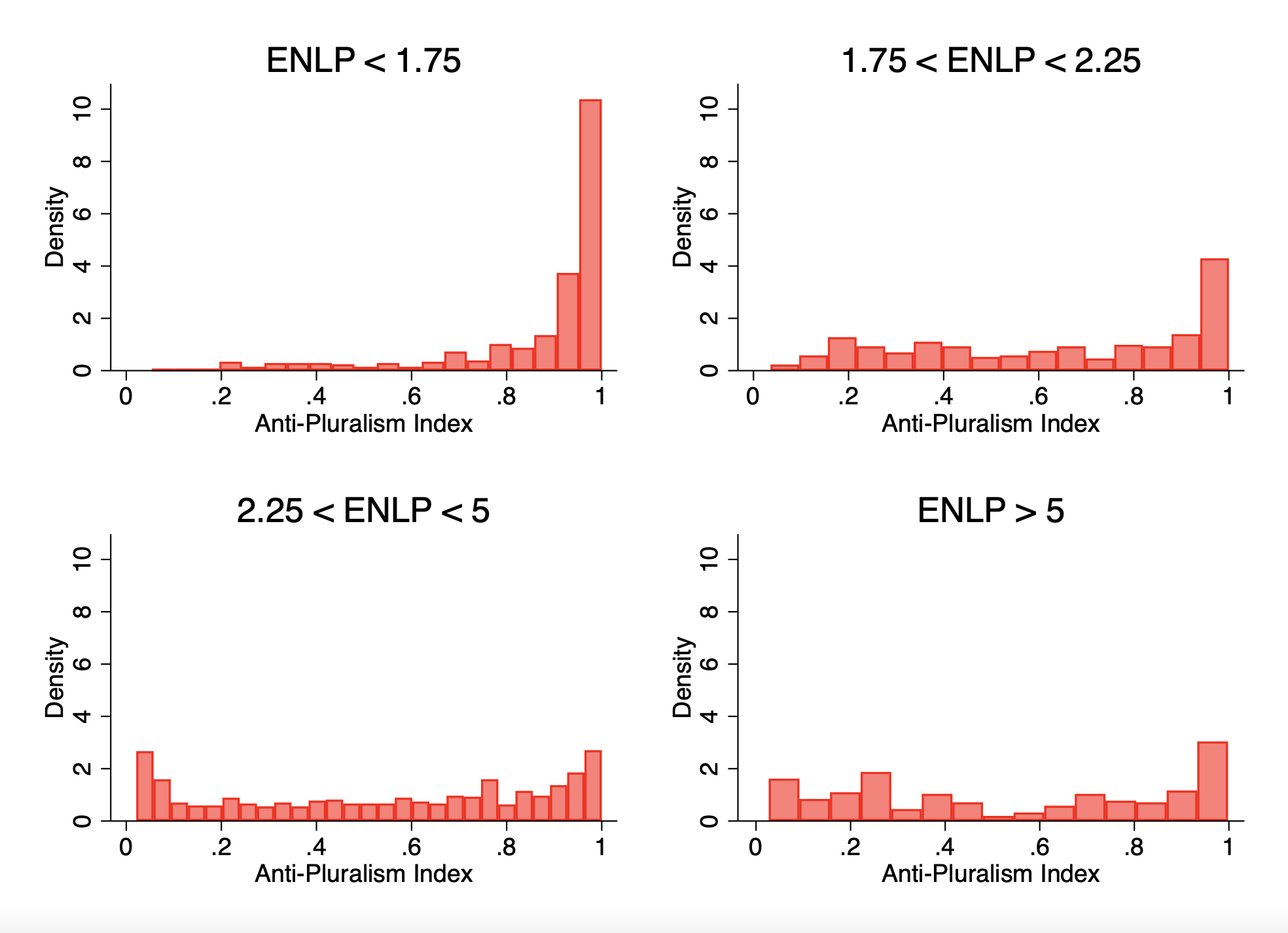
    With this, let’s look at some data. First, let’s divide countries into groups: uncompetitive party systems where ENLP < 1.75, two-party systems as above, multiparty systems with ENLP greater than 2.25 but less than 5, and fractionalized systems with ENLP > 5. And let’s look at how anti-pluralist is the most anti-pluralist party in that system? Here’s what we get.

    More competitive and more fractionalized party systems do not have very many anti-pluralist parties in them. Uncompetitive party systems, by contrast, have lots of anti-pluralist parties. This makes sense—anti-pluralist parties that control government are indeed anti-pluralist in government. Two-party systems lie in the middle. They sometimes do have anti-pluralist parties, but much less frequently than do uncompetitive party systems with one predominant party.

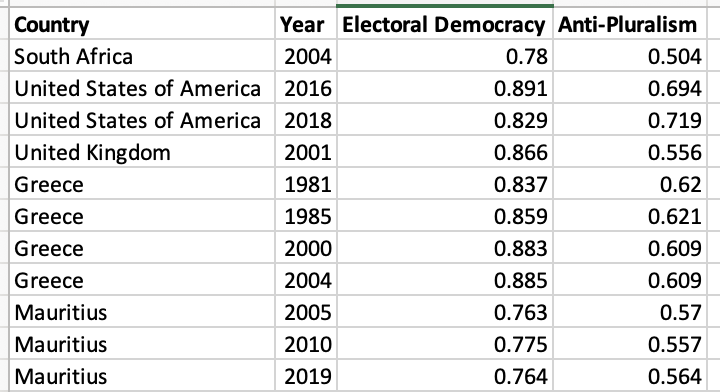
    So how many of those are democratic systems? To do this, I have selected those countries and years that have a political party that is greater than .5 on the antipluralism scale, greater than .75 on the electoral democracy scale, and which have a two party system. Here is the list that results from subsetting the data this way.

    The United States was not on that list prior to 2016. There are not a lot of other countries on this list; and the most anti-plural party in the US in 2018 is more anti-plural than any other anti-plural party in these other cases. And yes, the data do not extend past 2019. The contemporary GOP would certainly fare worse today than it did in 2018 on the anti-pluralism metric.

    So that is answer to the question posed above: two-party democracies with large anti-pluralist parties are rare, and the United States is not in good company right now.

    The question I’ll close this post with is, what does this imply about the future of American democracy? I think it is plain that GOP has two possible futures when it takes national office again, which is likely in the near future. In one, it moderates its anti-pluralist stance and becomes a normal pluralist party once again. The other is that it continues its anti-pluralist stance and implements the policies that many of its elected officials and candidates for office keep saying that they wish to implement. Those are the only two feasible ways to get off this list… the third way, which is to become a robust multiparty democracy, is not feasible in the near term. It’s a waiting game right now, we’ll see what happens.