Category: Research

  • Visualizing the 2024 Indonesian Presidential Election Results

    Indonesia’s 2024 presidential election was atypical from among post-New Order presidential elections in that it featured three presidential contenders, but the results were decided in one round only. In every presidential election since 2004, either there was a run-off among the top two candidates in the first round, or there were only two candidates. In 2024, three tickets—Prabowo Subianto-Gibran Rakabuming Raka, Anies Baswedan-Muhaimin Iskandar, and Ganjar Pranowo-Mahfud MD—each ran campaigns and appeared on the presidential ballots. Aided by the strong endorsement of the wildly popular incumbent president Joko Widodo, Prabowo Subianto handily won the election.

    I like to make maps of Indonesian election results. These are easiest when there are only two candidates, because strong results for one entail weak results for others. It is harder to plot with three candidates! But it can be done: below is a ternary plot created using the tricolore package in R.*

    As you can see, there some missing observations, especially in Papua, where data aren’t reliable. But nonetheless, this figure conveys four important pieces of information.

    1. Prabowo (the blue areas) fared really well nearly everywhere.
    2. Where Prabowo did less well, he mostly divided his vote equally between Ganjar and Anies. Anies did dominate some districts; Ganjar dominated no districts.
    3. Anies’s best showing was in Aceh and parts of Jambi and West Sumatra.
    4. Ganjar did well only in parts of Java, but even here he divided his votes with Prabowo and Anies.

    Zooming in on Java helps this last point to become visible.
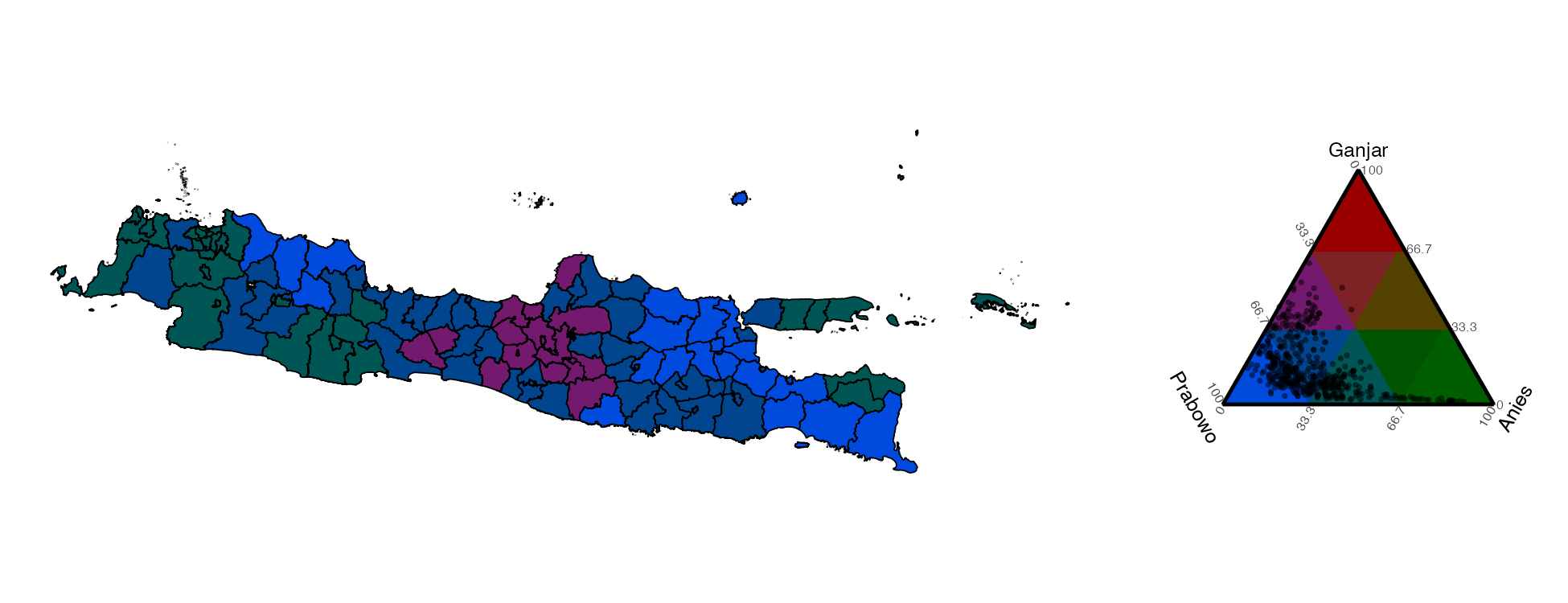
    The figure matches my understanding of the results in Java quite well. Prabowo did extremely well around Jakarta, Surabaya, and in much of East Java. In much Central Java, Prabowo split the vote with Ganjar. In West Java, Banten, and Madura, Prabowo split the vote with Anies. Watch this space for more interpretations.

    NOTES

    * See Schöley J, Kashnitsky I (2024). “tricolore. A flexible color scale for ternary compositions.” CRAN. Version 1.2.4, https://cran.r-project.org/package=tricolore; and Schöley J (2021). “The centered ternary balance scheme. A technique to visualize surfaces of unbalanced three-part compositions.” Demographic Research, 44, 443–458. doi:10.4054/DemRes.2021.44.19.

  • The Journal of East Asian Studies Will Transition to Full Open Access by 2025

    As editor of the Journal of East Asian Studies, I am very pleased to announce an exciting change to JEAS’s publication model. In collaboration with Cambridge University Press and with the full support of the East Asia Institute, starting in 2025 JEAS will transition to a fully Open Access publication model. This means that starting next year, every new article published by JEAS will be freely available to any reader, anywhere in the world, at no cost. Even more importantly, none of the costs of this transition to full Open Access will be borne directly by our authors.

    This is a major milestone for JEAS, and for scholarly publishing on East and Southeast Asian politics. But it is the culmination of a process that has been in motion for at least a decade, as academic institutions and funding organizations have realized that the traditional model of scholarly publication placed substantial barriers on scholarly information and exchange. For JEAS’s audience—readers and prospective authors alike—that publication model was particularly harmful, because it made it difficult for readers who aren’t employed in wealthy institutions to access our journal. For authors who wanted to publish their articles under an Open Access model, the costs of doing so—through “Article Processing Charges”—were often prohibitive.

    Even with these constraints, JEAS has already made great strides towards Open Access publication. In 2022, 61% of our research articles were published on an Open Access basis. This next step will remove all remaining barriers to access, making all research in JEAS available to everyone, regardless of position, institutional affiliation, or ability to pay.

    The new model that CUP and EAI have introduced works because CUP has secured agreements with thousands of institutions around the world to support Open Access publication for their own researchers. These agreements allow CUP to subsidize Open Access publication for any author who is not covered by such an agreement, which is especially important for scholars from East and Southeast Asia. This means that beginning in 2025 (Volume 25), any author whose manuscript is accepted for publication for JEAS will either be covered by CUP’s existing agreements, or will be automatically granted a waiver for all Article Processing Charges by CUP.

    This is an exciting time for JEAS. Thanks to the hard work of my predecessors Byung-Kook Kim and Stephan Haggard, and to the dedication of our excellent Editorial Board and our committed peer reviewers, I am fortunate to step into my position as editor knowing JEAS has an outstanding reputation for publishing cutting-edge research on politics, political economy, and international relations in East and Southeast Asia. I am committed to continuing to build JEAS’s international reputation as a premier venue for scholars of Asian politics, one that is open to submissions from any methodological tradition or theoretical perspective but with high standards for evidence, analysis, and argument.

    But my other commitment is for JEAS to amplify the voices of underrepresented scholars—not just from Asia but from around the world—doing research on East and Southeast Asian politics and society. Our transition to full Open Access is an important step towards this goal. Stay tuned for more, and check out the excellent research that is published and forthcoming at JEAS.