Category: Politics

  • When Did Reformasi End?

    Scholars of modern Indonesia like to periodize the country’s political history according to its macropolitical environment. The established periodization looks something like this, with some disagreements about just when the Liberal and Guided Democracy periods began and ended.

    • 1602-1942: Dutch Colonial Era
    • 1942-1945: Japanese Occupation
    • 1945-1949: Independence Struggle/National Revolution
    • 1949-1957: Liberal Democracy
    • 1957-1965: Guided Democracy
    • 1965-1998: New Order

    Historians will divide up the Dutch colonial period into the VOC, the middle, and then the Ethical Policy, and everyone recognizes that this kind of periodization is very Java-centric. The topic of today’s post, though, is how to think about what has come next.

    • 1998-now: ???

    One common term for post-New Order Indonesia is the “Reformasi Era.”

    Soeharto’s Resignation (via http://anisavitri.wordpress.com/)

    Reformasi (reform) was the single most captivating expression of anti-Soeharto sentiment starting in 1998, and it became a rallying theme for reformers after Soeharto resigned—so much so that his successor, B.J. Habibie, appropriated it in the name of his cabinet.

    But it’s been 14 years since Soeharto’s resignation. It is certainly possible to think of this as all the Reformasi Era (as wikipedia does) but that seems, to me, to be inconsistent with the spirit of Reformasi as a reaction against the New Order in particular. No one can ignore the New Order’s influence on politics today, but my instinct is to say that this isn’t Reformasi anymore. This is a new normal.

    Two questions follow. First, when did the Reformasi Era end? Second, if not the Reformasi Era, then what era are we in right now in Indonesian political history?

    One the first question, one could mark the end of the Reformasi Era at various points. The first competitive legislative elections in 1999. The ouster of Gus Dur in 2001. The election of SBY in 2004. These are developments that focus on national politics at the highest level. But I would argue that the most important changes have not been competitive legislative elections (since 1999) or direct presidential elections (since 2004), but rather the devolution of power to the regions through decentralization and regional autonomy, implemented beginning in 2001. Starting then, Indonesian politics ceased to be “about” Reformasi (despite the continued ubiquity of the term in political speech) and started being “about” the division of political authority in the center versus the regions, in contrast to the steep hierarchy with Jakarta at the top and the regions at the bottom.

    So by that standard, the Reformasi Era ended in 2001. OK then, so what do we call this era? We already know its defining features: multiparty democracy plus regional autonomy. I’d like to think of a snappy two-word term, one that has a nice Indonesian translation, but (like titles) snappy two-word terms are not my specialty. Divided Democracy? Not really accurate. Decentralized Democracy? Accurate but bland. Contested Democracy? Multiparty Democracy? Don’t really get at the issue of decentralization. I want something like Polycentric Democracy to connote the proliferation of political parties and loci of power at various levels, but “polycentric” is terrible.

    After a couple of days thought, I think I have a winner: Segmented Democracy. For Indonesians, we might best translate this Demokrasi Terpisah (although that’s not great, pisah is closer to “to separate” than “to divide into segments”). Neither are perfect. If you have a better idea, let me know.

    • 1998-2001: Reformasi Era
    • 2001-now: Segmented Democracy
  • Race and Communalism in Malaysia

    Hoisted from the comments:

    The only bone I have is though, is the non-threatening euphemisms that you have chosen – to cover up the rampant racism that are being practised.

    What is wrong with calling a spade, a spade?

    Why do you have to cover up racism from officialdom with euphemism like “communalism” ?

    With the use of ‘communalism’ you are grouping the victims along with the perpetrators – instead of pointing out racism, as it is.

    The commenter, “Penang,” wants to know why I don’t talk about racism in Malaysia. When I write or lecture about Malaysia, I often use the terms “race” and “racism,” but I am careful to say that this is the term that Malaysians use, not one that I would prefer to use. I like to talk about ethnic, or better yet, communal issues.

    Why? Good question, and although “Penang” seems eager to start a fight with me about it (for some reason that I don’t quite understand), it’s worth a discussion. This is a teachable moment for students of Malaysian politics and Malaysians alike.

    One reason why people like me might avoid using the term “racism” in Malaysia is that in general, race as a category for describing variation in human populations does not correspond to any objective physiological reality, which is what the term is meant to do. But while that is true,  I don’t mind using the term “racism” to talk about the United States. So why not Malaysia?

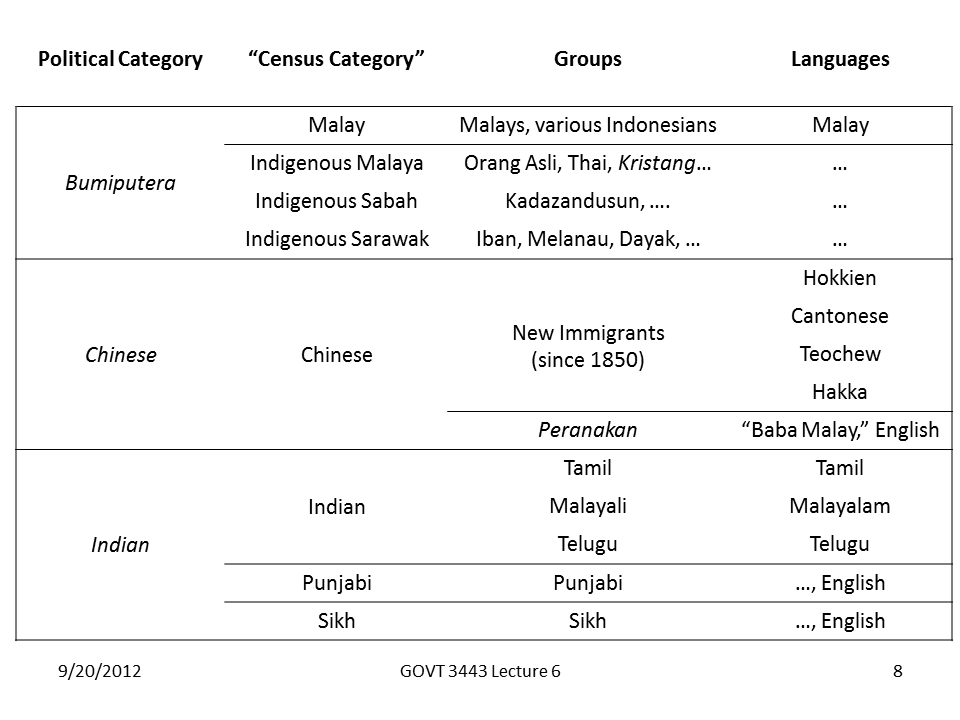
    The answer is political. Here is a slide from my Malaysia lectures which makes the point better in images better than I can with words.

    Question: Does race separate Malays from Chinese or Indians?
    Answer: no.

    This slide is one of my favorites. It shows some examples of the great variation out there in the types of people who count as Malay, and gives us the legal definition for why that is the case. Given the legal definition of what constitutes a Malay, it is simply not true that race is the proper term to describe the differences between Malays and non-Malays (or bumis and non-bumis; don’t get me started about Kristang). This would be true even if race were a useful analytic category. The fact that the phrase masuk Melayu exists—to become Malay, or more literally, to “enter Malayness”—shows you why “race” doesn’t capture the essence of ethnic or communal issues in Malaysia.

    It’s possible that “Penang,” like others in Malaysia, uses the term “racism” because it has clearly negative connotations, whereas “communalism” is a more neutral. To this observer, neither is a good thing. And anyway, we shouldn’t choose terms based on how they make us feel, we should use terms that describe society as it is.

    The “racialization” of communal differences in Malaysia has a long and interesting history. My interpretation is that the country’s ruling elites long ago settled upon a strategy of divide-and-rule. The principle of division was communal: Malay-Chinese-Indian, later to be modified as bumiputera-Chinese-Indian. But as this lecture slide shows, all of these categories obscure more than they reveal.

    Categorizing Malaysians

    As the pressures of modernization and globalization threatened the established identity landscape in Malaysia, fostering new overlapping identities and suggesting that there might be room for a post-communal politics, a language emerged among the regime’s defenders, perhaps not consciously, that racialized communal differences. By racializing, I mean recasting communal differences as fundamental, durable, immutable, and biological. This process obscured the variation within communal groups (and the frankly non-racial definition of Malayness) as a mechanism for cementing the organizing principle for Malaysian politics. After all, if we remember that for many, Malayness was a choice—literally—in the 1950s, then we might not feel so strongly that being Malay or Chinese or Dayak is a big deal, or that we need to things like vote based on our identity. Racializing communal identity is an ideological project that is designed to compel Malaysians to think about themselves in communal terms, because that is what keeps Malaysia’s status quo working.

    One final thought, from a more activist perspective. Here’s another way to phrase what I’ve just written. If you think that the differences between Malays and non-Malays are racial, well, then you’re a sucker. You’ve fallen for the politicized communal discourse that generations of Malaysians have been subjected to, a discourse that insists that there are deep, immutable, fundamental, biological differences among Malaysian as a mechanism for justifying the policies that maintain the political status quo.

    And since I’m not a sucker, I don’t use “race” to describe communalism in Malaysia.