Category: Politics

  • Why Crowd-Sourced Election Monitoring Mattered in Indonesia

    Indonesia’s 2014 election finally came to a close last Friday, as Indonesia’s Constitutional Court rejected the Prabowo-Hatta team’s challenge of the July 9 elections (see Ray Yen at New Mandala for some pictures). This is not an unexpected ruling: we have known for some time that Jokowi-JK won the popular vote by a substantial margin.

    We know this, of course, because of crowd-sourced election monitoring by KawalPemilu.org and other outfits that digitized the tens of thousands of ballot forms that had been scanned by Indonesia’s Electoral Commission (KPU) and placed online. A lot of credit is due to KPU itself for taking the affirmative step to put all of these forms online in the first place. But given the slow pace of KPU in actually releasing the final tallies, KawalPemilu.org gets major kudos for releasing everything, and quickly.

    Let’s take a look at how KPU did. Since July 17, every other day or so I’ve been scraping the village/ward-level vote tallies from the KPU website using a nifty little Python script put together with Seth Soderborg. KPU has 81,000 villages/wards to cover, so it’s not surprising if not everything is ready at once. But a substantial proportion of these results remain missing, over a month after “official” decision by KPU on July 22 and even today, a month later! The slopegraph below illustrates the problem of missing vote returns, over time and by province. The vertical dashed lines are for July 9 (election day), July 22 (the date that the official result was released), and August 22 (the final verdict by the Constitutional Court).
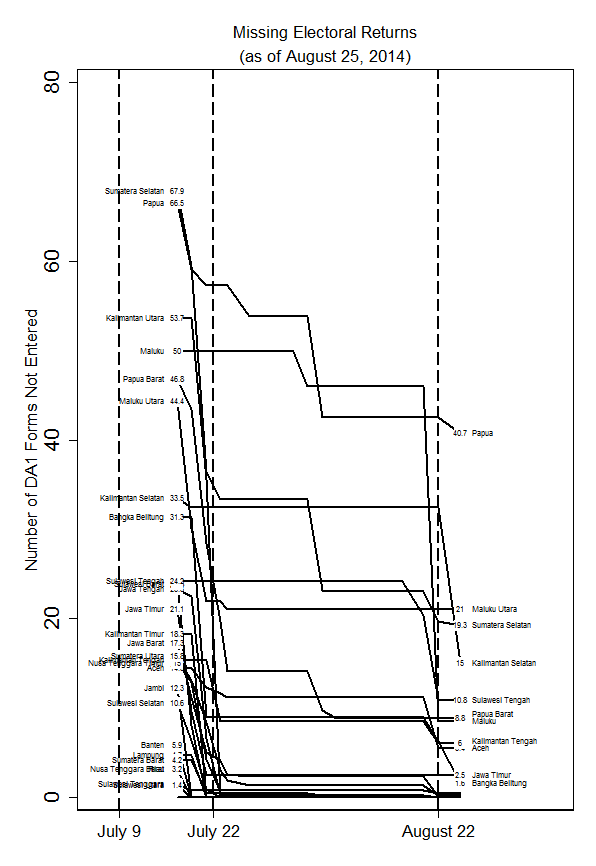
    missing1
    You can see clearly that even today, KPU has yet to release substantial amounts of data on the final vote returns from provinces like Papua, North Maluku, and South Sumatra. And clearly, they were holding back even more data until the August 22 decision: the data points for on August 22 are what I scraped during the North American daytime hours that day, meaning that they were uploaded to the KPU website only hours earlier, right after the Constitutional Court’s decision, Indonesia time.

    Again, KPU gets major credit for putting the scanned forms online. But it was KawalPemilu.org, and everyone who helped count the votes, that confirmed that Jokowi-JK won before anyone else could.

    UPDATE

    Kevin Fogg points out in a comment that the above figure might be misleading in its focus on the percentage of missing villages/wards. It’s also useful to see the total number by province. Here is what that looks like.
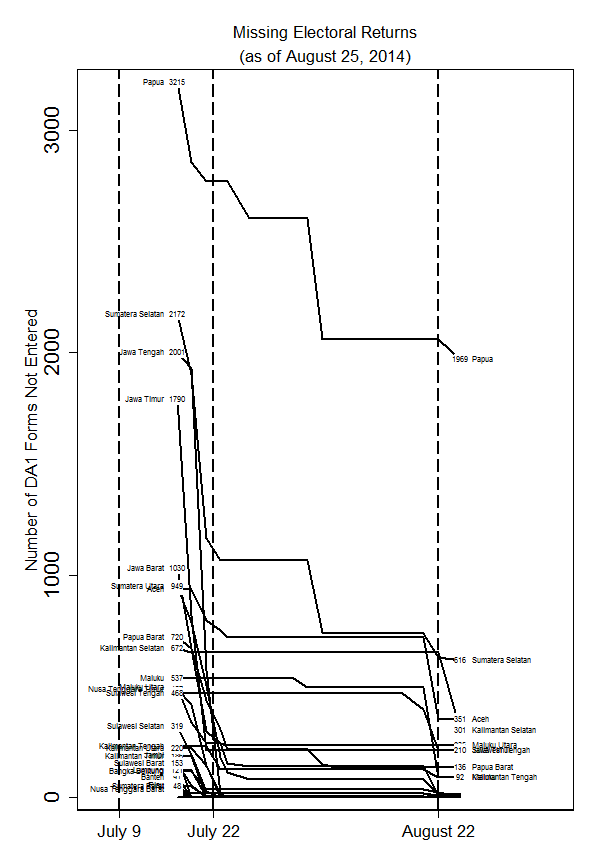
    missing2
    What we really want to know, though, is the percentage of Indonesian voters whose votes have yet to be counted. Alas, we can’t count that, not without a separate estimate of the population of each village or ward.

  • Good Tsar Bias and Bad Cossack Amnesia

    The Hitler Myth is an excellent book about how ordinary Germans understood Hitler and the Nazi Party while Hitler was in power. It enjoys the distinction of being one of the two books that I was assigned to read in more than one class in college.* Xavier Marquez wrote a fascinating post on the book a couple of weeks ago, using the term “Good Tsar Bias” to describe the phenomenon that

    until the war started turning sour in late 1942, Hitler was far more popular than the Nazi Party, which quickly grew to be disliked, even despised, by the vast majority of Germans.

    He goes on to note that Good Tsar Bias is by no means unique to Germany under Hitler:

    Regardless of the specifics of the Nazi case, these sorts of rationalizations seem common enough that they deserve a name. We find something like them, for example, in the combination of dissatisfaction with the Venezuelan government and genuine love of Chavez characteristic of many Chavistas even before Chavez’ death; or in the contrast between the apparent popularity of Putin and the unpopularity of much of Russia’s political class and governing apparatus; and perhaps also in the Franco regime, with the disjunction between Franco’s apparent high prestige and the unpopularity of the Falange during the 1940s and 1950s.

    He later references Brad Delong’s reminder that “the Cossacks work for the Tsar,” implying that Good Tsar Bias requires a peculiar kind of belief structure, one that supports a leader but not the party or the movement that s/he leads.

    Of course, I cannot help but read this and think of Indonesia. In Indonesia, “Good Tsar Bias” used to go by the term SARS, or Sindrom Aku Rindu Soeharto [= I Miss Soeharto Syndrome].

    Photo Credit: http://adibsusilasiraj.blogspot.com/2014/05/sepenggal-kisah-di-bulan-mei-yang-gerah.html
    Photo Credit: http://adibsusilasiraj.blogspot.com/2014/05/sepenggal-kisah-di-bulan-mei-yang-gerah.html

    Soeharto’s former son-in-law Prabowo Subianto, with his soldierly background and a career that was utterly dependent on his personal connections to Soeharto himself, is almost the ideal personification of the Cossack. He was also widely despised by Indonesians during Soeharto’s rule, even seeking asylum in Jordan for a time after Soeharto’s fall.

    Much like Vladimir Putin has been portrayed as a modern-day Tsar, though, Prabowo sought to portray himself as a modern-day Soeharto. This was almost a winning strategy. Perhaps there is another tendency like Good Tsar Bias—we might call it Bad Cossack Amnesia—that represents the continuation of Good Tsar Bias after the Tsar has been deposed.

    *********
    * The courses were HIST 2 (“Modern European History, 1789-1980,” which no longer seems to exist) and GERM 50 (“20th Century German Culture”, which is now GERM 0500). The other book was Imagined Communities.