Category: Indonesia

  • Indonesia’s Total Defense System

    A powerful op-ed in yesterday’s Jakarta Post by Ristian Atriandi Supriyanto from ANU indicts the 2015 Indonesian Defense White Paper for its “superficial” treatment of Indonesia’s maritime security challenges. But more importantly, it identifies a disturbing emphasis on bela negara as central to Indonesia’s strategic defense outlook.

    I have been critical of bela negara before. One common set of responses that I received at the time was that this program wasn’t going to be taken very seriously by most Indonesians, that it lacked a clear funding mechanism, and so forth. That much may still be true, but it is meaningful that the national strategic defense policy currently devotes such attention to bela negara. From the introduction to the English version of the white paper (pdf here), we read the following description

    National defence is managed in a total defence system to achieve its national goals. The system is essentially a defence involving all citizens in accordance with their roles and functions. The involvement of every citizen in national defence is in-line-with the 1945 Constitution of the Republic of Indonesia. A State Defence Programme, or defined as Bela Negara programme, is implemented within the next decade and expected to reach 100 million citizens who are militant. This programme will continually develop the needs of national defence.

    Concepts like citizens having “roles and functions” are reminiscent of corporatist ideology under Indonesia’s New Order. Remember, Golkar literally means “functional groups.”

    This atrocious graphic—once you look past its atrociousness—summarizes how defense policy involves ordinary Indonesians. Screen Shot 2016-06-15 at 8.28.23 AM Watch this space for more on what bela negara means for Indonesian democracy.
  • Benedict Anderson and the Etymology of Bule

    The great scholar Benedict Anderson‘s posthumous memoir, A Life Beyond Boundaries, is now available for purchase. It promises to be an exciting read by one of the most influential scholars of Asia of our time. I have not yet had the chance to read it, but already I have heard the stir caused by one of its most striking claims: that Anderson coined the term bule as an epithet for a Caucasian person.

    Bule is a slang pronunciation of the Indonesian word bulai, which means albino. You can see how it’s used by doing a Google image search for kerbau bule [= albino water buffalo]. In common parlance, bule is a semi-derogatory term for white person, akin to something like “whitey” in American English. At least it used to be an epithet: I think that for my generation, bule has lost most of its power as an insult. For example, there was an old bar in Jakarta called Bugil’s, which is both a portmanteau of bule gila [= crazy whitey] and also the Indonesian word for naked, and it was a famous expat haunt (I remember short pours of watered down bourbon). In this sense, bule is like queer in American English, a term that has been appropriated by the community against whom it was directed and thus has lost its ability to be an insult. Equivalent terms in Hong Kong (gwai loh), Singapore (ang mo), Malaysia (mat salleh), and Thailand (farang), to my knowledge, have not been so embraced by their target community.

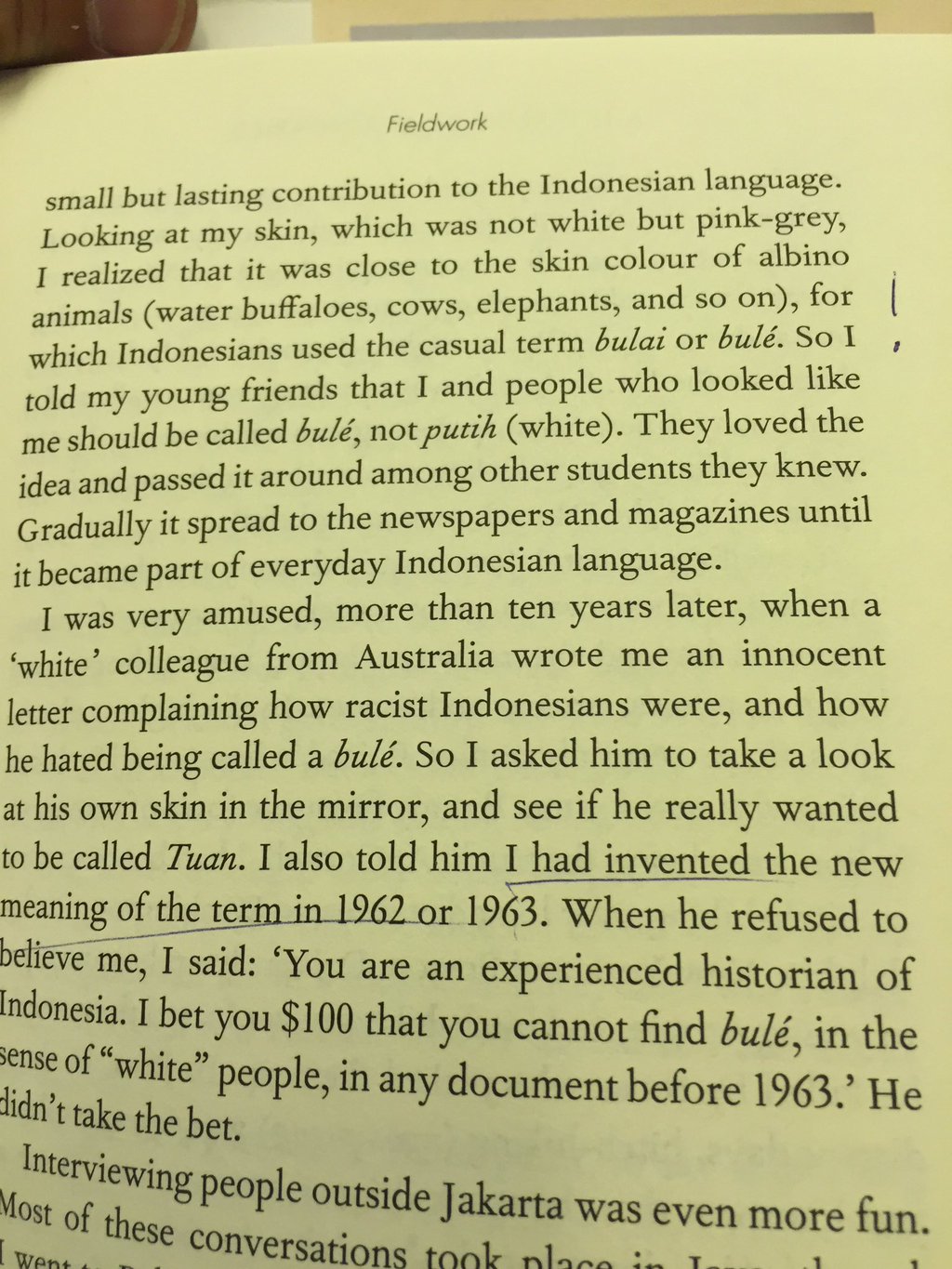
    Anyway, the etymology of such epithets is interesting. I always assumed that the link from bulai to bule to “whitey” was self-evident, not something that someone would be able to claim. But Anderson offers a strict challenge here (the picture is due to a friend of mine):
    CjP5hvdWsAAgGPo
    Not only does Anderson claim to have invented bule in the early 1960s, he challenges us to find an earlier use of the term.

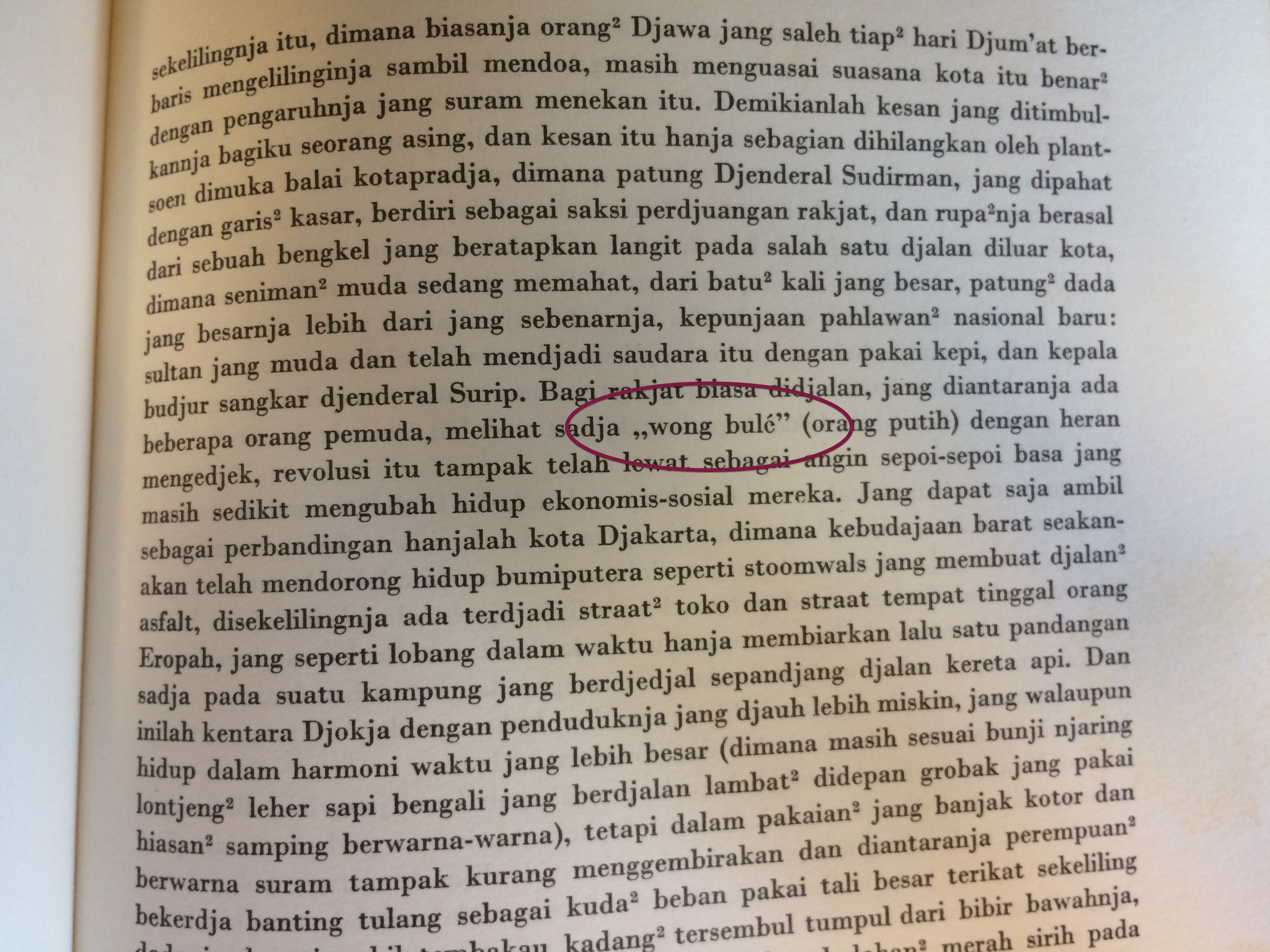
    I have found such an instance. I found it originally with a Google Books search for the words bule and Djakarta, restricted to anything published before 1965, on the intuition that if the term would be found it would be found in a book using the Dutch spelling. The source is a book by W. le Fèbre entitled Taman Siswa: Ialah Kepertjajaan kepada kekuatan sendiri untuk tumbuh…, published in 1952 by Balai Buku Indonesia. Happily, the Cornell library has the original book so I checked it out, and here’s what we find on page 17.
    IMG_3250-1
    The meaning is very clear: “wong bule” (orang putih) is best rendered as “honkeys” (white people) in American English.

    An interesting footnote to this find is the context of the quote: it is describing the sentiments of youth during the time of the Indonesian national revolution, seeing wong bule as confused and unsettled by the social upheaval at the time. That community and that time period is exactly the subject of Anderson’s Java in a Time of Revolution. A nice parallel, reinforcing the power of language in a time of revolutionary ferment.

    Now, my finding this quote does not reject the possibility that it was Anderson’s use of bule with his friends that is responsible for its prominence today. But it does directly challenge Anderson’s claim that “bule, in the sense of ‘white’ people” cannot be found prior to 1963.