Category: Current Affairs

  • Regional Implications of the Russian Currency Crisis

    Unless something changes dramatically in the next couple of days, we will code this week as the onset of the 2014-15 Russian currency crisis. Using Quantmod, I’ve plotted below the evolution of the ruble-dollar exchange rate since 2010 along with 180-day Bollinger bands.

    The Indonesians have a verb for this kind of currency movement: anjlok, which my Echols and Shadily dictionary defines as “to plummet,” or figuratively, to “jump the rails.”

    One interpretation of the unfolding currency crisis is that this is bad news for Putin, and hence good news for US/Western foreign policy. Here are two reasons to be circumspect, at least at this stage.

    Recent History

    First, the historical context. Let’s look back another decade, shall we?

    Russia managed to ride out the 2008-09 Global Financial Crisis pretty well. One might look to this as evidence that Putin has the “room to move” to withstand an external shock of this sort, although I’d add two caveats to this view. For one, the ruble depreciation of 2008-09 looks a lot like a return to trend than a departure from trend (as it does now). But also, and the 2008-09 depreciation is probably a consequence of a flight to liquidity during the Global Financial Crisis, which is not true today.

    Regional Context

    A second reason to be skeptical is the external implications of a Russian ruble crisis. Let’s also look at XR movements in the Ukraine over the same time period.

    Just eyeballing this, it looks like the same pressures affecting Russia will be affecting the Ukraine too, which would mean that any harm that comes to the Russian economy would also spill over to its neighbors too, including those neighbors that are seen as friends of the U.S.

    Fortunately, we know that we should not just eyeball our time series, because non-stationary time series can be misleading. I’ve plotted below the daily changes in hryvnia/USD (blue) and ruble/USD exchange rates (red).
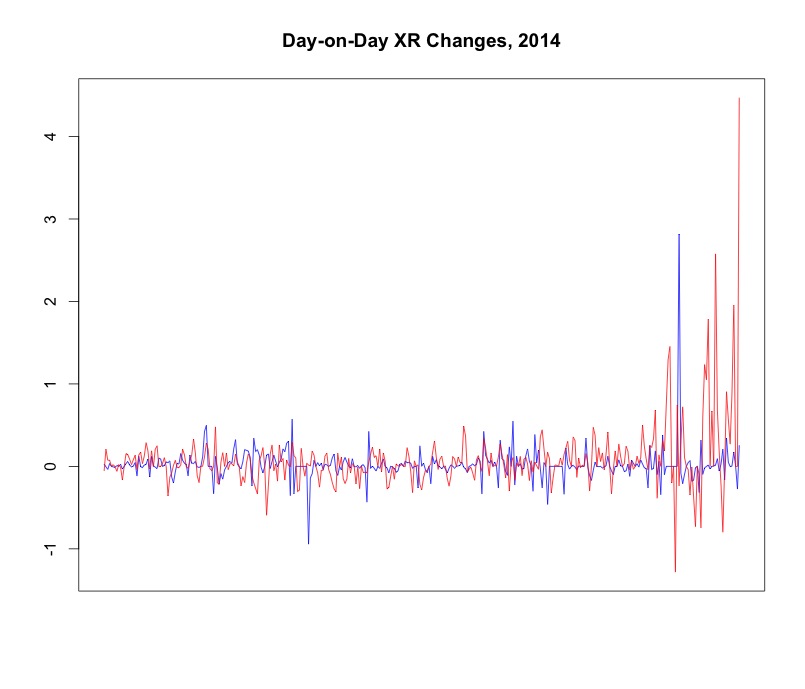
    It’s not so clear that they are related. We can also look at a scatterplot of day-on-day changes.
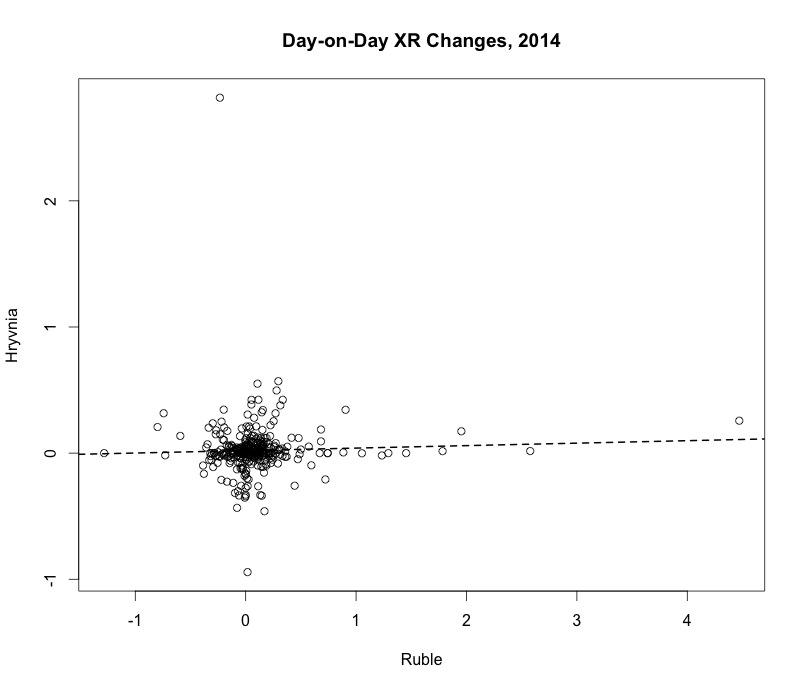
    There is only the slightest positive relationship here between hryvnia-USD movements and ruble-USD movements.

    So why write about this at all? Because it is also possible to show you this figure, from a time in which Ukrainian-Russian ties were not marred by invasions and things.
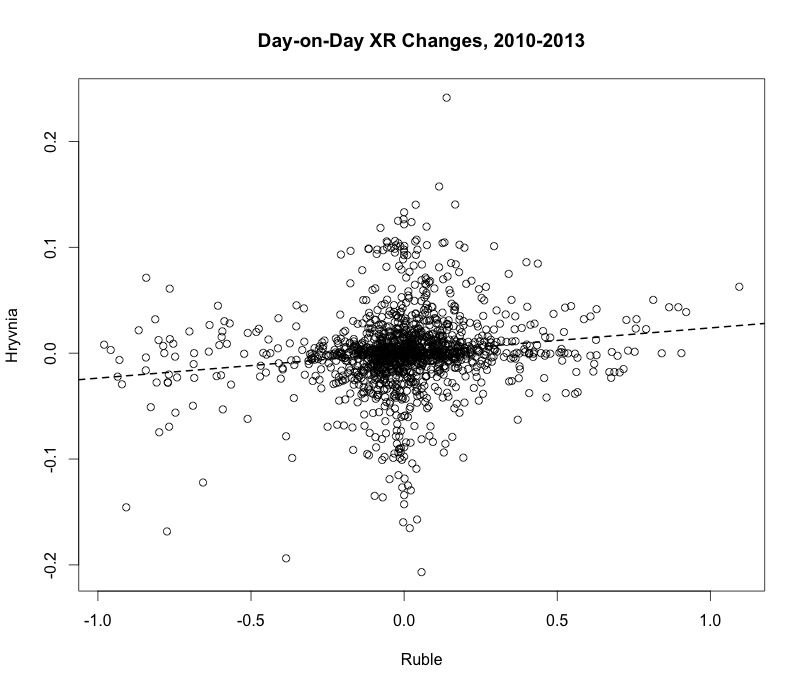
    The t-stat on the line of best fit is 5.6, and remains unchanged when controlling for lagged levels of each country’s exchange rate.*** This reflects the fact that during normal times, we expect there to be spillover effects from the Russian economy to the Ukrainian economy. (This figure is all the more striking given that the Ukraine was maintaining a quasi-fixed exchange rate during this period.) The economies are really tightly integrated: Russia is the Ukraine’s largest trading partner, after all.

    The takeaway thought is that currency crises have external consequences. Russia’s will too, and they might lead analysts to be careful of what they wish for, even as many of them happily watch the markets hammer Russia.

    Note

    *** Of course, I’d be curious to see a full ARIMAX/VECM model, and will post the R code to get all the data together in the first comment on this post.

  • The Ethics of Intervention

    Everyone is talking about the recent Montana field experiment on ideology in non-partisan judicial elections. I’m hearing even from non-political scientists, which is my measure of significance. There are three discussions happening now.

    1. Should the state seal have been used?
    2. Should researchers intervene without the consent of those targeted by the intervention?
    3. Should researchers intervene in politics?

    I’m not interested in point (1) here, or in discussing this particular experiment at all. I’m interested in points (2) and (3) as general points.

    There’s a pretty stunning amount of misinformation about there about point (2), such as beliefs that deception is never justified, that IRBs cannot approve research involving deception, and that all human subjects research requires informed consent—all of which are false.* Your IRB has procedures for determining whether a given research project requires consent or allows deception, even both (here’s Cornell’s on consent and deception). And we can argue about whether or not procedures were followed in this particular case by the IRBs in question, but there is no legal requirement that all human subjects research requires informed consent, or precludes deception.

    Now there might be an ethical case against such interventions, but as a friend commented to me elsewhere, it’s a consequentialist argument: are the anticipated consequences acceptable? But that brings us to point (3), the real meat of my commentary here. I want to argue that the possibility that a research design has political consequences cannot itself render such research unethical. This applies equally to experimental interventions and to observational research.

    My argument rests on an assumption that all social science research has the potential to affect political outcomes. There is nothing special about field experiments here—ask Chileans and Indonesians if non-experimental social science research affected their politics, or ask the MAD theorists and their Soviet counterparts. Moreover, the continuing handwringing by many in the political science discipline about public engagement and disciplinary relevance is precisely about using social science to affect politics. It is a peculiar position to argue that we can be advocates, but we can’t act ourselves.

    If there is an argument that is particular to field experiments, it is (as Dawn Teele argues here) that field experiments cause variation in the real world as an inherent part of their design. It’s not an accident, it’s the point.

    Source: Teele (2014, p. 119)
    Source: Teele (2014, p. 119)

    But again, I cannot support the position that surveys and ethnographic work don’t have the potential to affect politics too.** The fact that interventions are not in their design does not mean that they are apolitical, or that they do not affect the social world in which they are embedded.*** (For those of you rolling your eyes, this is not a nitpicky point, it gets to the very foundation of what about a direct intervention would make it objectionable.)

    My summary point is that all social science research has the potential to affect politics. We have no general ethical obligation to avoid any research that could indirectly affect politics; we have instead a specific ethical obligation to consider the risks and benefits of any research project, experimental or not, in the field or not. I’m completely on board with any proposal to think more about disciplinary ethics and political science research, but my bet is that that would make non-experimentalists a lot more uncomfortable than they think. Do we have an ethical obligation not to cause variation in the world deliberately, even if it has political effects? I don’t see it.

    But, But, and Once Again, But…

    But I am prepared to concede one important point that comes out of this, one raised privately by two friends at universities that rhyme with Schmearacuse and Schmisconsin. That is, we have always conceptualized the notion of harm and benefit from treatment as an individual thing. In the medical literature: did you also get cancer from your diabetes medicine, things like that. What this large field experiment raises is the possibility of that harms from treatment are not realized at the individual level, but rather only from the collective responses of all of those treated and non-treated together. I don’t think that we have the conceptual tools to think through the collective effects of treatments in cost-benefit terms. Perhaps the bioethicists and medical ethicists have thought about this in their discussions of vaccines, epidemics, and things like that, but I’ve not seen them applied here. Perhaps that would change my mind. But if so, I’d still hazard a guess that field experiments wouldn’t be the only ones affected.

    Notes

    * Strictly speaking, the position on deception is an ethical one, and many people do appear to hold the view that regardless of IRBs will approve deception, it is still unethical. See Kim Yi Dionne for a discussion.
    ** One personal example will suffice: my own survey-based research showed that Islamist party ideology usually does not confer an electoral advantage in Indonesia. I first reported my findings in Indonesian in 2009, at an event attended by an Islamist party leader who approached me and asked me about the implications for his party’s strategy. Now that party no longer campaigns on implementing sharia law. Is that all because of my research? No…but I am certain that my research affected how that party campaigns.
    *** Another personal example: I write these blog posts about ethnicity and Malaysian politics. I receive criticisms from some Malaysians that these posts themselves are reifying the ethnic logic of Malaysian politics, such that my discussing these findings at all is bad for a post-ethnic Malaysian politics (one that I myself support).