Author: tompepinsky

  • Section Diversity and APSA 2017

    Two weeks ago, the Diversity Committee of the Society for Political Methodology released a diversity report (PDF) that identified, in blunt terms, that the SPM

    faces severe diversity challenges. There is a disproportionately low number of women and minorities in the field of political methodology in all spheres- graduate student body, assistant professors, tenured professors, journal editors, etc.

    Although the data in its report are striking on their terms, even more interesting was the comparison of the Political Methodology section with the rest of APSA’s organized sections. Figure 3 in the report (tweeted by Patrick Egan and based on data from Jacob Montgomery) shows that Political Methodology has the fewest women as a percentage of all section members of any APSA organized sections.

    https://platform.twitter.com/widgets.js

    One question that follows from this is whether or not the APSA annual meeting program reflects similar patterns. Comparing gender breakdown by section membership and gender breakdown by participants in the annual meeting would be one way to see if, for example, the annual meeting reflects-and, as a result, might reinforce-such gender imbalances across sections.

    This is an issue that many of us care about. I was co-organizer of the Comparative Politics organized section with Sara Goodman, and we thought explicitly about “manels” but not directly about the overall gender balance of all of our panels and whether or not it matched our section membership. However, APSA has generously provided us with demographic data for all participants in the 2017 annual meeting. That allows us to not only compare the gender balance across different sections (not just our own), but also to check (using Jacob Montgomery’s data) whether or not they reflect section membership.

    Here is what we have found.
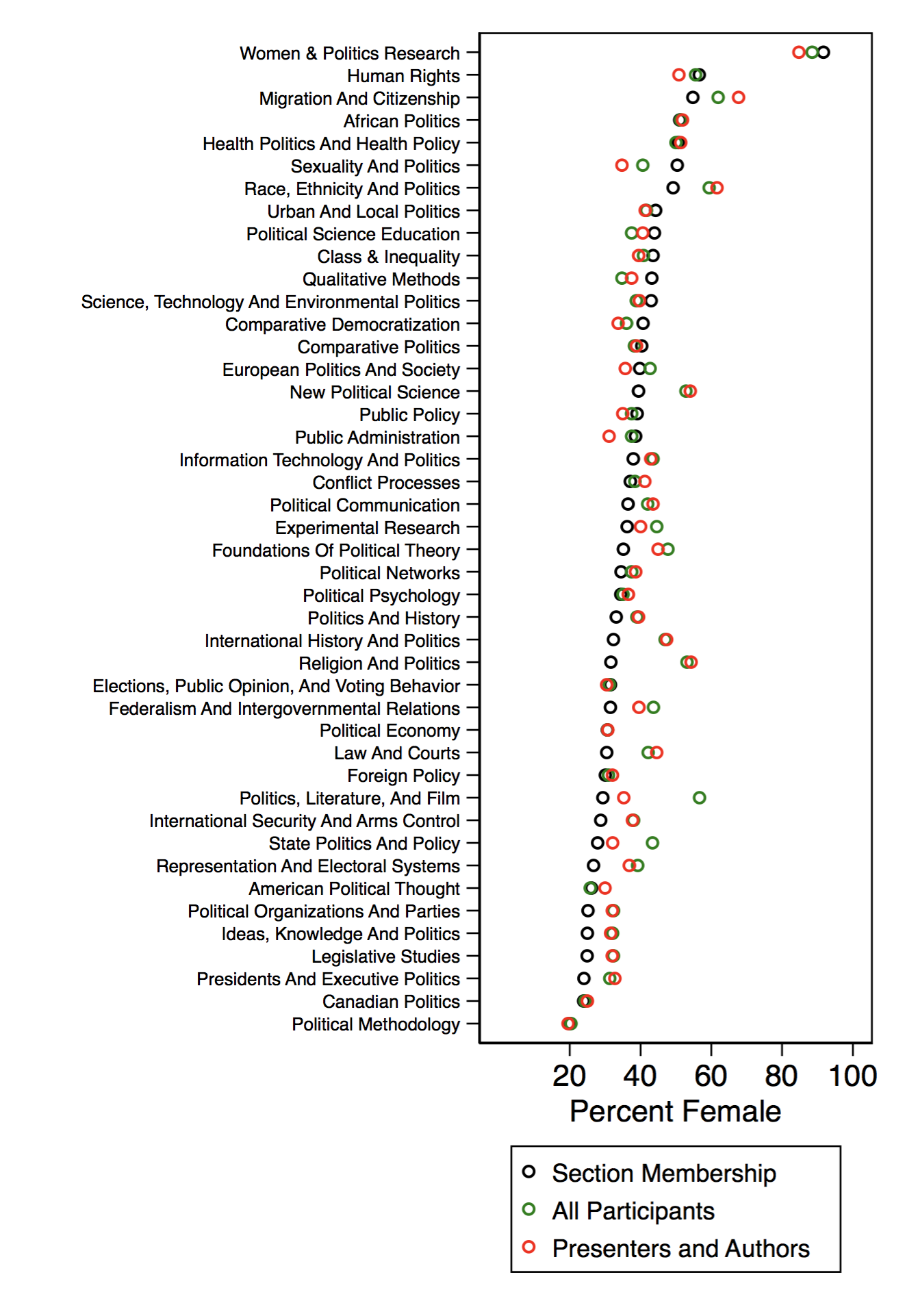
    Annual Meeting 2017 versus APSA Membership

    The black dots correspond to Montgomery’s data on the percentage of each section’s membership that is female. The green dots, by contrast, are the percentage of each section’s total panel participants (all chairs, discussants, presenters, and authors) that are female. Because many people argue that the roles of “chair” and “discussant” allow for only token participation, the red dots are the percentage of each section’s authors and presenters only that are female.

    We learn from this exercise that many sections are representative of their membership, but not all are. New Political Science and Race, Ethnicity, and Politics, for example, have a lower percentage of women as members than they do women as presenters. The reverse is true for Qualitative Methods. Comparative Politics (our section) was about as diverse at APSA 2017 according to gender as one might expect given our membership. The same is true of Political Methodology; while far below average relative to the general APSA membership (35%), APSA participation does reflects its section membership.

    There is much to think about here. One question that might follow is why there is such limited diversity in section membership among those sections at the bottom of this figure. Their panels at APSA are more diverse than we’d otherwise expect. To the extent that section membership matters-and I believe that it does-this would be one area in which the discipline might focus its efforts.

  • Identitarianism and the Theory of Groups

    Identitarianism is a political movement that, in its broadest understanding, is “premised on an acknowledgement that political questions begin with identity.” Identitarianism thus described may encompass any ethnic, racial, religious, national, or other grouping—but in common parlance it refers to a specific European and now American movement concerned with the interests of white Europeans and Americans of European descent. The Southern Poverty Law Center has a nice overview of the identitarian movement in the United States, although it is now clearly dated.

    In The Logic of Collective Action, Mancur Olson explained that large groups face an inherent problem of acting collectively because individual members have an incentive to free-ride on the actions and contributions of others. Combatting this free-rider problem requires either providing selective benefits to those who do contribute, morselizing the group into smaller units (say, clubs or college campuses) in which free-rider problem is easier to manage, or by relying on some sort of political entrepreneur who does not mind paying disproportionately the costs of organizing and mobilization.

    Identitarianism as a political movement faces something of a dilemma, then. In every society in which it flourishes, it is a movement that aims to represent the majority of citizens (“whites”). It should be the hardest to this majority to organize as a group to advances its interests qua a group.

    How useful is the collective action and theory of groups perspective for making sense of identitarianism in American and European politics? On one hand, the idea of operating at smaller scales, morselizing the problem of collective action, seems to describe how the identitarian movement works well. So too the idea of the political entrepreneur: the National Policy Institute in the U.S. (which “endeavors to do the impossible: give voice to the interests of white peoples”) is exactly this. But there are two departures from the classic theory of groups that might usefully be noticed.

    The first departure is that much of what the identitarian movement is about is not organizing whites as a group, but rather convincing whites that they are a group. This task is substantial. It requires “boundary work” or “boundary making” (qua Barth [PDF]): deciding who is in and who is out (Jews, Roma, Turks, sometimes southern and/or Eastern Europeans, and so on and so forth), and how to deal with ambiguity (as the Nuremberg Laws did). But it also requires propagation of this concept more broadly among the community to which it is applied. This differs from the classic collective action framework in which groups more or less objectively exist: wage laborers, or members of religious congregations. The collective action problem, when the group exists, is to convince individuals that their interests are best achieved through collective effort, not that the they in fact have mutual or collective interests. The identitarian movement works to create that group first, and at the same time, in doing so, to imbue that group with a particular set of interests. In 2016, Glenn Loury observed pointedly that

    I really don’t know how you ask white people not to be white in the world we’re creating

    Identitarianism can thrive within this political space, even if saying “the interests of white peoples” openly, as an invitation for individuals to conceive of themselves as a group that has collective interests, remains something of a provocation.

    The second departure has to do with the free-rider problem. The identitarian movement does not confront the standard collective action problem because success does not depend on broad contributions of all potential group members. It is true that the identitarian movement would be stronger politically if it had universal active support. But the movement can prove effective even under conditions of broad apathy. So unlike the congregation that will not build its new church unless all members contribute, or the labor union that cannot effectively press its demands unless all members participate in the strike, the identitarian movement does not need to convince everyone to join the movement in order to change policy. Only for people to accept that the boundaries and groups exist, or even less, not to oppose them. In this way, identitarianism can change national political conversations even without winning converts to its cause.