Author: tompepinsky

  • It's the Wrong Heri, Gromit!

    One of the consequences of living in a country with, ahem, lax copyright enforcement is that when a restaurant with a unique name hits on a particularly winning recipe or formula, ripoffs and clones will spring up immediately. For the unsavvy consumer–that is, me–it often becomes impossible to tell them apart, to tell the real ones from the fakes. Examples of this include Ayam Goreng Ny. Suharti, a famous Javanese fried chicken restaurant; Sederhana, the country’s best Padang-style restaurant; and, it turns out, Pondok Sate Pak Heri on Jalan Sabang.

    I learned this yesterday as I was looking for a quick bite. I had in mind something like fried fish or roasted chicken, and I wanted it to be fast. So I walked over to the local foodstall street and started walking down it. Then I started noticing something. There was another place calling itself Pondok Sate Pak Heri. Hm. Then I saw another one. By my count, there are no less that four different places that block that call themselves the exact same thing and sell the same thing.

    So how do you know which one is the right one? By how many people were there. Only one Pondok Sate Pak Heri was crushed with people at 7:15 PM, and it was not the one that I went to the second day I was there. So I decided that in the name of fairness to the real Pak Heri, I’d try this one as well.

    The Real Pak Heri

    5-12-09.1

    Crushed with motorcycles, with a bunch of people waiting and an oversized grill going out front making a huge smoky haze that extends half a block, this is the place to be. I also notice that almost everyone was ordering the chicken sate. So because of this, and because I’m feeling like I may have eaten enough mutton for an army over the past week, I decided to sacrifice comparability in the name of variety. Also, because I was feeling tired and antisocial, I got my sate to go and ate back in my room.

    Sate Ayam, tambah lontong

    5-12-09.2

    This shows you the customary way to get something “to go” in Indonesia: wrapped in a banana leaf, and then wrapped in butcher paper. This is chicken sate with steamed pressed rice cakes in banana leaves (lontong) on the side. And the taste? Pretty damn good.

    My grade: B+. As far as taste goes, these are a winner. Tender dark meat chicken, rich sauce, nice and peanuty and sweet and salty. Just how I like it. The rice cakes are good too, big and tender. But the problem? No acar (the crunchy vinegary vegetables). This is a deal-breaker for me. It makes the dish too rich.

    More food pictures are up in the food pictures folder, including gado-gado and masakan Padang.
  • Official Results

    The official results of the 2009 legislative elections are in. Here is the breakdown of all the parties that got enough votes to get seats in parliament.

    Party Perc. Seats
    Democratic Party (PD)  20.85 148
    Party
    of the Functional Groups (Golkar) 
    14.45 108
    Indonesian
    Democratic Party–Struggle (PDI–P) 
    14.03 93
    Prosperous
    Justice Party (PKS) 
    7.88 59
    National
    Mandate Party (PAN) 
    6.01 42
    United
    Development Party (PPP) 
    5.32 39
    National
    Awakening Party (PKB) 
    4.94 26
    Great
    Indonesia Movement Party (Gerindra) 
    4.46 30
    People's
    Conscience Party (Hanura) 
    3.77 15

    These results show a couple of things. First, the biggest parties by far are the non-Islamic ones (these are the first three). Second, the personal parties of former military leaders do surprisingly well, given that with the exception of PD they were formed just about a year ago (these are the last two). Let's look now at the development of parties over time.

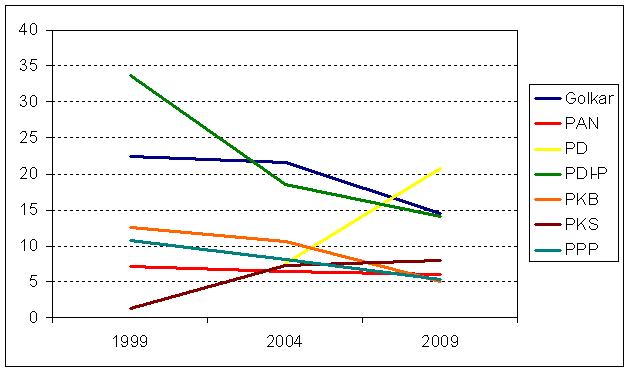
    Three Rounds of Democratic Elections

    5-11-09


    I leave off Hanura and Gerindra because trends don't make sense with one data point each. But if you look at the trends over time, you can that there are only two parties that have increased their vote shares since 1999: PD and the conservative Islamist PKS. (In 1999 PKS ran under a different name.) All other parties have seen their support eroding: the nationalist ones (Golkar and PDI-P, the moderate Islamic-nationalist ones (PKB and PAN), and the Islamic one (PPP). (Two additional conservative Islamic parties, PBR and PBB, did so poorly in this election that they no longer have seats in parliament.) Even PKS, though, didn't do great…it's vote share is up less than 1% from 2004, and in absolute terms it actually received fewer votes compared to 2004. The only party that really increased its vote share is PD.

    I'm trying to wrap my mind around what this all means. One might read this as encouraging: Islamist support is dwindling. I think that this is right, but there's another, less optimistic way to read this. The traditional nationalist powerhouses are becoming obsolete. The newcomer nationalist party is doing very well, but we know that it won't survive to 2014 because it's purely a personal vehicle for SBY. There's no successor being groomed, and SBY can't run again in 2014, so we can't expect PD to draw any support in 2014. So who will step up? A lot of civil society people worry that if Golkar and PDI-P can't reverse their steep declines–and I don't foresee them being able to do this–the most likely option will be PKS, whose on-the-ground organization is the envy of all other parties (even if its popular support right now isn't very high). This would be worrying.