Author: tompepinsky

  • Storm Beer (Bali)

    The craft brewing craze has arrived in Indonesia. Seriously. I was strolling around one of Jakarta's swanky malls this weekend, pricing bespoke suits (everything's out of my price range), and happened across a fancy grocery store. I always have fun looking at grocery stores in other countries, and so I took a stroll through it. And while there, I noticed a display selling five kinds of specialty beers brewed by a firm called Storm Beer, based out of Bali. So of course I had to get a couple to sample.

    Having lived for some time in the Napa Valley of beer, I have pretty high expectations of craft breweries. (I also have a limited tolerance for annoying craft brewing techiques, like brewers that attempt to outdo one another making the "hoppiest" or "strongest" or "darkest" beer in search not of good taste but rather of superlatives. But I digress.) So here are my reviews of three of Storm Beer's selections. I decided to skip two of them (Bronze Ale and Pale Ale) because I tend not to like those styles very much, especially pale ales. The remaining three are the ones that looked most appealing.
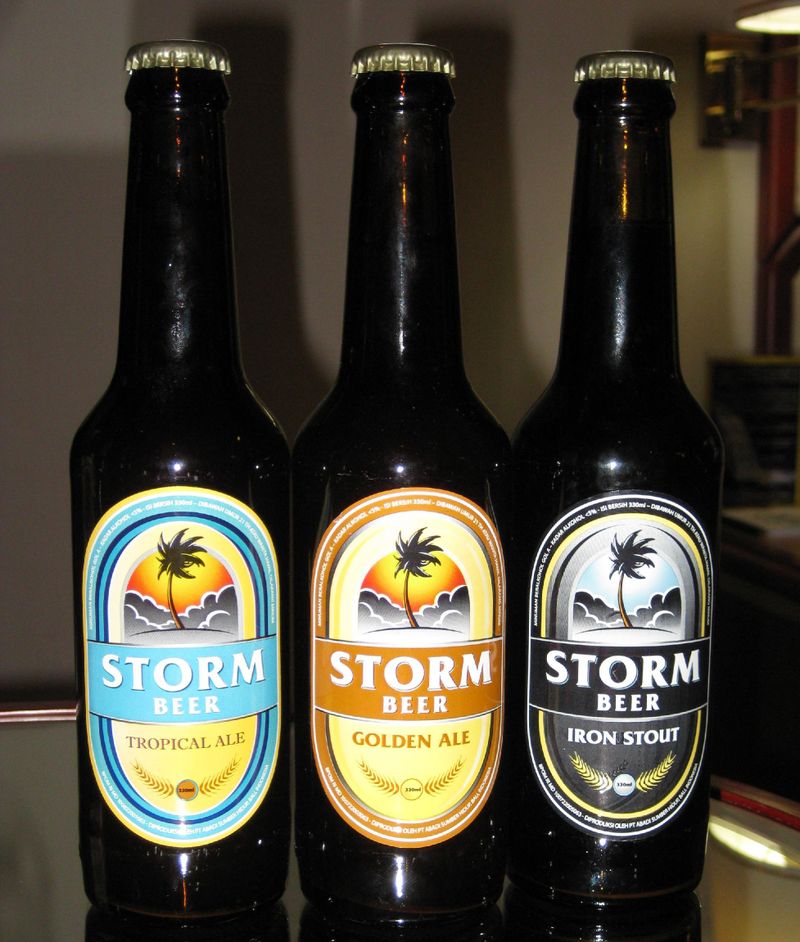
    5-19-09

    Before we get started, let me admit that I have no idea about how to taste and or rate beer. None. So this is just me aping the way that I've seen other beers rated.

    Storm Beer Golden Ale
    Pours a large head, but is highly carbonated so it evaporates quickly. Cloudy with a golden color. The nose hints of wheat and hops. The initial taste is wheat and yeast, followed by unidentifiable sweetness (not like a honey or sugar sweet, but I can't describe it properly). Dry bitter finish and aftertaste. Overall: for a summer beer there is probably too much flavor here, but it is pretty good and I prefer this to the standard local swill.

    Storm Beer Iron Sout
    Pours a nice head, also fairly carbonated. Brown/black in color. The nose smells roasty. Taste is surprisingly bitter and thin, less big and chocolatey or malty or roasty as I would prefer in a stout. Bitterness continues though the finish and aftertaste. Again, the word that comes to my mind is "thin." Overall: this is unremarkable as far as stouts go, but it's not a bad beer in general.

    Storm Beer Tropical Ale
    Another big foamy head, highly carbonated but less than the Golden Ale. Lemony yellow in color, not cloudy but still opaque. A distinctly skunky nose, reminiscent of the lower rungs of the Milwaukee ladder/my sock drawer, but combine that with a whiff of lemon. Confusing taste: starts with lemon, then moves to grassy and herbal flavors. Also a bready/yeasty note which does not combine well with the others. Finishes with more lemon and some light hops. Citrus taste lingers for a bit, and is not unpleasant, but the last bit of the aftertaste is of Icehouse. Whoops. Overall: sock drawer + Icehouse: this is a disappointment. Maybe a slice of real lemon might help. Would not drink again.

  • Majorities with Minority Mentalities

    There is a phrase that's often used to describe Islamic activists in Indonesia, that they are a "majority with a minority mentality." (I think the term comes from FW Wertheim, but I'm not sure if he actually coined the phrase.) Maybe "activists" isn't the word I'm looking for, maybe something more like Muslims with a consciously Muslim identity. Whatever. The point is, it's an evocative phrase that makes a lot of sense. Indonesia is overwhelmingly Muslim in addition to being the world's largest Muslim country, and it's a country where piety is taken very seriously by both Muslims and non-Muslims. There is an argument out there that Indonesian Islam "doesn't count"–it's taken from a misreading of Geertz's The Religion of Java combined with a certain Mecca/Medina-centrism in the Arab world–but I largely dismis this. Nevertheless, despite being a dominant majority, the mentality among many Indonesian Muslims has been similar to that of a minority: that their aspirations are being neglected, that they face systematic discrimination, that they have no proper political (or even, really, social) representation, etc. This was particularly the case under the Sukarno and Soeharto, about whom Wertheim was writing. So this leads to the peculiar outcome of a numerically dominant majority couching its political strategies in the language of an oppressed minority. To give but one example from today's political scene, there is lots of concern by Muslim groups that the presence of Ahmadiyah (a tiny sect that most Muslims consider deviationist) threatens Indonesian Islam, so some action must be taken agains it.

    Political scientists are trained to look for patterns and similarities across countries and contexts. And I think that the concept of a majority with a minority mentality actually fits the case of American political Christianity very well. I mean this in the following sense: as a political project, Christianity in the United States relies on the idea that Christians are repressed or under fire in some fashion. This despite the fact that the United States is probably the most pious advanced industrial economy in the world, one in which even hippy-progressive Ithaca has dozens of churches of every denomination. I could go on. But still the rhetoric we hear is that in America Christians and their rights are under assault. I think that this commercial sums it up perfectly.

    Hat Tip: DSP

    Note the framing of the issue of gay marriage here as not giving rights to a group that has been denied them, but rather taking rights from a group that has always enjoyed them.

    The point of this is that I think we see a common strategy here. Numerically dominant groups must couch their demands in terms that make themselves seem small or at risk in order to mobilize their supporters for their cause. I think that this is consistent with what we know about collective action and social movements and the types of conditions that make them most effective. I also wonder if there's a subtle strategy of creating social cleavages (which is what the "us versus them" mentality is) in order to force groups to align on an issue in a way that a minimum winning coalition is formed. Political scientists can call this endogenous cleavage formation. This is a different perspective on how identities are shaped than that of Daniel Posner. He argues that multiple identities exist in any society (religion, race, culture, language, etc.), and the one that is politically salient is the one that allows for a minimum winning coalition to form. I suggest that when one identity is not minimum-winning (as numerically dominant religious majorities are in Indonesia and the United States) then the identity is itself shaped or reconstituted in a way that makes it minimum-winning.

    NB: Nothing here should be read as being against either Islam or Christianity. I am concerned here not with religion as an abstract concept, a way of life, or whatever. Rather, I am interested in understanding how groups who wish to use religion to achieve political power do it, or put otherwise, in the choice of strategies among numerically dominant religious groups trying to advance a platform via political means.