Author: tompepinsky

  • Guess the Colonial Power

    As I polish up a first serious draft of a paper on decolonization, today I came across a discussion of “annexation.” I invite readers to peruse the following and imagine which tropical territory is being discussed.

    Many…who felt…that annexation was inevitable sentimentally opposed it. It would be far pleasanter, were the world constituted differently, for  many states, representing different planes of culture, different races, and differing attitudes toward life to exist beside one another in amity. But the world, simply, was not constituted that way.

    In the Nineteenth Century, as always before and always after, it was a realistic world, one whose separate parts continually came closer together. _____, potentially, had things that the world wanted. Left untroubled, the _____ans themselves clearly would not produce those things. Yet it could be fairly argued that they had no right to fail to do so. No one of radical opinions would grant the right of a private owner of great acres, of a factory, of a ‘means of production’ of any kind, to shut it off from common use merely because it was the owner’s whim or nature to do so. How then could it be argued that far greater proprietors under the name of race or nationality should exercise that right?

    Seems like something right out of the “enlightened” part of the colonial era, right? Say, mid-19th century on. Probably some Belgians talking about rubber in the Congo Free State. Or the British talking about rice in the Irrawaddy delta. The sentiment is not so much that the European should be enslaving the colonial subject, but rather that the colonial subject cannot be a proper member of the global economy without some direction. What is an enlightened European to do? (I love the use of the construction “it could be fairly argued” here.)

    Turns out, this quote is of more recent vintage, and it is not European. It is taken from John W. Vandercook’s 1939 book King Cane: The Story of Sugar in Hawaii (New York: Harper & Brothers Publishers), pp. 42-43. Yes, this is a quote is referring to the annexation of Hawaii, so that those noble yet indolent Hawaiians could be directed to grow sugar.

    Americans owe it to themselves not to forget this chapter of our history. For more, I highly recommend McCoy and Scarano’s Colonial Crucible on the role of empire in the construction of the modern American state.

  • Race and Communalism in Malaysia

    Hoisted from the comments:

    The only bone I have is though, is the non-threatening euphemisms that you have chosen – to cover up the rampant racism that are being practised.

    What is wrong with calling a spade, a spade?

    Why do you have to cover up racism from officialdom with euphemism like “communalism” ?

    With the use of ‘communalism’ you are grouping the victims along with the perpetrators – instead of pointing out racism, as it is.

    The commenter, “Penang,” wants to know why I don’t talk about racism in Malaysia. When I write or lecture about Malaysia, I often use the terms “race” and “racism,” but I am careful to say that this is the term that Malaysians use, not one that I would prefer to use. I like to talk about ethnic, or better yet, communal issues.

    Why? Good question, and although “Penang” seems eager to start a fight with me about it (for some reason that I don’t quite understand), it’s worth a discussion. This is a teachable moment for students of Malaysian politics and Malaysians alike.

    One reason why people like me might avoid using the term “racism” in Malaysia is that in general, race as a category for describing variation in human populations does not correspond to any objective physiological reality, which is what the term is meant to do. But while that is true,  I don’t mind using the term “racism” to talk about the United States. So why not Malaysia?

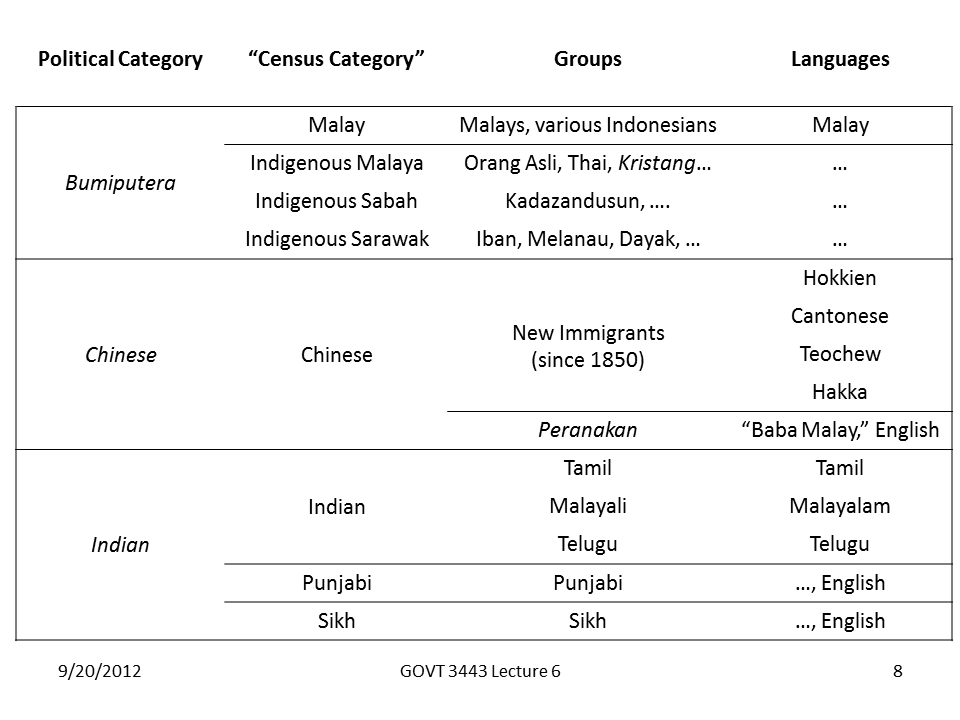
    The answer is political. Here is a slide from my Malaysia lectures which makes the point better in images better than I can with words.

    Question: Does race separate Malays from Chinese or Indians?
    Answer: no.

    This slide is one of my favorites. It shows some examples of the great variation out there in the types of people who count as Malay, and gives us the legal definition for why that is the case. Given the legal definition of what constitutes a Malay, it is simply not true that race is the proper term to describe the differences between Malays and non-Malays (or bumis and non-bumis; don’t get me started about Kristang). This would be true even if race were a useful analytic category. The fact that the phrase masuk Melayu exists—to become Malay, or more literally, to “enter Malayness”—shows you why “race” doesn’t capture the essence of ethnic or communal issues in Malaysia.

    It’s possible that “Penang,” like others in Malaysia, uses the term “racism” because it has clearly negative connotations, whereas “communalism” is a more neutral. To this observer, neither is a good thing. And anyway, we shouldn’t choose terms based on how they make us feel, we should use terms that describe society as it is.

    The “racialization” of communal differences in Malaysia has a long and interesting history. My interpretation is that the country’s ruling elites long ago settled upon a strategy of divide-and-rule. The principle of division was communal: Malay-Chinese-Indian, later to be modified as bumiputera-Chinese-Indian. But as this lecture slide shows, all of these categories obscure more than they reveal.

    Categorizing Malaysians

    As the pressures of modernization and globalization threatened the established identity landscape in Malaysia, fostering new overlapping identities and suggesting that there might be room for a post-communal politics, a language emerged among the regime’s defenders, perhaps not consciously, that racialized communal differences. By racializing, I mean recasting communal differences as fundamental, durable, immutable, and biological. This process obscured the variation within communal groups (and the frankly non-racial definition of Malayness) as a mechanism for cementing the organizing principle for Malaysian politics. After all, if we remember that for many, Malayness was a choice—literally—in the 1950s, then we might not feel so strongly that being Malay or Chinese or Dayak is a big deal, or that we need to things like vote based on our identity. Racializing communal identity is an ideological project that is designed to compel Malaysians to think about themselves in communal terms, because that is what keeps Malaysia’s status quo working.

    One final thought, from a more activist perspective. Here’s another way to phrase what I’ve just written. If you think that the differences between Malays and non-Malays are racial, well, then you’re a sucker. You’ve fallen for the politicized communal discourse that generations of Malaysians have been subjected to, a discourse that insists that there are deep, immutable, fundamental, biological differences among Malaysian as a mechanism for justifying the policies that maintain the political status quo.

    And since I’m not a sucker, I don’t use “race” to describe communalism in Malaysia.