Author: tompepinsky

  • Trade Competition and American Decolonization

    A new working paper entitled “Trade Competition and American Decolonization” (PDF), prepared for the 2012 IPES meeting and the subject of several previous posts, is now available. I’m happy to be presenting a primarily qualitative paper at a conference that has a reputation for being quantitative—although I am on the last panel before social time on Friday afternoon, so while I’m rambling on about sugar cane and coconut oil my audience may be daydreaming of Nelson County wine and Virginia tobacco. Ah well. Comments welcome.

    I have always posted working papers online. Not everyone does this. The fear appears to be that posting articles online violates the anonymity of the peer review process for anyone who has access to Google. I used to do lame things like changing the title of my papers before submitting them to journals, but I do not think that has fooled any reviewers.

    There is one cost of not posting research online: it hinders discussion and engagement from a wider audience. Nate Silver recently told TechCrunch that a “lot of journal articles should be blogs.” Steve Saideman put it best: “no, but lots of articles shld be blogged.” He goes on:

    Journal articles r longer & more technical than a blog post, need to be more thorough, sophisticated. But articles should be summarized…summaries can and should be posted in non-gated places so that ideas disseminate even while research is still refined/vetted

    There is a long debate about the role of blogging in modern academia, centering around the idea that blogging competes with research (see Dan Drezner for one story). I think the opposite is true, although I do recognize that most academic bloggers tend to blog about life more than they do about their own research. Saideman is right that we ought to let our ideas out for some time in the yard before we imprison them forever in a journal.
  • Etymology of Coconut Oil Stew

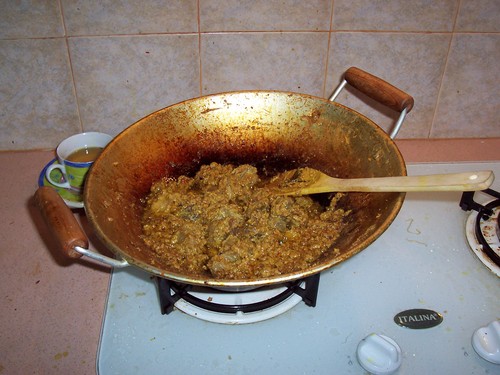
    Every Indonesia hand knows about rendang, a spicy mutton or beef curry. What makes rendang so special is that it is prepared by boiling meat in coconut milk until the water of the coconut milk evaporates. When that happens, the coconut oil separates from the solids, and is used for frying the meat. Long-time readers will remember when we first made this dish in Jakarta in 2004.

    Rendang Daging, Taman Rasuna Apartments Flavor, 2004

    But maybe it’s not so special. It turns out that every good Jamaican knows about run dung (occasionally rundung or run-dung), also known as Dip and Fall Back, because

    When yuh boil down di coconut milk with seasoning to di point it turn custard and yuh add the salt fish – shad, cod or mackerel yuh haffi dip and fall back.

    This description seems to be exactly the same as making rendang. And run dung isn’t always made with fish. Check out this image of chicken run dung:

    Chicken in coconut “run dung” sauce, from http://www.bestjamaica.com

    The question to ask is how it got that way. Does rendang ≈ run dung? A brief web search cannot uncover an etymology for either term, but this is too close to be an accident.

    If the terms are related, it’s fun to speculate about the possible etymological links. Three paths seem possible to me.

    1. British encountered rendang either in Malaya or in the Netherlands Indies, and brought the recipe and the name with them to Jamaica. This isn’t as unlikely as it might seem: Sir Stamford Raffles was born in Jamaica, after all, and we all eat something called ketchup (= kecap).
    2. A related version of this: rendang came to the West Indies via the Javanese in Suriname—although rendang is Minangkabau in origins, I’m sure Javanese had heard of it—and from there made its way to the islands.
    3. Both run dung and rendang come from some Indo-Aryan or Dravidian root. It moved to Indonesia like many other words of those origins, through trade and cultural contact, and it moved to the West Indies through colonial migration. This is a story of common origins rather than later contact.

    If I were a PhD student in anthropology, I would work on topics like this.