
A linguist friend once described Bahasa Indonesia, the national language of Indonesia, as “the language killer.” By this he meant that the spread of Indonesian has had a remarkable impact on the thousands of local languages in Indonesia, with little or no official status. One amazing consequence of this is that languages like Javanese, with over a hundred million speakers, may actually be endangered.
The social aspects of Indonesian’s spread are a rich area of study. Here is one illustration: using a .1% sample of the 2010 Indonesian census, I have modeled the probability that an ethnic Javanese respondent speaks Indonesian at home as a function of gender, age and age squared, whether he or she lives in an urban or rural area, and the percentage of the respondent’s district who is ethnic Javanese. Below I plot the predictive margins: estimates of the probability of speaking Indonesian for various interesting combinations of these variables.

The findings are actually a bit reassuring: in heavily Javanese areas (basically, Central and East Java) Javanese is being spoken at home by children. But as Javanese move outside of these regions—and especially in urban areas—the probability of speaking Indonesian jumps dramatically. And the curves by age are predictions of the future: children who speak Indonesian at home will almost certainly not be able to teach their children Javanese.
Still, Indonesian will have a long way to go to kill Javanese, because most Javanese still live primarily among other Javanese and primarily in rural areas, as the chart below illustrates.
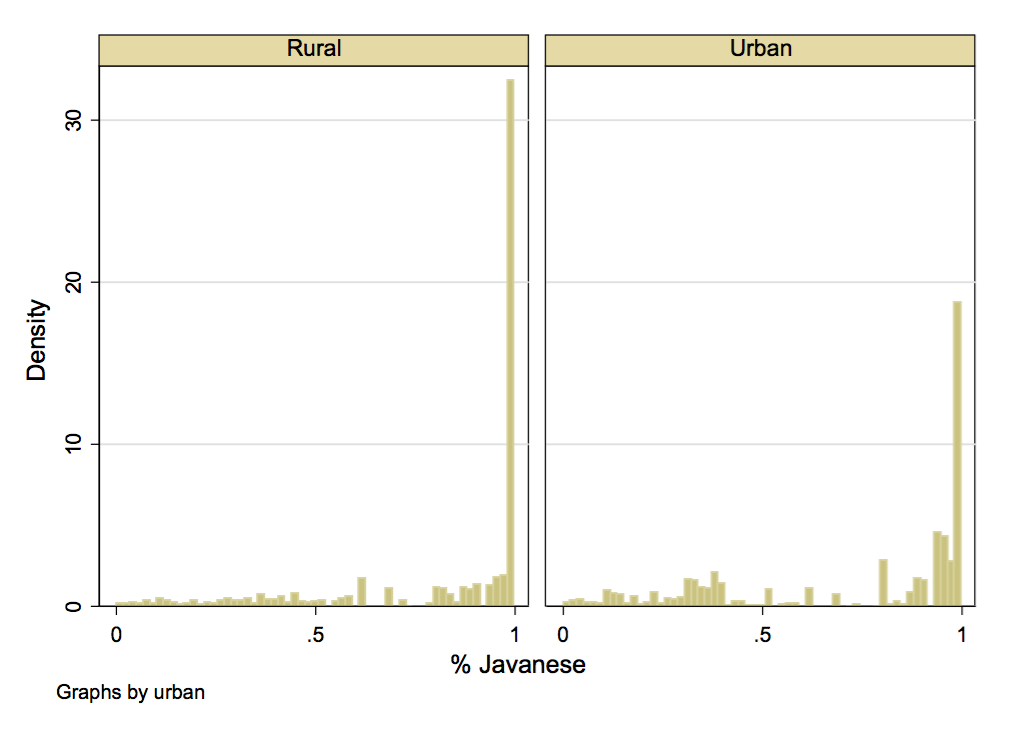
So long as this is the case, Javanese will be safe. Unfortunately, the Indonesian census records neither bilingualism nor linguistic competence; if it did, we could learn the extent to which bilingualism in Indonesian is degrading competence in Javanese. That is the frontier for research—how Indonesian kills them softly.
 Tom Pepinsky