Author: tompepinsky

  • Argentina’s Sovereign Default in Perspective

    I am surprised at how little coverage Argentina’s sovereign default has earned. The Financial Times even notes something of a post-default calm in financial markets (although it also warns of choppy seas ahead). One reason may be that the default has been anticipated for so long—given Argentina’s history of sovereign default—that it’s not really news. Another might be that sovereign defaults are a bit abstract for everyone but creditors and the citizens of the defaulting countries.

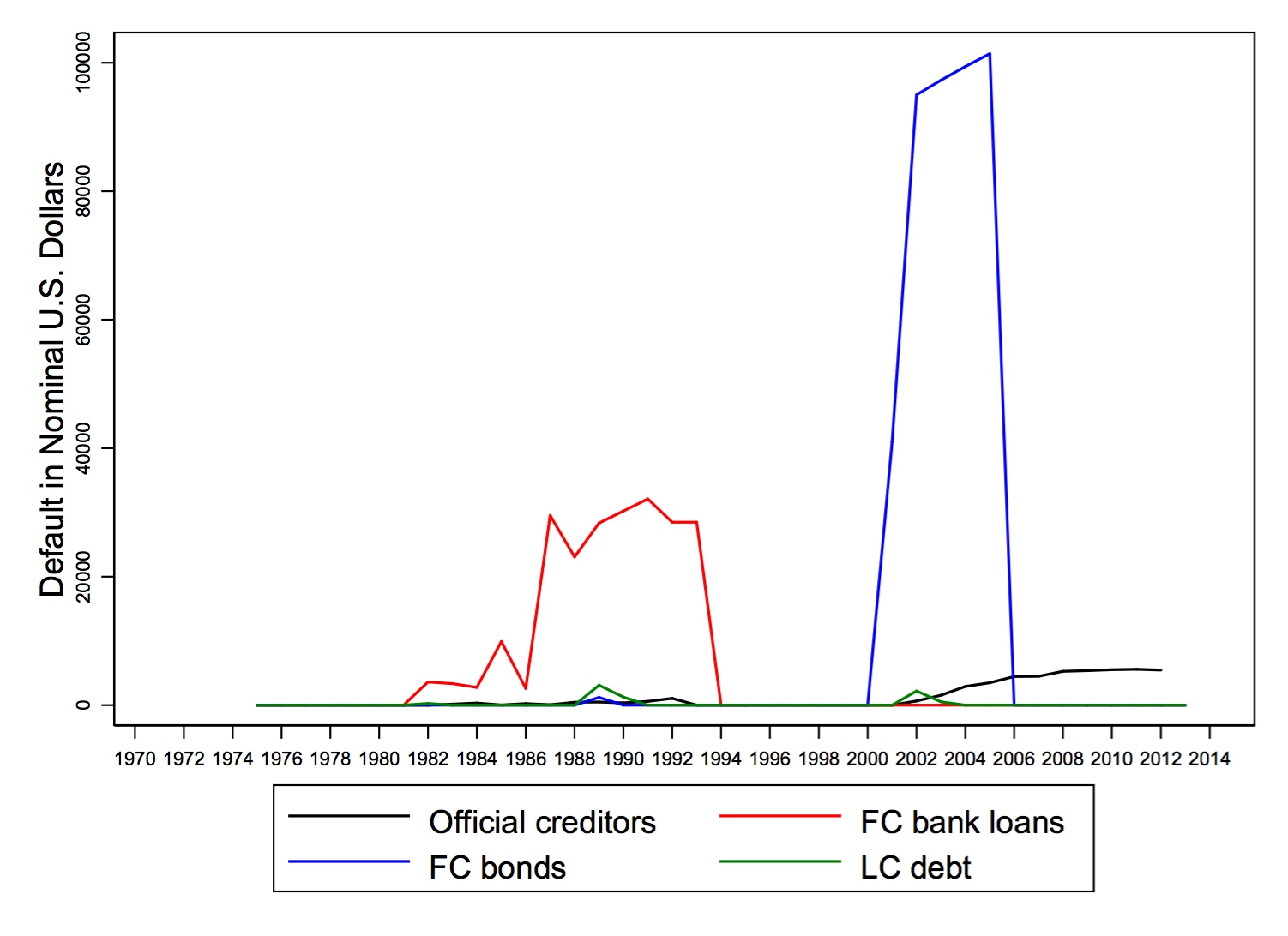
    One useful new source for some data that can put Argentina’s default into perspective is a dataset from the Bank of Canada described in this report by Beers and Nadeau. Unlike the more comprehensive financial crisis data from Reinhart and Rogoff, which extends much further back in time in addition to covering more types of crises, the Beers and Nadeau data cover many more lower- and middle-income countries. They also usefully distinguish among various types of sovereign default according to who actually holds the debt. If we plot the data for Argentina, here is what we find:
    argentina
    The 1980s and early 2000s debt crises are readily apparent here, as are the differences between the two. The data also help to remind us that unlike personal bankruptcy, defaults endure. We also see original sin in action: Argentinian defaults do not involve LC (local currency) debt because Argentina/Argentinians cannot borrow abroad in their local currencies.

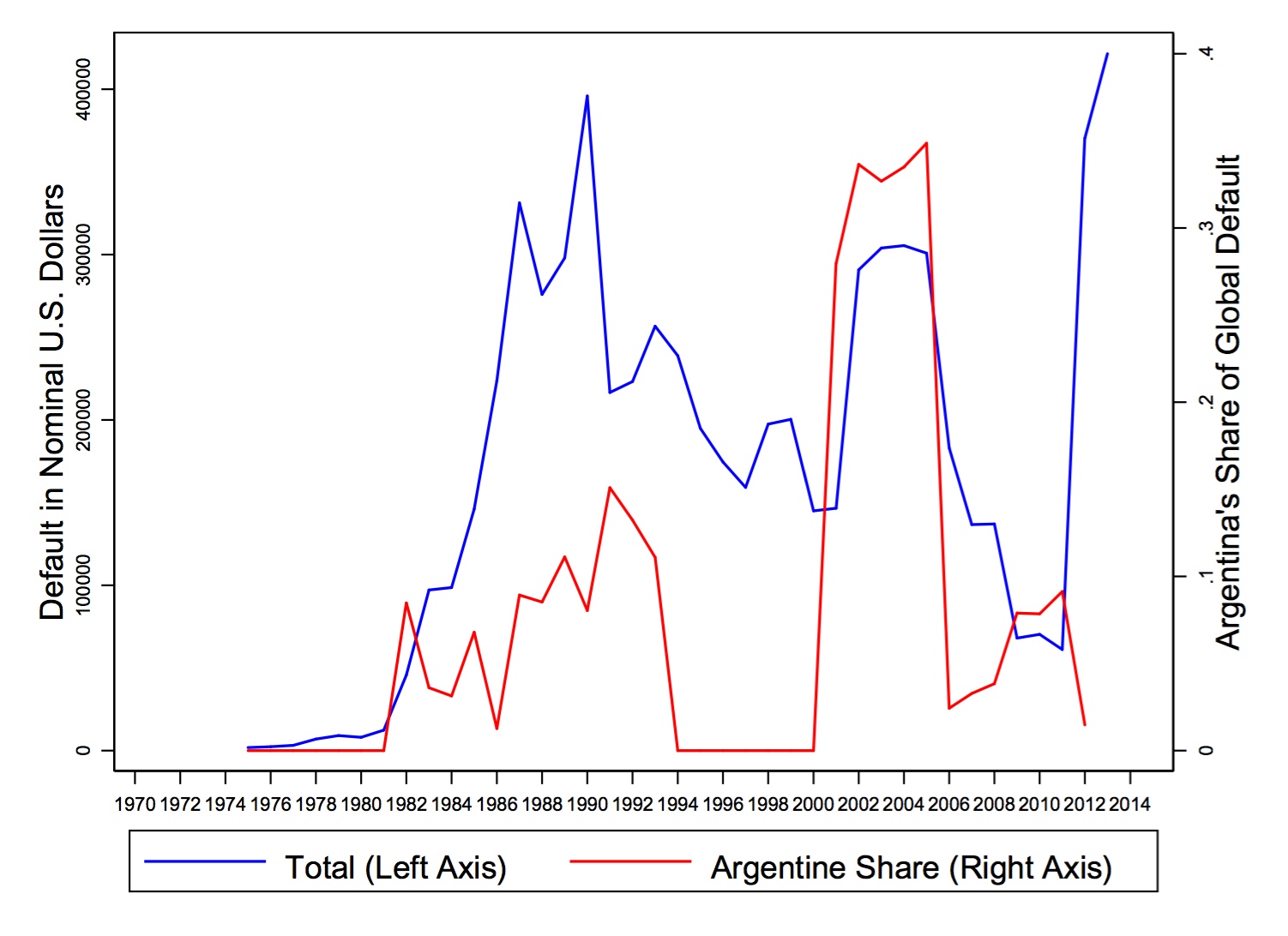
    What’s interesting to me is the share of Argentine debt in default as a ratio of the total amount of debt in default globally. We can look at this too:
    ArgentinaShare
    Perhaps one reason why Wednesday’s default is not such big news is that globally, Argentina is not unique these days, as it clearly was in the early 2000s.

    Oh, and for another perspective on Argentina’s default, we can always read Oscar Wilde:

  • Losing Hearts and Minds through Violence

    calvin-soldiers
    I am no specialist in the Israel-Gaza conflict, but I read with great interest Marc Lynch’s recent post at the Monkey Cage about political science and the current conflict in Gaza. One topic that seems to have been overlooked in that particular discussion is what we know about the role of violence as a tool of insurgent and counterinsurgent warfare.

    Here’s what I think we know: indiscriminate violence does not generate compliance. And this is absolutely fundamental to understanding the conflict right now and what its likely implications are going to be.

    The most topical recent work on this is Anna Getmansky and Thomas Zeitzof’s forthcoming APSR piece, which finds that exposure to rocket attacks in Israel is associated with greater support for right-wing parties among Israelis. The core feature of the rockets fired from Gaza is that they cannot effectively target people or installations. They fall almost randomly. Looking back in history to an earlier insurgent war, Matthew Kocher, Stathis Kalyvas, and I find that South Vietnamese villages exposed to aerial bombing from the United States and Republic of Vietnam forces were more likely to shift towards NLF (Viet Cong) control. Our argument also relies on the indiscriminate nature of this violence, which was simply incapable of separating true NLF supporters from neutrals or even RVN partisans within Vietnamese villages.

    Taken together, these studies show that indiscriminate violence—whether used by insurgents or counterinsurgents—does not generate compliance. In fact, it does the opposite. It loses the hearts and minds that are necessary for either side to prevail in asymmetric warfare.

    As Matt noted in the introduction to our Vietnam paper, quoting Hannah Arendt, “violence can destroy power; it is utterly incapable of creating it” (see here [PDF] for the quote in context). If the goal of the violence produced in the Israel-Gaza conflict is to sow death and destruction on both sides, then violence will work. If the goal is to compel civilians and non-combatants to change their minds about the conflict, to create a new kind of politics, then it will not. Most worryingly, if our findings are true, then this dynamic creates incentives for each side to make it harder for its opponent to discriminate between its own combatants and non-combatants. This is sad, and frightening.