Here are two interesting graphics that I’ve made while preparing for a presentation on Islam and elections in Southeast Asia. For both Indonesia and Malaysia, I have taken the results from the first parliamentary election after independence and the most recent parliamentary election, and compared the results for self-identified Islamic parties (green) versus other parties (red in Indonesia, blue in Malaysia). Pie charts are usually bad, but in this case they highlight the qualitative comparisons nicely.
First, the Indonesia results.

The continuity between the 1955 and 1999 elections has been widely noted, but these results show that 10 years of democracy hasn’t changed much either.
Now, the Malaysia results.
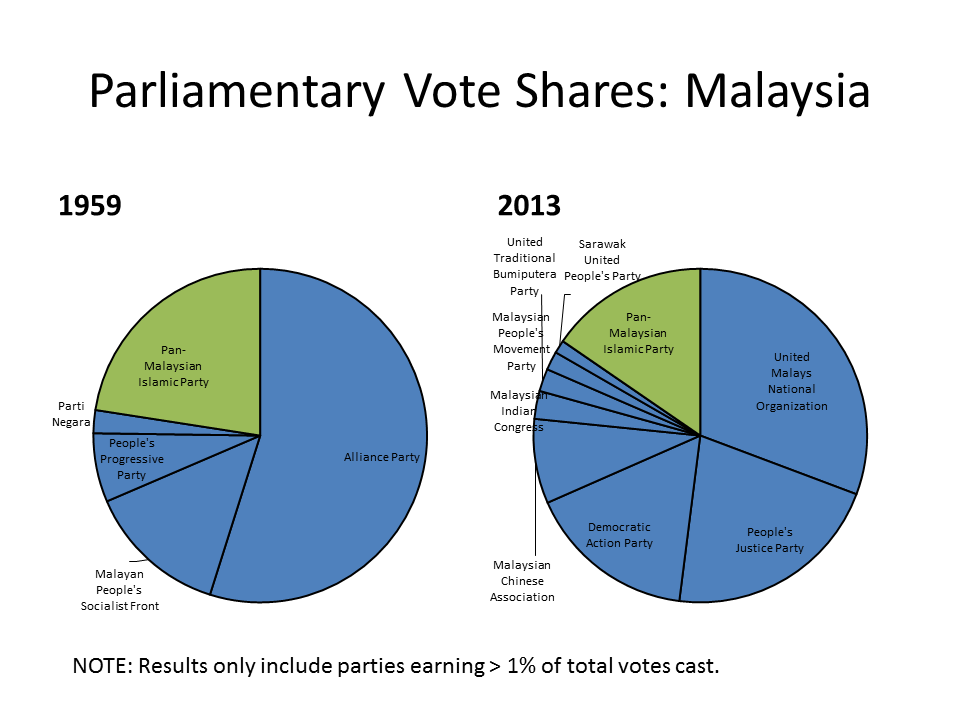
To my knowledge, this is the first time that the parallels between 1959 and 2013 have been highlighted this way, and also the first time that that continuity has been explicitly compared to Indonesia.
What’s the point I hope to make? Simply this: the popular conversation about Islam in Southeast Asia holds that Islamism is “on the rise.” These figures complicate that simple conclusion: they highlight that electorally, explicitly Islamist parties are not gaining ground—if anything, they are losing ground. If we are to argue that Islamism is on the rise, we must find a way to explain this. I have some ideas about how we might do that, but suffice it to say these ideas consider the rise of Islamism as a complex phenomenon which is interrelated with a lot of other concomitant social, economic, and political transformations.
This post also stems from a conversation I had while at a workshop at the American Center for Oriental Research last week. An audience member approached me after my presentation comparing Indonesia to Egypt and Tunisia, and insisted that Indonesia has a lot more Muslims than it used to. The exact quote: “87% Muslim? I don’t think so. Unless something has changed recently.”

 Tom Pepinsky