
I really enjoy thinking about how to present quantitative information in a visual format rather than in boring tables of digits. However, at the same time, I think that many common ways to visualize quantitative results in political science are actually misleading. How can I hold both of these views at the same time?
The answer is, because we use heuristics to interpret what the information presented in a figure means, and I think that these heuristics are often faulty. And this is more likely when we adopt a disciplinary conventions for presenting results in certain ways, such that these heuristics become so widely shared and automatic that we do not consciously think about them. In this way, I disagree somewhat with the conclusions in Kastellec and Leoni (ungated PDF) who argue that graphs enhance communication relative to tables. I think that graphical presentation of data can do this when we know that both the sender and the receiver speak the same language competently. I made this point some years ago in a presentation to Cornell graduate students (PDF).
The example that brings this to mind is the marginal effects plot, popularized by Brambor, Clark, and Golder (2006) (PDF). These are used to visualize how the effect of one variable varies according to the value of another variable. Like this.
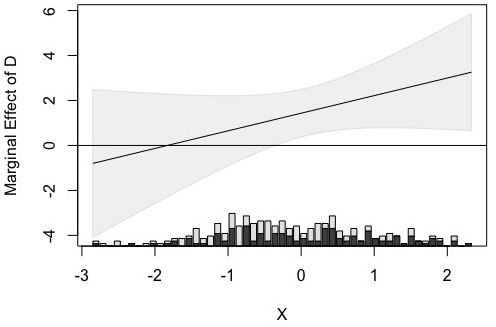
I’ve written up a little essay that illustrates how one common visual heuristic for interpreting these marginal effects plots can result in misleading inferences. Does this figure tell us that the effect of D depends on X? The answer may surprise you.
The problem here is not with the plot itself—the plot does not create information that would not be available if the same data used to draw the lines and bars were presented in a tabular format. The problem is also not the calculation of those lines and bars. The problem is the heuristic through which these are interpreted. One might say, “yes, don’t use that heuristic,” and I agree.
As a postscript, here is a slideshow that includes some of my favorite figures from my own published and unpublished work. I’m sure by some other objective standard (perhaps Tufte‘s) these are ugly, but I think they are effective and that is what I care about. And because you don’t have a ready-made heuristic about how to interpret them, it’s more likely that you’ll slow down and look at them.
 Tom Pepinsky