
My sociology colleague Kim Weeden recently shared her paper in Sociological Science (coauthored with Sarah Thébaud and Dafna Gelbgiser) entitled “Degrees of Difference: Gender Segregation of U.S. Doctorates by Field and Program Prestige.” It studies the relative degree of gender segregation across academic fields among earned U.S. doctoral degress, using statistical models that allow the authors to identify differences in segregation by relative program “prestige” (basically, by 1995 NRC rankings).
The paper is full of data, but one piece of information that might be of interest to political scientists is the result for U.S. political science doctorates, which appears only in a supplemental appendix as a line in a table. I’ve turned it into a figure, displayed below.
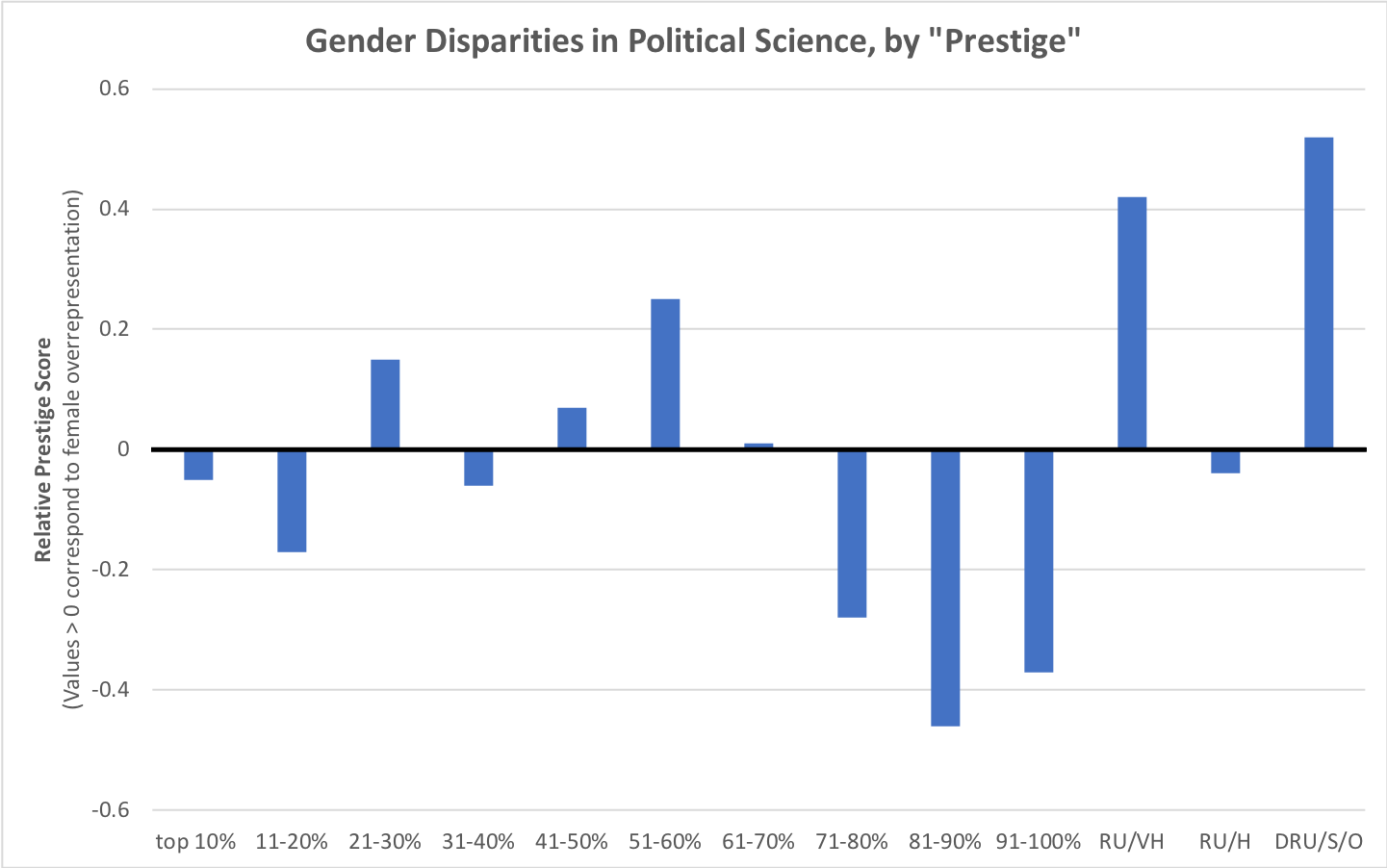
What we learn here is that among 2003-2014 doctoral degrees holders, men are slightly overrepresented at the top 10% of programs, more so at the top 20%, but especially so at the lowest ranked programs. We also learn that women are overrepresented at “unranked” political science PhD programs, which are the three categories at the right end of this figure.
The other piece of information that might be of interest is their estimate of the field-specific measure of prestige segregation in political science (which corresponds to Φ in Equation 3 in this article). The value for political science is .31, which is relatively low compared to most hard sciences and also many humanities fields like Comparative Literature, German, and Religion, in which men are much more overrepresented in the highest ranked programs. For results that are more easily interpretable to compare gendered prestige segregation across fields, you can look at the Panel B on Table S3 here (PDF).
These results, to reiterate, only look at who has completed a Ph.D. The authors have a very nice discussion of the possible mechanisms that might generate these results:
(1) sorting based on gender differences in readily observed indicators of ability (and their unobserved correlates), (2) sorting based on gender-biased self-assessments of ability, (3) self-selection based on gender-differentiated preferences for different program attributes that are correlated with prestige, (4) prestige-linked organizational strategies surrounding admissions, and (5) gender-specific attrition from graduate programs.
The fourth and fifth of these seem particularly interesting for current discussions within the field political science.
 Tom Pepinsky