
Many people living in non-democratic systems face a difficult personal decision when their regimes hold elections. Should they participate in the election, on the hope that doing so might overturn the regime by surprise, or that it might at least generate some sort of accountability from the regime? Or should they abstain, stay at home, to avoid being complicit in legitimating a regime that is fundamentally uninterested in democracy or popular voice and which has no intention of losing? As it turns out, we have few guides for helping us reason through this moral question, despite the fact that authoritarian regimes that hold elections are increasingly common around the world.
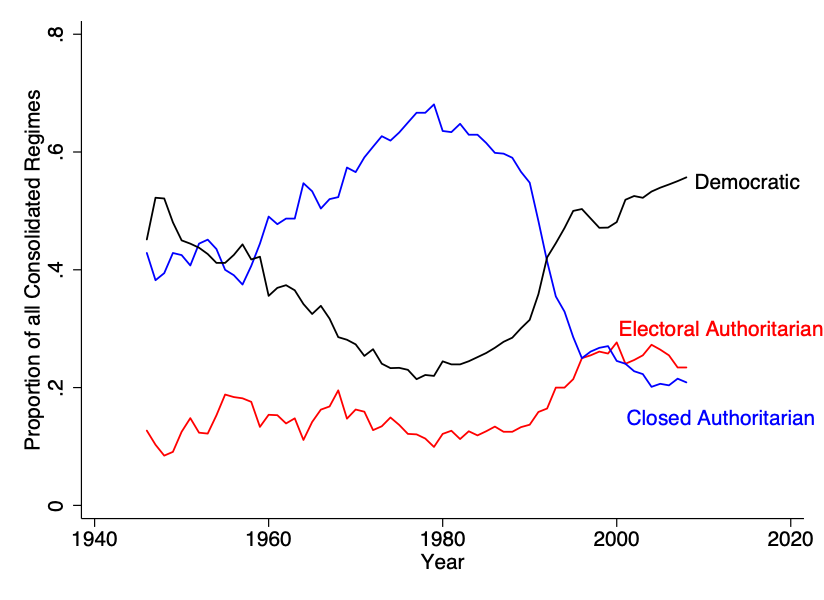
In a new working paper (PDF), Turku Isiksel and I provide a framework for helping us to resolve this tension. The starting point is that democratic theorists and political philosophers have devoted substantial effort (see e.g. here) to the question of the moral obligations to vote under democracy (either idealized or actually-existing democracies). But authoritarian elections are fundamentally different, and these differences undermine many of the arguments that might either justify or obligate citizens in democracies to participate in elections. Many of us believe that good citizens always vote in elections—but authoritarian elections are a different affair, and it might be the case that good citizens don’t vote in authoritarian elections.
So, should you vote in an undemocratic election? The short answer is it depends. The long answer is that the obligation to vote in an authoritarian context depends on background assumptions about what value we attribute to this particular form of political participation, the anticipated consequences of collective voice in an authoritarian regime, and expectations about whether democratic habitus under authoritarianism is a foundation for democratic citizenship some point in the future.
There’s lots more to chew on in the paper itself. Here is the abstract.
When accounting for why elections, voting, and political representation are meaningful and valuable practices, political theorists tend to assume that the political system in which these institutions occur is broadly democratic. However, authoritarian regimes also make use of these institutions. Furthermore, recent empirical research shows that elections in “hybrid,” “competitive authoritarian,” or “pseudo-democratic” regimes matter. They can stabilize authoritarian regimes by giving them the veneer of popular approval, although they can also provide opportunities for unseating incumbent regimes. Are the ethics of political participation—and, specifically, of voting—fundamentally different in non-democratic regimes? Do the same civic imperatives that support voting in democracies come out in favor of boycotts, abstentions, or even civil disobedience under electoral authoritarianism? Can citizens expect elections and electoral participation to increase the chances of a democratic transition? We argue that more complex moral considerations confront voters in authoritarian regimes compared to voters in democratic regimes, since the answers to these questions hinge in part on the role elections play in authoritarian states. We argue that a voter’s judgment must depend not merely on principled justifications for political participation but also on prudential considerations about the impact that electoral participation is likely to have on the regime’s longevity. We enumerate some of these considerations.
 Tom Pepinsky