
If you had to predict what kinds of advanced industrial economies would be most likely to contain the spread of COVID-19, would your answer be? For me, the key factors would be a strong state with an effective bureaucracy and the ability to compel citizens to comply with public health directives. Such states tend to favor social stability and cohesion over individual rights and liberties.
There are two ways that you might end up with such a strong state that favors stability over individual liberty. One is the “social democratic” model. The other is the “developmental state” model, pioneered by Japan and followed by Singapore, South Korea, and Taiwan.
As it turns out, you can see this in the data. I grabbed from the JHU github page the most recent data (as of this morning) on COVID-19 cases by country, and matched it with the data from Lane Kenworthy‘s new book Social Democratic Capitalism. If you simply correlate Kenworthy’s measure of social democracy (1980-2015) with the current case count as a fraction of population, you don’t find much. But if you take out South Korea and Japan (historically the developmental states) and Australia and New Zealand (islands), you get a very nice negative correlation between social democracy and confirmed COVID-19 cases.
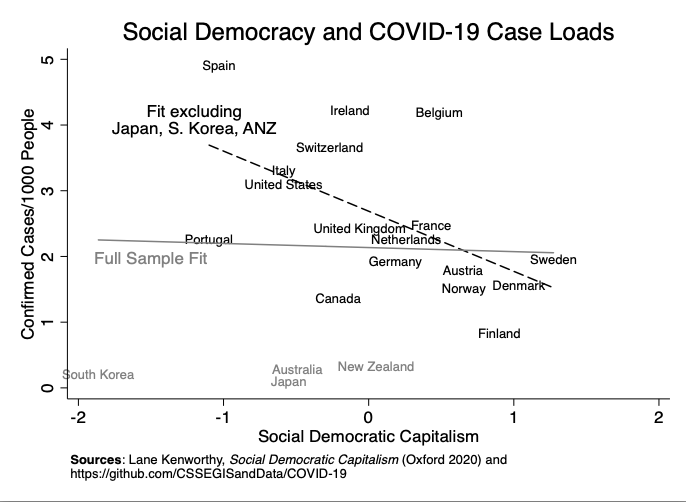
These results hold up (p < .05, N = 21, adjusted R2 = .48) in a regression that also controls for health spending, GDP per capita, and log of population. It helps to be a social democracy, a developmental state, or an island.
Note here how Sweden and Denmark are so close to one another, despite the former having famously rejected the most aggressive social distancing and government lockdown measures. This might suggest that there is something about social compliance rather than the policies that governments implement. But these results do tell us something important about what kinds of states manage to contain the spread of COVID-19. And it is interesting to speculate how different these results would be if we actually had comprehensive testing in countries like the United States.


 Tom Pepinsky