
Since March of this year, I have been working in collaboration with Shana Gadarian and Sara Goodman on a NSF-supported project to track how Americans are responding to COVID-19. We now have three rounds of survey data, having received the latest round just last night.
The first round of our survey took place very early in the pandemic. The second came at the height of the aggressive responses by the states in late April. And the third followed the mobilizations around #BlackLivesMatter in the wake of George Floyd’s murder, which also coincided with the gradual re-opening happening in most states. These three dates give us three nice snapshots of the state of American mass public opinion on COVID-19.
My previous posts (here, here, here) have focused on partisanship as one of the most important factors in explaining Americans’ public health behavior. I think that our expectation has always been that partisan differences would eventually disappear, as the pandemic spread beyond its first coastal hotspots to affect all Americans. Viruses do not respond to partisanship.
We are now four months into the COVID-19 pandemic, and there is no sign yet that partisan differences among Americans are disappearing. In some cases, they seem to be growing.
Look first at health behaviors. We’ve plotted below the average responses, by party and survey wave, to 10 questions about health behaviors (the last two we only added in Wave 2).
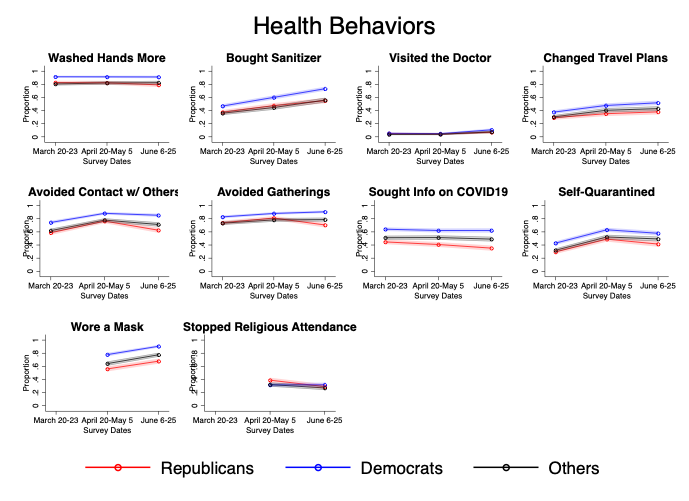
The first thing to note is that we do not see any instances of partisan convergence with the exception of our last item, on attending religious services. For all other behaviors, differences across parties are stable, or even growing. Look in particular at “Avoided Contact with Others” and “Avoided Gatherings,” where we see stability among Democrats and Others but declining rates of compliance among Republicans. These differences across waves by party—meaning that Democrats and Republicans have diverged over time—are highly statistically significant.*
We see a similar trend when we look at respondents’ worries. Although Americans of all partisan identities are getting less worried, this is particularly strong among Republicans.
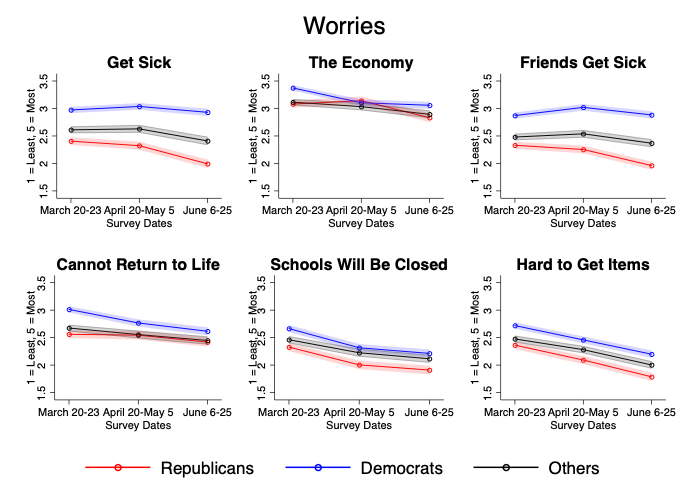
Note in particular the growing divergence between Democrats and Republicans in how worried respondents are about getting sick, or about their friends getting sick. The only area of partisan convergence that we identify is when it comes to worrying about not being able to go back to school, where Democrats are converging towards Republicans.
Finally, a selection of items about policy responses. Partisan differences are stable and growing throughout, but differences about opening back up again (should we “Cancel Everything”) are now strikingly large.
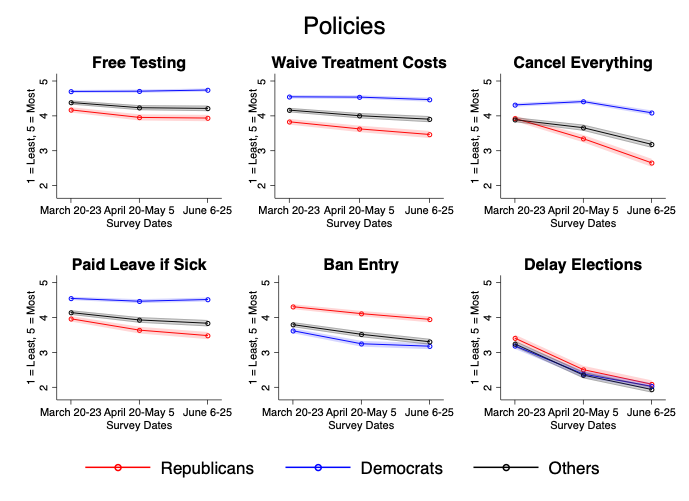
One bright spot of partisan convergence is on elections. There have never been large differences across parties in whether or not respondents want to delay elections in response to COVID-19. But we can see here that Americans as a whole—regardless of partisanship—are steadily becoming much less willing to delay elections. It’s interesting to think why this might be: perhaps Republicans don’t want to delay elections because they don’t see a big public health concern, whereas Democrats don’t want to delay elections because they think that they will win them. Whatever the reason, it is good that there is not an emerging partisan divide on delaying elections in response to COVID-19.
What is ominous, in my view, is that we see growing partisan divides about whether or not people are worried about getting sick, whether or not they are staying away from social gatherings, and whether or not they want to open the economy back up again. These differences seem to me to have direct implications for public health in the United States.
Stay tuned for more.
NOTES
* We test the significance of these differences by interacting party identity with survey wave in a difference-in-differences framework. Because this is a panel, we also include survey-respondent fixed effects in these models, which amounts to a very conservative empirical strategy.
 Tom Pepinsky