Category: Politics

  • This Just In: A Political Commentator is Wrong about Political Science

    Via Henry Farrell at the Monkey Cage, I came across an essay in the Weekly Standard entitled “Is Political Science Dying.” Stephen Hayward, a visiting fellow at Pepperdine Law School, makes the case that political science is too divorced from politics, too mathematical, too model-based and abstract. The motivating observation is a good one: given massive interest in contemporary politics, why aren’t students flocking to political science?

    one reason is that the fundamental questions of justice have either gone missing from most political science curricula, or more often are only anemically discussed. This is the plague of the social sciences, where issues of justice are reduced to the category of “normative” questions, which, being subjective, are not treated seriously. They are not even much discussed in many classes. It might be more accurate to call them the “anti-social sciences.”

    Farrell takes him to task on the evidence that he brings to bear: there’s not a lot of evidence that declining enrollments at Stanford are representative of the discipline, his sample of anecdotes is skewed, and there are plenty of other good explanations (like the collapse of the legal job market) that might explain the same trend.

    One might also wonder what exactly a political commentator with a PhD in American studies who teaches(?) at a law school knows about what happens inside of the undergraduate political science classroom. Or puzzle at the claim that students “flock to radical courses.” Our humanities friends would be delighted if this were true.

    Those points aside, here is another view.* What if the problem is that political science as taught isn’t technical enough?

    Here is how this argument would work. College students understand (albeit imperfectly) the labor markets that they face upon graduation. College is expensive, loans are burdensome. This creates an incentive to obtain skills in college. Model-based disciplines that teach abstract thinking in a technical framework have the benefit of conveying the perception that there are skills to be learned, and that those skills are marketable in the knowledge economy. The issue with faculty such as me is that we keep prattling on about justice on the anniversary of the Indonesian killings, and students think they need to develop some hard skills. We should to be giving them courses with titles like Strategic Thinking and Non-Market Strategy in Asia, and exposing them to coding, data management, and analytics.

    I can’t test this argument in a way that Henry Farrell (or I) would prefer, not in a way that supports a causal argument. But I can give impressionistic evidence, in the form of three questions.

    1. Do we live in a higher education landscape where technical training (STEM, etc.) is viewed as legitimately and self-evidently the route to both individual career success and national prosperity?
    2. Is economics collapsing in enrollment?
    3. Are the critical humanities rising in enrollment?

    If the answer to these three questions is YES-NO-NO, then Hayward is, plausibly, exactly wrong about political science. It’s not proof, and I am in no means in favor of actually turning political science into economics. But it might help us to diagnose exactly why Hayward has the impression that political science is in trouble.

    NOTE

    * This view is by no means representative of the department where I teach, or of my employer.

  • Islam and Violence: Why “Religiosity” is the Wrong Question

    In the wake of the horrible mass shootings in San Bernardino by one Syed Farook, media attention and commentary has turned immediately to the question of his religiosity. Knowing whether or not Farook has become “more religious” recently, the logic goes, might help to explain why he and his wife committed such an unspeakable crime.

    The danger in this line of thinking is that it presumes that religiosity or piety has something to do with radicalism or violence. Such thinking risks alienating or stigmatizing pious Muslims, as if piety is itself a risk factor or leading indicator of violent behavior. In point of fact, the question of whether pious Muslims are violent Muslims is an empirical one. There is very little data available that can help us to answer this question, but together with Bill Liddle and Saiful Mujani, I have collected some data from Indonesian Muslims that can shed light on whether piety indeed is associated with radicalism and violence.

    In 2008, we collected survey data from a representative sample of Indonesian Muslims on piety and political beliefs. In our larger book project (nearly complete) we use these data to formulate new questions about the way that individual religious belief and practice is related to political behavior. Indonesia is a good context to investigate such questions because it is the world’s largest Muslim country, and it is hope to a breathtakingly diverse range of beliefs and practices, from syncretism to Salafism and beyond. One of our main innovations is to construct an index of individual piety that enables us to locate individuals along a spectrum from those who report that they are Muslims but who do not practice their faith to those who report consistently the highest level of religious beliefs and behaviors. Our book project contains lots more about the index and what it means, but suffice it to say that this index does not assume that piety has a political or radical element. We also collected data on several indicators of radical belief or action, including whether or not individuals had participated in the stoning of adulterers, whether they thought that apostates should be murdered, whether they had participated in mob actions destroying places that sell alcohol, and others.

    That allows me to ask, in a very straightforward manner, are pious Muslims more likely to be radical or violent?

    First, the basics. Reported levels of participation or support for violence or radicalism are very low, around the 10% level. Few Indonesian Muslims support stoning adulterers or killing apostates. But such statistics—often used as evidence that Islam is not violent or radical in general—do not help with this question. What I want to know is, are Muslims who do support violence or radicalism more pious? That’s the Farook question: if we discovered him to have become more religious, does that tell us that he would be more likely to support radicalism or violence?

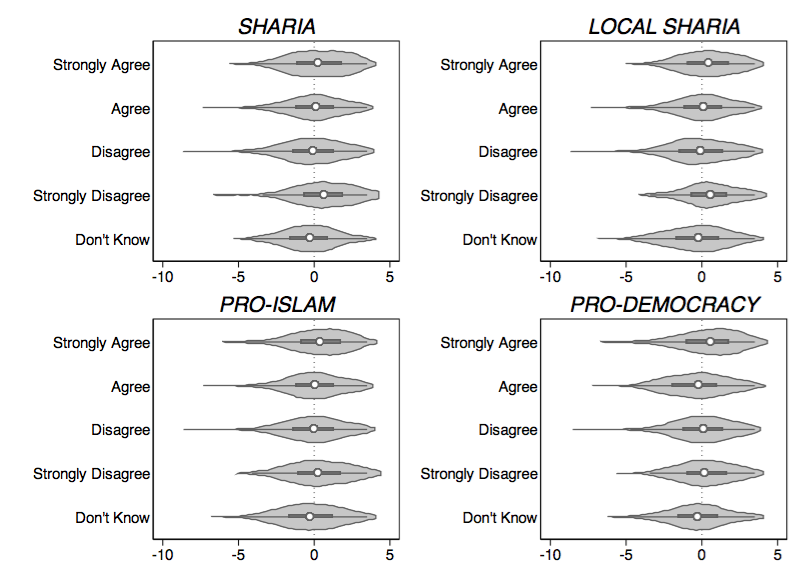
    To answer that question, look at the figures below. These are violin plots: they show the distribution of a variable alongside its median and interquartile range. Here, I show the distribution of our measure of piety (positive numbers are more pious, negative numbers are less pious) broken up by whether or not a respondent reports support for radical Islamic views (top two) or participation in violent activity (bottom two).
    violin_radicalism
    To read these, pay attention to both the spread of the values of piety (the gray regions) and the median values (the white circles). Here is what we learn: the median Indonesian who strongly agrees that the Bali bombing was justified is less pious than the median Indonesian who strongly disagrees. When it comes to killing apostates, the median among those who strongly agree and strongly disagree are equally pious. Combine that with the fact that there are far more Indonesians who oppose radicalism than there are who support it, and we can conclude that knowing how pious a Muslim is gives us no information about his or her support for radical Islamic beliefs.

    When it comes to actions, we do learn that those who report having stoned adulterers are more pious than those who report that they would never do this; we also learn though, that those who report having destroyed a bar or other establishment selling alcohol are less pious than those who report that they would never do this.

    These kinds of patterns also show up when we study support for political Islam. The plots below represent support for implementing Islamic law in Indonesia (SHARIA), support for implementing Islamic law in a region of Indonesia (LOCAL SHARIA), support for Islam playing a greater role in politics more generally (PRO-ISLAM), and support for democracy (PRO-DEMOCRACY).
    violin_politicalislam
    As a rule, both the most pro-Islam and the least pro-Islam, and the most pro-democracy and less pro-democracy, are more pious than others. Indeed, opponents of sharia are the most pious, on average, among Indonesian Muslims.

    The takeaway from these results is simple: Muslim piety is important, but it does not predict radicalism or violence. Whatever link there is between piety and violence and radicalism is certainly not simple or unconditional. Pundits, commentators, and ordinary citizens the world over should be mindful that the trope linking religious belief and practice to radical beliefs and actions is a claim, maybe a possibility, almost certainly a bias. It is not a fact.