Category: Politics

  • Islam and Violence: Why “Religiosity” is the Wrong Question

    In the wake of the horrible mass shootings in San Bernardino by one Syed Farook, media attention and commentary has turned immediately to the question of his religiosity. Knowing whether or not Farook has become “more religious” recently, the logic goes, might help to explain why he and his wife committed such an unspeakable crime.

    The danger in this line of thinking is that it presumes that religiosity or piety has something to do with radicalism or violence. Such thinking risks alienating or stigmatizing pious Muslims, as if piety is itself a risk factor or leading indicator of violent behavior. In point of fact, the question of whether pious Muslims are violent Muslims is an empirical one. There is very little data available that can help us to answer this question, but together with Bill Liddle and Saiful Mujani, I have collected some data from Indonesian Muslims that can shed light on whether piety indeed is associated with radicalism and violence.

    In 2008, we collected survey data from a representative sample of Indonesian Muslims on piety and political beliefs. In our larger book project (nearly complete) we use these data to formulate new questions about the way that individual religious belief and practice is related to political behavior. Indonesia is a good context to investigate such questions because it is the world’s largest Muslim country, and it is hope to a breathtakingly diverse range of beliefs and practices, from syncretism to Salafism and beyond. One of our main innovations is to construct an index of individual piety that enables us to locate individuals along a spectrum from those who report that they are Muslims but who do not practice their faith to those who report consistently the highest level of religious beliefs and behaviors. Our book project contains lots more about the index and what it means, but suffice it to say that this index does not assume that piety has a political or radical element. We also collected data on several indicators of radical belief or action, including whether or not individuals had participated in the stoning of adulterers, whether they thought that apostates should be murdered, whether they had participated in mob actions destroying places that sell alcohol, and others.

    That allows me to ask, in a very straightforward manner, are pious Muslims more likely to be radical or violent?

    First, the basics. Reported levels of participation or support for violence or radicalism are very low, around the 10% level. Few Indonesian Muslims support stoning adulterers or killing apostates. But such statistics—often used as evidence that Islam is not violent or radical in general—do not help with this question. What I want to know is, are Muslims who do support violence or radicalism more pious? That’s the Farook question: if we discovered him to have become more religious, does that tell us that he would be more likely to support radicalism or violence?

    To answer that question, look at the figures below. These are violin plots: they show the distribution of a variable alongside its median and interquartile range. Here, I show the distribution of our measure of piety (positive numbers are more pious, negative numbers are less pious) broken up by whether or not a respondent reports support for radical Islamic views (top two) or participation in violent activity (bottom two).
    violin_radicalism
    To read these, pay attention to both the spread of the values of piety (the gray regions) and the median values (the white circles). Here is what we learn: the median Indonesian who strongly agrees that the Bali bombing was justified is less pious than the median Indonesian who strongly disagrees. When it comes to killing apostates, the median among those who strongly agree and strongly disagree are equally pious. Combine that with the fact that there are far more Indonesians who oppose radicalism than there are who support it, and we can conclude that knowing how pious a Muslim is gives us no information about his or her support for radical Islamic beliefs.

    When it comes to actions, we do learn that those who report having stoned adulterers are more pious than those who report that they would never do this; we also learn though, that those who report having destroyed a bar or other establishment selling alcohol are less pious than those who report that they would never do this.

    These kinds of patterns also show up when we study support for political Islam. The plots below represent support for implementing Islamic law in Indonesia (SHARIA), support for implementing Islamic law in a region of Indonesia (LOCAL SHARIA), support for Islam playing a greater role in politics more generally (PRO-ISLAM), and support for democracy (PRO-DEMOCRACY).
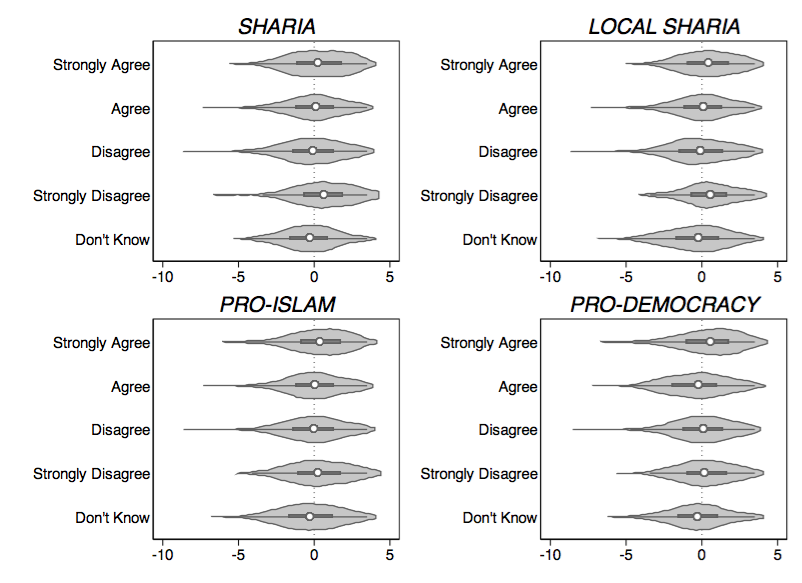
    violin_politicalislam
    As a rule, both the most pro-Islam and the least pro-Islam, and the most pro-democracy and less pro-democracy, are more pious than others. Indeed, opponents of sharia are the most pious, on average, among Indonesian Muslims.

    The takeaway from these results is simple: Muslim piety is important, but it does not predict radicalism or violence. Whatever link there is between piety and violence and radicalism is certainly not simple or unconditional. Pundits, commentators, and ordinary citizens the world over should be mindful that the trope linking religious belief and practice to radical beliefs and actions is a claim, maybe a possibility, almost certainly a bias. It is not a fact.

  • Bela Negara and the Re-Militarization of Indonesia

    Indonesia has a long history of military involvement in politics. Indonesia fought a bloody war of independence against the Dutch after WWII, and after independence the army—one of the few institutions that could claim to be truly national—remained a key political force. And of course, the events of 1965-66 brought to power General Soeharto, who would rule Indonesia as president until 1998. Under Soeharto, the Indonesian armed forces (ABRI) developed an ideology of dwifungsi [= dual function], which held that the military was both a military and a sociopolitical force. This did not merely justify, it actually required active involvement of the Indonesian military in political and social life. During the New Order, the prominent journal Indonesia frequently published articles that simply summarized what was going on in the Indonesian military. That is how important developments in the military were understanding Indonesian politics. (For academic treatments, see Crouch and Sundhaussen, among others.)

    Democratization in 1999 set in motion substantial reforms to the Indonesian military which made significant progress towards converting the military to a civilian role. These included separating the military from the police force, removing reserved seats for the military from the People’s Representative Council, and other changes. It is very clear that Indonesia’s military never “got out of politics” or “went back to the barracks,” if for no other reason than the fact that significant portions of the military’s budget still do not come from the official state budget. Instead, funding is generated by the military itself. But Indonesia’s military reforms did make substantial progress on a number of fronts. The best work on the nuances of this period is by Mietzner.

    In recent years, however, progress has stalled, and it is evident that Indonesia’s military—either as a corporate body, or among important leaders—does continue to insist that its interests extend far beyond a traditional “Western” notion of defense. The new program Bela Negara, launched last week by Defense Minister Ryamizard Ryacudu, marks the most visible sign yet of the re-militarization of Indonesian politics and society.

    By re-militarization I do not mean that the Indonesian military is entering domains in which it had left; as observed above, in most domains, it never left in the first place. Rather, I mean two things. One, a visible reassertion of military prerogative in domains in which the military has been relatively inactive, or in which activities have remained out of the public eye. And two, a revival of a New Order-era language of defense against imagined threats, one that implicates all Indonesians in a common project of maintenance of the state and nation.

    What I find particularly meaningful is the effort to deny that a program called “Defend the State,” and proposed by the Department of Defense, amounts of militarization. This effort, to non-Indonesians, is simply bizarre. Here is a press release.

    jelas bahwa bela negara bukanlah wajib militer, bukan militerisme, bukan militerisasi dan bukan pula sebuah usaha pembelaan atau pertahanan negara secara fisik dalam menghadapi ancaman militer.

    Akan tetapi, sebuah upaya membangun karakter bangsa yang menyadari hak dan kewajibannya untuk berbuat yang terbaik bagi bangsa dan negara, guna menjamin kelangsungan hidup bangsa dan negara dalam menghadapi multidimensionalitas ancaman yang membahayakan kedaulatan negara, keutuhan wilayah dan keselamatan bangsa.

    it is clear that “defend the state” is not a military service requirement, nor militarism, not militarization, not even an exercise to defend the state physically against a military threat.

    Rather, it is a way to develop national character that recognizes the rights and responsibilities to do good for the nation and the state, to assure the continuity of the nation and the state in confronting the multidimensional threats that endanger state sovereignty, territorial integrity, and the well-being of the nation.

    There is something so very New Order about this insistence that using the military to inculcate military values does not amount to militarization. Look at the picture that accompanies the above press release.
    4421babbd9f579520b8945d05fc8e741
    One might be forgiven for thinking that this is just a touch militaristic.

    Still, Bela Negara draws on some common themes that aren’t just about the Indonesian military. One is a conception that pervades Indonesian political life about national character as an ideological project. One sees this in Prabowo Subianto’s campaign, in aspirations for a political culture that is adab [= civilized], and also in Jokowi’s “Mental Revolution.” Mass political culture in all of these different examples is something that must be cultivated (perhaps by politicians), and that is somehow currently deficient.

    A second theme is one of total people’s defense, or pertahanan rakyat semesta. A former Cornell master’s student, John Lee, wrote a compelling thesis on the origins of the institutional culture of the Indonesian armed forces, arguing that its norms, values, and self-understandings emerged under the PETA [Pembela Tanah Air, = defenders of the homeland] units established by the Japanese under the Second World War, but that the model for PETA was in fact the Imperial Japanese Army, in particular the experiences of the Kwantung Army in Manchuria. Here is how he described the Imperial Japanese Army’s relationship to Japanese society in the late 1800s:

    As Japanese society quickly became more educated, industrialized, and thus increasingly diverse and socially mobile, military leaders developed an obsessive fear of national disunity…

    Military leaders also exploited the natural tendency toward cohesion and cooperation in rural village life. The funding for the militarized local organizations came from the community, not the national government, reinforcing each village’s financial and psychological sense of investment in the military. Responsibilities for civic services such as fire departments were given to local military reserve units, so that the line between civil and military functions often disappeared.

    You can easily see the parallels with Indonesia under the New Order. Total people’s defense emerges in the 1950s as a central principle in Indonesian military doctrine, and today shows up as the term hankamrata (pertahanan keamanan rakyat semesta), which adds a concept of security or safety [= keamanan] but does not change the meaning.

    Re-militarization as described above is a qualitatively different thing than the persistence of odious paramilitaries like Pemuda Pancasila, the military protecting private mining activities, forbidding public discussion of the killings of 1965-66 at a writer’s workshop, or the invocation of vague ill-defined threats to explain restrictions on movement and speech. Re-militarization is a mobilizational project predicated on, first, legitimating the rejection of a boundary between military and national interests, and second, mass participation in an undefined threat to both state and nation. Both legitimation and participation elements of that project became contested in ways never before possible after 1999.

    And that is important. One thing that does distinguish contemporary Indonesia from the New Order period is the possibility of discussion and criticism. Critics of this new and still fuzzy Bela Negara program do exist and are vocal: see here and here. (On the other hand, Prabowo likes it.) So it is not right to say that re-militarization has happened, or is complete, or is inevitable; it is none of those things. I am sure that those analysts of military and politics in Indonesia can tell us a lot more about the deep politics of re-militarization, and the extent to which programs like Bela Negara are more of the same, something new, or simply huff and bluster.