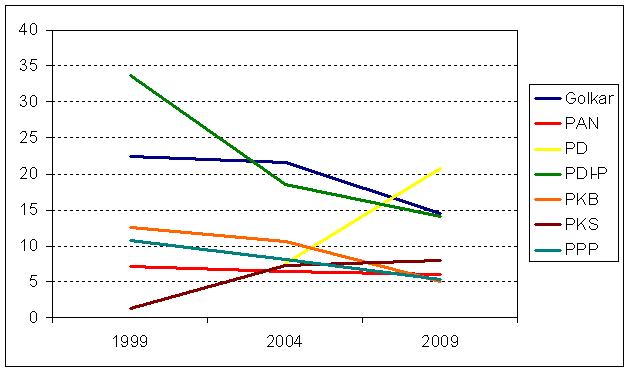
Indonesian politics is at its most interesting right now. The April 9 legislative elections appear to have returned a solid victory for the president's party (the Democrat Party, PD), with just over 20% of the vote. The next two highest vote-getters are the Indonesian Democratic Party of Struggle (PDI-P) and the Golkar Party, each with around 15% of the vote. After that, there is a set of smaller parties, which we can divide into those that are officially Islamist (PPP, PKS) or have strong links to Islamic mass organizations (PAN, PKB) and some nationalist parties based around former military leaders (Gerindra and Hanura). There might be a couple others that meet the minimum threshold to be seated in parliament. The official results come out Saturday.
(There have been widespread allegations of two kinds of irregularities in these elections. One, which is probably true, is that there were huge problems with voter registration, such that millions of voters showed up and their names were erroneously left off of the registration lists. The second, which seems much less likely, is that PDI-P earned many more votes than initial electronic counts have said. The manual recount is ongoing and for the time being looks to match the electronic count.)
Here's where things get interesting. A party needs to have 20% of the seats in the parliament (or 25% of the popular vote) to nominate a candidate for president. The presidential elections happen in July. The only party with enough seats is PD, which will nominate its candidate who is also the sitting president, Susilo Bambang Yudhoyono. SBY is very popular right now and looks like he's going to win. All other parties failed to meet the minimum threshold. So, they need to have to form coalitions with one another to be able to contest the presidency. This is where we see politics creating some strange bedfellows.
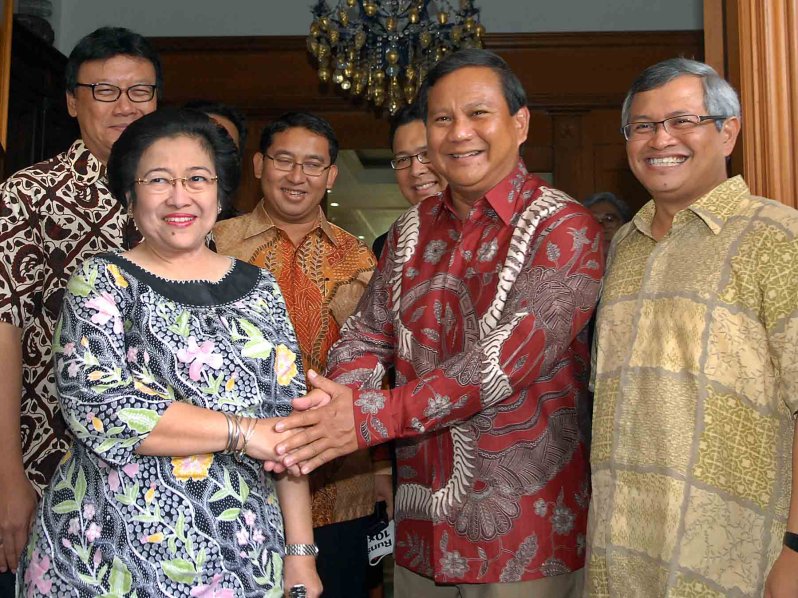
The strangest bedfellows of all come from the possibility that PDI-P will ally with Gerindra. To understand why this is strange, or more accurately "sad", some history is in order. PDI-P's head is Megawati Sukarnoputri, former president and as her last name suggests, one of Sukarno's daughters. Gerindra's head, Prabowo Subianto, is a retired general and Soeharto's son-in-law. So that's interesting.
Megawati, Prabowo, and awkward smiles

But what's more amazing for longtime Indonesia followers is the history that Mega and Prabowo have with one another. As the New Order drew to a close, Mega (as head of PDI-P's predecessors, PDI) was an important opposition figure who railed against the system. Her ideology is basically social democratic, with a heavy dose of traditionalism and social justice and lots of Javanese imagery to boot. Prabowo, on the other hand, was a high-ranking military official who spend much of his time engineering brutal repression of PDI and other leftist threats to the regime. What's more, Prabowo almost certainly played a central role in the May 12 Trisakti massacre, and possibly also in the May 13-14 riots, both in the final days of the New Order in 1998. He certainly also was responsible for the irregular disappearance of certain pro-democracy activists in April 1998, and most damningly, of running terror squads in what was then the Indonesian province of East Timor in the 1990s. That he might be nominated as Mega's VP is to be completely unbelievable. Moreover, Prabowo's history and the tensions between him and Mega have really not been talked about in the mainstream media here. And even more unbelievable is the way that PDI-P members are discussing this. According to them, Prabowo is attractive because he's a "fighter." Yeah. In that he has blood on his hands.
There are some other interesting pairings too. The current VP, Jusuf Kalla of Golkar, looks like he'll choose as his running mate Wiranto, another former general with blood on his hands, Wiranto, the head of Hanura. This isn't so strange, though: Golkar was the ruling party under Soeharto, and Wiranto was another top general who vied for power with Prabowo. Wiranto came in third in the 2004 presidential elections, and despite his history has been relatively (and I use this term carefully) moderate since the end of the New Order. (I mean this in the sense that he didn't try to engineer a coup or to halt democratization, which we can't say of all military figures in post-authoritarian contexts.) You could imagine Kalla-Wiranto as being a sort of center-right law and order type of ticket. However, it's clear that a Kalla ticket has no chance to defeat SBY. It seems almost irrational to me that he would try to run on his own rather than just sticking with the VP slot with SBY.
So if Kalla runs for president, this leaves SBY needing a new VP. And here, it looks like the Islamic parties are positioning themselves to provide the candidate. What is interesting is what this means. Remember, PD doesn't need any particular party to form a coalition in order to nominate SBY, whereas Golkar and PDI-P do. So PD has the power to offer worse terms to a VP candidate's party than they would get in forming a coalition with the other parties. The Islamic parties, in other words, have to sacrifice more to get into the coalition. It's going to be interesting to see what they sacrifice. The elections were a huge disappointment for them, on a whole, as no parties got stronger and the percentage of votes going to Islamic parties dropped from around 38% to 25%. It will be a coup for them to get the VP spot, but remember, it looks like they're only going to be able to get that spot because they are so weak. In the press releases I've seen, the Islamic parties have emphasized that they think they did poorly because they didn't communicate their core messages of economic empowerment and clean government. They also have said that the coalition with PD makes sense because their economic platforms are so similar: increase foreign and domestic investment while protecting the poor and creating upward mobility for all.
But at the same time, observers will have to keep an eye on this. It's the more hardline Islamic parties that are the ones that look to be most likely to get the VP nod. This is going to get a lot of negative attention from those who fear the rise of political Islam in Indonesia. It remains to be seen if they will have to abandon their core Islamic principles to form this coalition with PD.

 Tom Pepinsky