Category: Language

  • Indonesian, the Language Killer

    A linguist friend once described Bahasa Indonesia, the national language of Indonesia, as “the language killer.” By this he meant that the spread of Indonesian has had a remarkable impact on the thousands of local languages in Indonesia, with little or no official status. One amazing consequence of this is that languages like Javanese, with over a hundred million speakers, may actually be endangered.

    The social aspects of Indonesian’s spread are a rich area of study. Here is one illustration: using a .1% sample of the 2010 Indonesian census, I have modeled the probability that an ethnic Javanese respondent speaks Indonesian at home as a function of gender, age and age squared, whether he or she lives in an urban or rural area, and the percentage of the respondent’s district who is ethnic Javanese. Below I plot the predictive margins: estimates of the probability of speaking Indonesian for various interesting combinations of these variables.

    indonesian the language killer

    The findings are actually a bit reassuring: in heavily Javanese areas (basically, Central and East Java) Javanese is being spoken at home by children. But as Javanese move outside of these regions—and especially in urban areas—the probability of speaking Indonesian jumps dramatically. And the curves by age are predictions of the future: children who speak Indonesian at home will almost certainly not be able to teach their children Javanese.

    Still, Indonesian will have a long way to go to kill Javanese, because most Javanese still live primarily among other Javanese and primarily in rural areas, as the chart below illustrates.
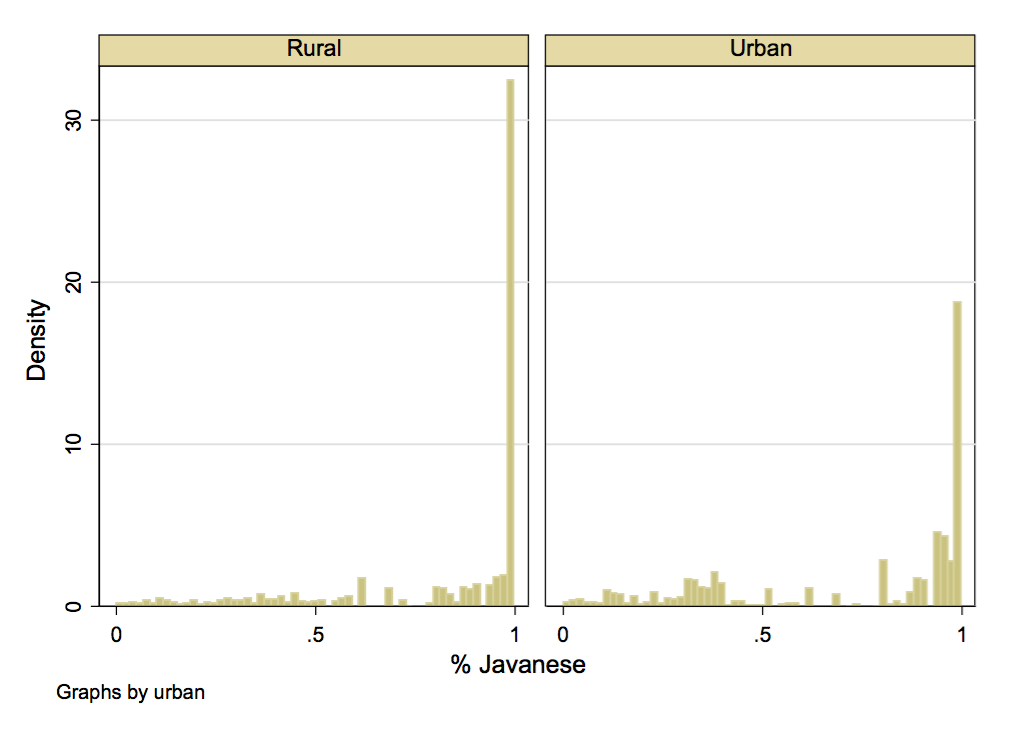
    Javanese by district

    So long as this is the case, Javanese will be safe. Unfortunately, the Indonesian census records neither bilingualism nor linguistic competence; if it did, we could learn the extent to which bilingualism in Indonesian is degrading competence in Javanese. That is the frontier for research—how Indonesian kills them softly.
  • Unit Homogeneity Within and Across Countries

    I had the following twitter exchange with Fabrizio Gilardi with reference to my previous post on subnational comparative research.

    I disagree that the unit homogeneity assumption is “more likely to hold” within countries than across countries as a general statement. (I also don’t think that we can ever “show” and assumption is true or false, we can only argue that it plausible or useful.) It all comes down to the research question, and in some cases assuming unit homogeneity actually makes a lot more sense across national boundaries. Here are some examples.

    1. Dan Posner‘s article on Chewas and Tumbukas in Malawi and Zambia. Here, the design rests on the assumption that ethnic groups are comparable across national boundaries, and that the national boundary captures a variable which varies at the national level: the relative sizes of ethnic groups.
    2. Michael Ross‘s book on rent seizing and tropical forest resources. The design is a focused comparison of four governments: Indonesia, Sabah, Sarawak, and the Philippines, each confronting a similar problem (“resource booms” in tropical hardwoods). Of note here is that Sabah and Sarawak are states within Malaysia compared with national governments in Indonesia and the Philippines. Sabah and Sarawak are not compared with Peninsular Malaysian states because we have no reason to expect that they would respond similarly to timber booms, not least because their tropical forest resources pale in comparison.

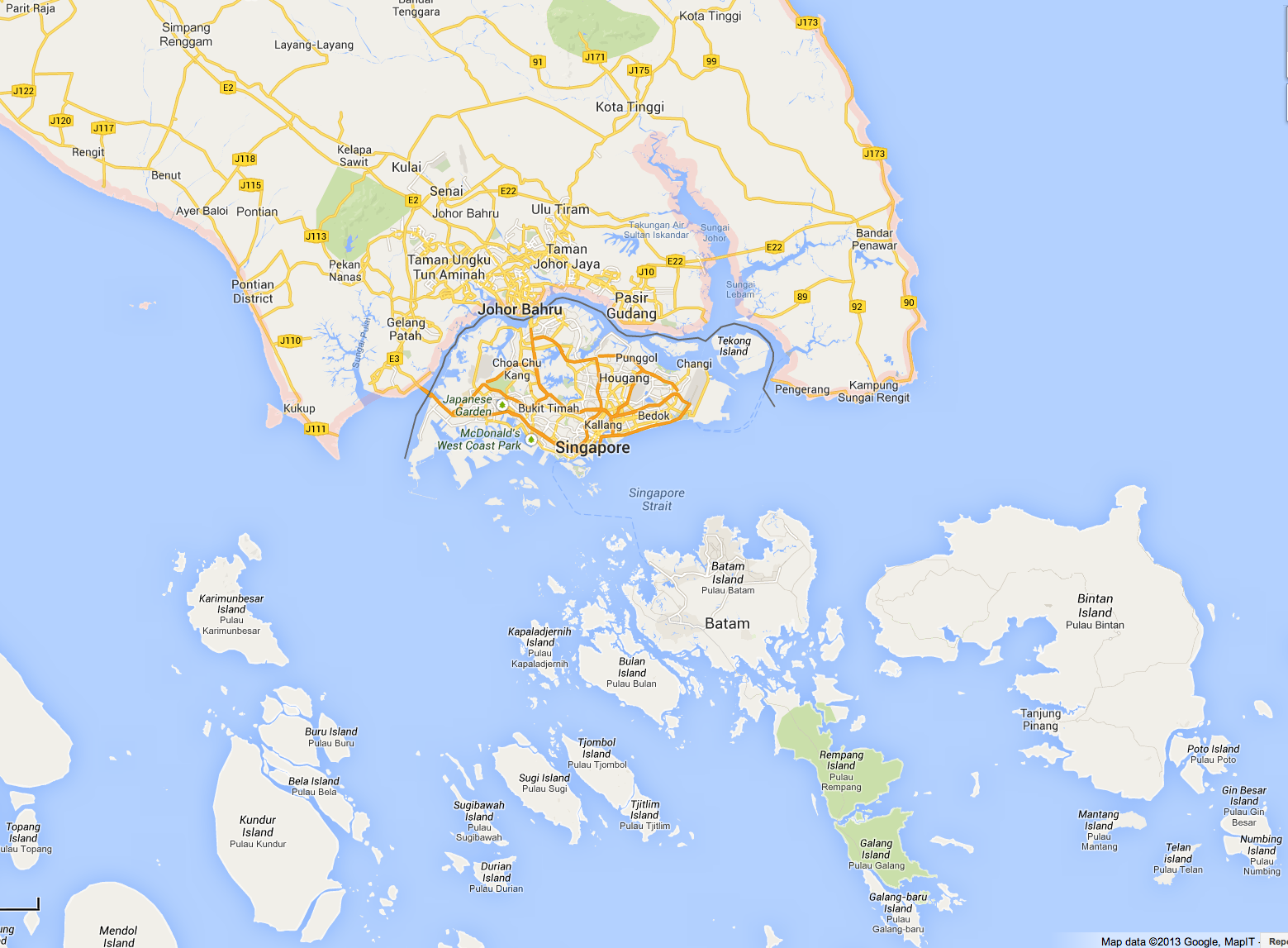
    You might imagine other examples. I’ve often wondered about the effects of national language regimes on the development of Malay languages; for that, comparing Riau Malay to Johor Malay would make good sense. This map clarifies the matter:

    Screen Shot 2013-11-27 at 9.37.16 AM

    Comparing Johor Malay to Kelantan Malay would not work (they both in the same country, so no variation in the language regime), and comparing Johor Malay to Pattani Malay would not either (they are different countries but starting from very different dialects prior to the language regime’s formation).

    The takeaway is that unit homogeneity is always an assumption, one that only can be adjudicated with reference to the research question at hand. Should we assume that Sabah has the features that make it comparable to the Philippines to study forest management? Should we assume that Chewa-ness and Tumbuka-ness are comparable ethnic categories? Should we assume that Johor Malay and Riau Malay were comparable prior to the formation of Bahasa Indonesia and Bahasa Malaysia? All of these seem reasonable to me.