Category: Islam

  • Muslim Democracy: Why Not Look to Indonesia?

    John Owen has a recent essay at the Monkey Cage entitled “What history says about the prospects for Islamic democracy.” It makes the case that democracy is entirely feasible in Muslim countries, but it may be unlikely in the near future.

    The West’s past suggest that, for a hybrid form of government to spread and flourish in a region, it must take hold in a large and influential country that interacts significantly with that region and is manifestly stable, secure and prosperous over time.

    Those large and influential countries for the West were Great Britain and the United States. Owen is skeptical that such a country exists right in the Muslim world. Not even Indonesia, the world’s most populous Muslim country and a consolidated democracy.

    Looking at the Middle East and its borderlands, it is difficult to find an exemplar of Islamic democracy. Indonesia, Malaysia and Bangladesh are all majority Muslim democracies, but their interactions with Middle Eastern states are too slight to qualify them as exemplars.

    I’m not sure how to parse Owen’s “interactions with Middle Eastern states are too slight.” A more pointed way to put it might be that Muslims in the Middle East don’t think that Indonesia counts.

    Stark, perhaps. Yet, it helps us to focus on what Owen is really dealing with in his essay. Owen is not writing about Islamic democracy, he is writing about Middle Eastern democracy. The elision of Middle Eastern political issues with the foundational questions of Islam’s compatibility with democracy is common, of course. But we must be sure that we realize it when we see it. And to remember that when it comes to Islam and democracy, yes, Indonesia counts.

    (For tangentially related writing on this topic, check out my recent essay “Political Islam and the Limits of the Indonesian Model” [PDF])
  • How Piety Varies among Indonesian Muslims

    Here are some figures from my current book project on piety among Indonesian Muslims. We—Bill Liddle, Saiful Mujani, and I—have constructed a measure of piety at the individual level that encompasses beliefs, rituals, and behavior. We rely heavily on this indicator to show that individual level piety among Indonesian Muslims ….

    does not explain any of the phenomena that we set out to explain: social identity by aliran, support for Islamic law or political Islam, support for Islamist parties, the use of Islamic financial services, or greater engagement with the Muslim world relative to other world regions

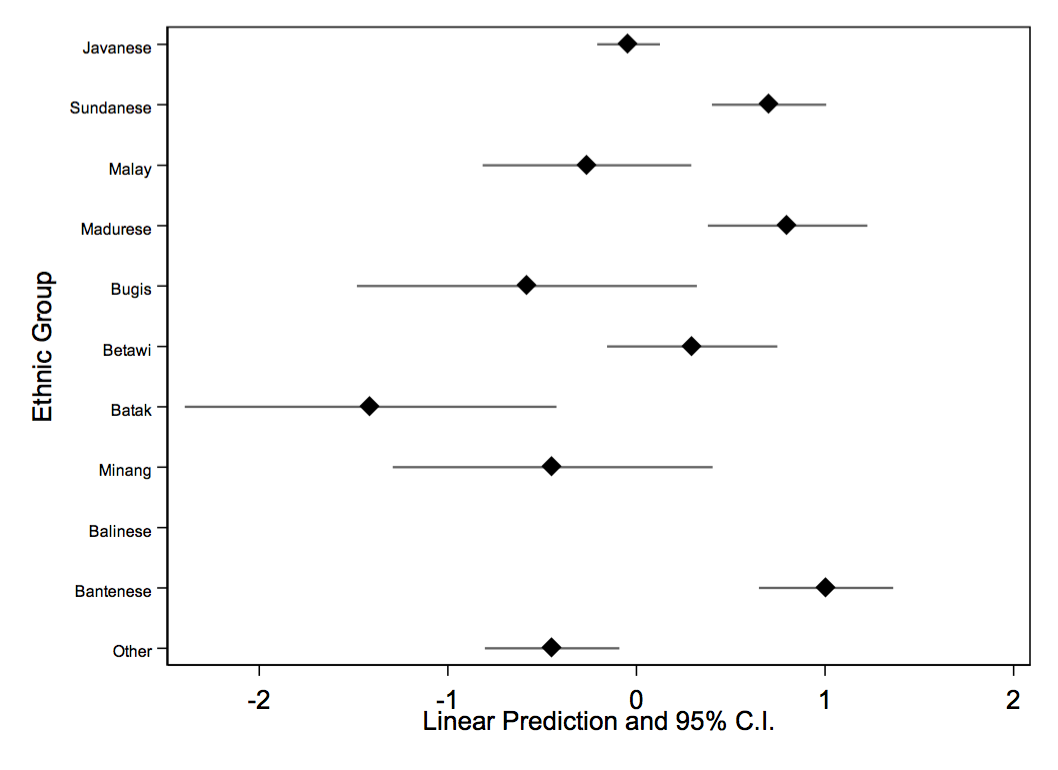
    But we can also use our variable to make some descriptive inferences too. Here, for example, is a plot of predicted piety among respondents in our sample based on ethnicity.
    piety_x_ethnicity
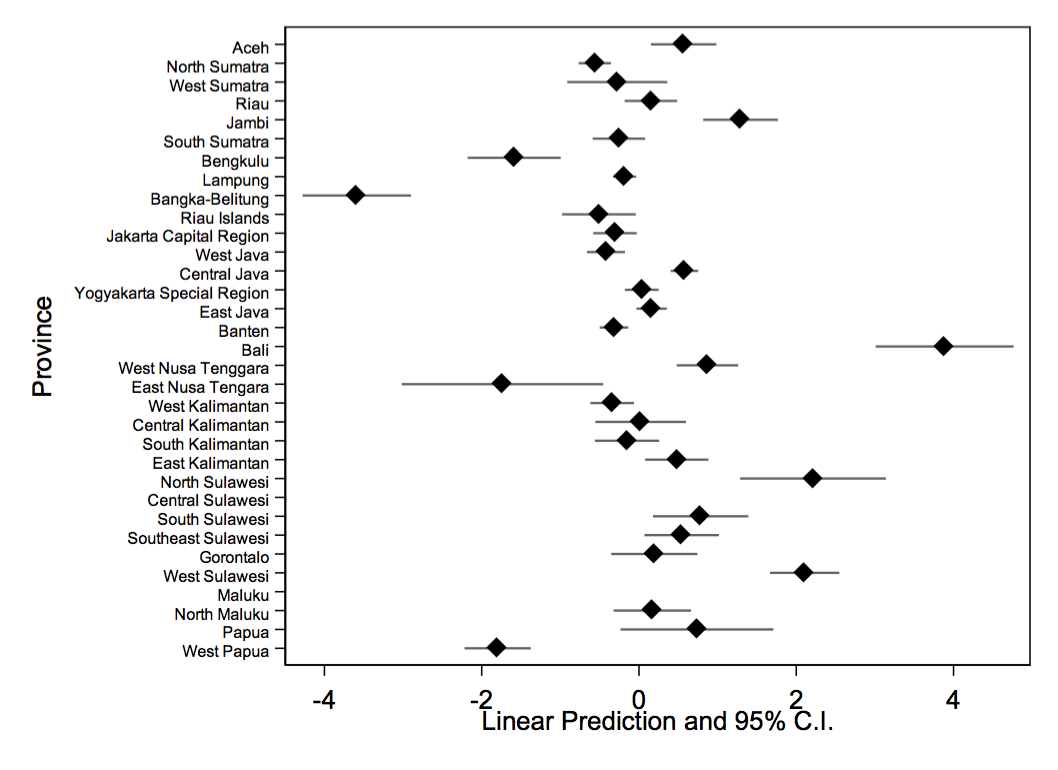
    And here is a plot of predicted piety based on province of residence. (We can go down to kabupaten/kota too but the figure is massive and unwieldy.)
    piety_x_province
    (In case you’re curious, the model we use to generate these predictions contains a full set of dummies for gender, age, level of income, employment status, level of education, number of children, and marital status.)

    This is one of those nice instances in which the quantitative data accord really nicely with our qualitative impressions. Sundanese, Madurese, and Bantenese Muslims tend to score more highly on our piety index than do Javanese Muslims, for example. But there are other, tantalizing bits in here that warrant further qualitative investigation. We see that Muslims in Aceh tend not to be more pious (net of ethnicity) than Muslims in Central Java, although the difference with East Java and Yogya is more pronounced. Muslims in the majority Hindu island of Bali tend to be far more pious—by our metric—than Muslims elsewhere in Indonesia, a pattern that we uncover as well among Muslims in majority-protestant North Sulawesi. Muslims in Bangka-Belitung score lowest on our piety index.

    What explains these findings? There are lots of possibilities, none of which we will be able to answer using surveys. But looking comprehensively at how piety varies is the first step in knowing what questions we need to be asking.