Category: Indonesia

  • Presentation

    Yesterday I did a presentation at the Indonesian Survey Institute (LSI) for researchers, activists, and the press. (Here is the announcement.) This was a first for me in three ways: (1) a research presentation conducted entirely in Indonesian, (2) a research presentation conducted in front of the press, and (3) a research presentation conducted in front of people who had a large stake in the research itself.

    I wanted to find a picture of myself taken by the press, but I can't seem to find one. Photogenic I am not. So what I tried to do was to take a picture of the press from my perspective, looking out onto them. Unfortunately I could only do it really quickly after it was announced that we'd break for lunch, so you can imagine the consequences.

    Lunch Buffet! Everybody Up!
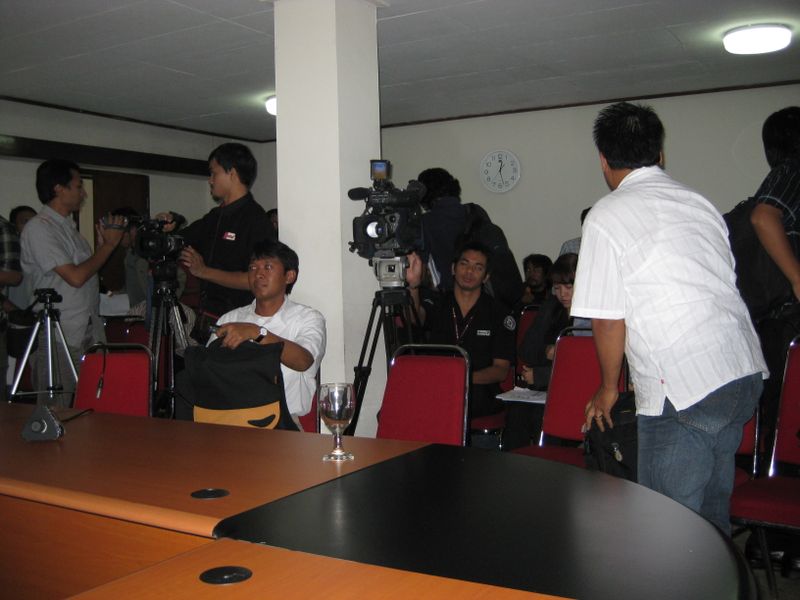
    5-15-09

    I can, though, find some media coverage of what was discussed. The English one I actually discovered while reading the print version of this newspaper over breakfast. The Indonesian one features the worst butchering of my last of all time.

    Actually, I think that although my presentation went well, my coauthor Saiful Mujani stole the show. The results of his latest public opinion surveys show some truly important things about the role of ethnicity, religion, and other "primordial" identities in the recent and upcoming elections. We hear a lot of chatter among the commentariat here that Indonesian voters want a diverse presidential ticket, one that has a nationalist candidate and an "Islamic" candidate, or one with a Javanese and a non-Javanese. Turns out, there's just no evidence that this is true. The upcoming presidential elections look like they'll feature a ticket of two ethnic Javanese from nationalist/neoliberal backgrounds running against a ticket headlined by an ethnic Bugis businessman with Muslim credentials (Jusuf Kalla) and a nationalist ethnic Javanese (Wiranto) and perhaps one more ticket to be named later. The double-Javanese nationalist ticket is the most popular by far. And critically, it is supported at the same rate by Muslims and Christians, ethnic Javanese and non-Javanese, Java-Bali and outer island voters. My guess is that the same people trying to clamour for an Islamic candidate or a non-Javanese candidate are simply representing the parties who see this as the only way that they can get any political influence.

    Saiful puts it like this, borrowing from Nietzsche: Politik aliran sudah mati. Rakyat sendiri yang membunuhnya. Or translated loosely, "Identity politics is dead. The people themselves have killed it."

  • The Art of the Interview

    I am the first one to admit that I am not a natural at interviewing people. Field work in general, I think, is not my one of my strengths. (And I don't even do real field work that requires living in a village or anything like that. I stay in hotels that have internet and cereal for breakfast.) But interviewing a key part of my job, and to follow what's going on in local politics you need to be able to talk to people to get the inside information that you don't find in published sources.

    I think that there is an art to doing a good interview, and while I have not yet mastered it, there are some key things that I have come to realize are important to consider when interviewing people. It's striking to me that by and large, political science graduate students are not taught these sorts of things before heading into the field.

    1. The Strategy of Silence.
    This is in many ways the hardest bit for me. Sometimes you ask your interviewee a question and get an answer which is OK but rather bland. I've found that sometimes, what has to come next is silence on your part, allowing a space to develop in the conversation. That silence will sometimes prompt the interviewee to be a little more forthright, or to reveal information that he or she hadn't thought to reveal. The risk is in overusing this, which leads to a situation in which the interviewee thinks you're a bad interviewer because you never say anything. The Javanese style of conversation–very calm, with silences rather common and introspection considered very important–makes finding this balance even harder for me.
    2. Non-Leading Questions. If you want to be intellectually honest, your questions should not prompt the respondent to say things that you want them to say just so you can mark them down as having said it. Here's an example: "So, isn't violence terrible?" is not very useful. The answers to such question are going to be neither illuminating nor germane to any serious academic inquiry. This is an extreme example, but it speaks to an issue at the heart of how to elicit useful–or perhaps more importantly, non-obvious–information from an interviewee.
    3. Leading Questions. Sometimes, though, it is critical to use leading questions to direct a conversation. That is, you need to ask a question in a loaded way to elicit the types of responses that will speak to the questions of interest. The very phrasing of a question, as above, sets the tone for how the interviewee will interpret it. This balancing act between leading and non-leading questions is a delicate one, one that I've only recently been cognizant of.
    4. Meandering Exchanges. What often happens to me is that the interview stops being really an interview, in the sense that I ask questions and get answers, and more that there is a sense of a free-flow conversation. This is nice in that it's more comfortable, and from my perspective less stressful, and accordingly my Indonesian actually gets better because I'm less focused on getting the nuances of phrasing exactly right. But the risk is that a meandering exchange ceases to be useful. This requires a difficult kind of internal "meta-conversation" in that you simultaneously have to be focusing on how the conversation is going but also being aware of what you need to get out of it.
    5. Notes. I hate writing notes, but I need to. (I find that recording conversations is unattractive due to the sensitive things that sometimes come up.) I have an awfully tough time writing notes in English to myself while speaking in Indonesian. Writing the notes in Indonesian doesn't make it any easier.

    About the only thing I'm naturally good at is the non-verbal, contextual side of interviews. At the risk of sounding immodest, I do think that I'm pretty good at appearing polite and interested, and at making interviewees comfortable. Sitting in a non-defensive way, looking people in the eye (but not too much or in a creepy way), showing proper deference and respect. But I stress, this will only get you so far.