Category: Indonesia

  • Foreign Easterners in Colonial Java

    As part of a long term, multi-paper project on decentralization and governance in Indonesia (see e.g. here and here), I am putting together some data on the social structure of colonial Java. I am most interested in colonial migration and ethnicity. Put coarsely, the Dutch colonial regime recognized three kinds of people in Java: natives or indigenous people (Inlanders), Europeans and other “assimilated” persons (Europeanen en gelijkgestelden), and a residual category of “foreign Easterners” (vreemde Oosterlingen). This last category had two main categories: Chinese and Others, the majority of whom (at least in Java) were Arabs from the Hadramawt. (The rest were Indians, Malays from British Malaya, Thais, and some others. Japanese, interestingly enough, were counted in the “other assimilated persons” category alongside the Europeans.)

    It is obvious to anyone who visits Indonesia today that the Chinese Indonesians play an important economic role across the island. It is less easy to see it, but Arab Indonesians do too. This economic differentiation between foreign Easterners and the native or indigenous peoples of Java dates to the Dutch colonial period, if not before.

    But not every part of Java was equally penetrated by Chinese and other foreign Easterners. As a way to visualize this, Cornell Government PhD student Diego Fossati has produced two fascinating maps of colonial settlement in Java that illustrate the spatial distribution of Chinese and other foreign Easterners across the island. The data were extracted from the 1930 Census of the Netherlands Indies, or Volkstelling 1930, and I have used maps of Dutch administrative boundaries (at the Regentschaap level when possible, or at the District level when necessary) to assign data on settlement by Chinese and other foreign Easterners in 1930 to contemporary administrative units (kabupaten and kota). I omit Jakarta from this exercise because the borders within Batavia are too difficult to match.

    First the Chinese:

    Data from Volkstelling 1930. Maps by Diego Fossati.

    Now, for the “other foreign Easterners,” recalling that most of these—but not all—were Arabs:
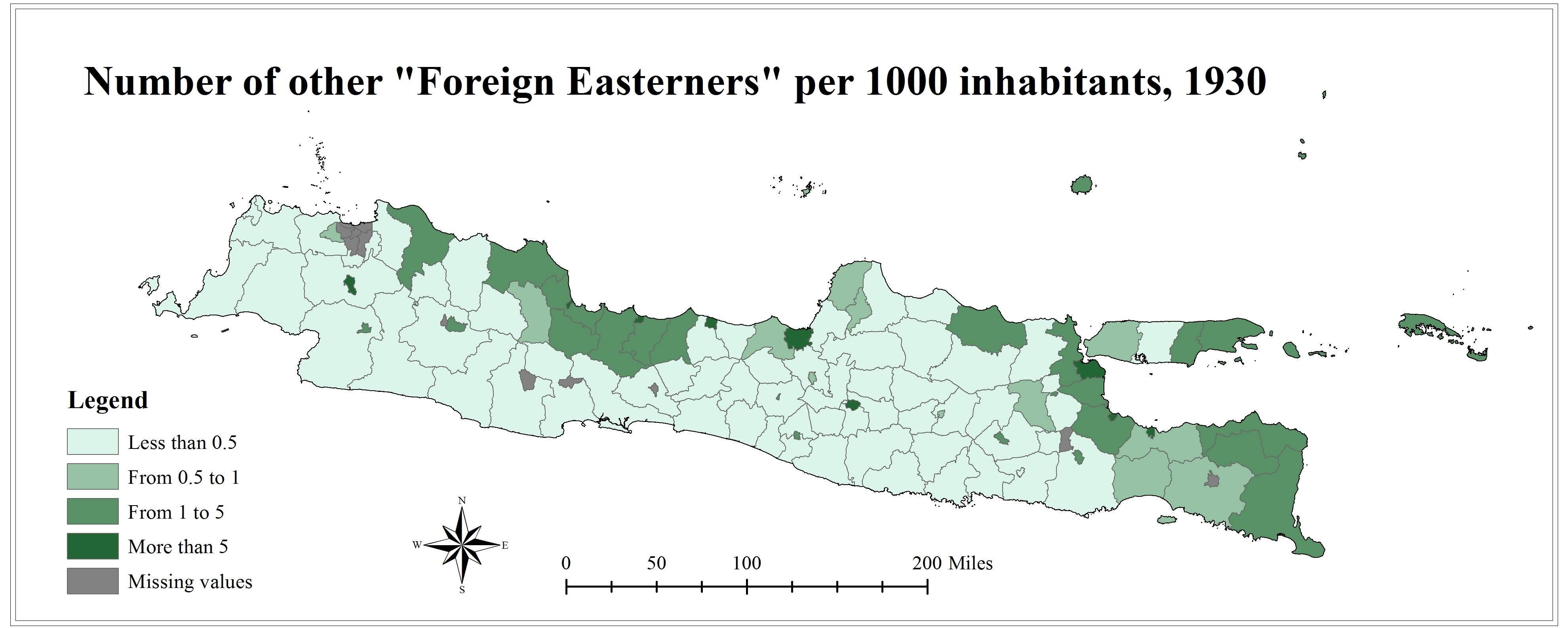
    Data from Volkstelling 1930. Maps by Diego Fossati.

    As fascinating as the maps are, it is hard to see from them how Chinese and other foreign Easterner settlement covary, so I have also produced a scatterplot of the two.
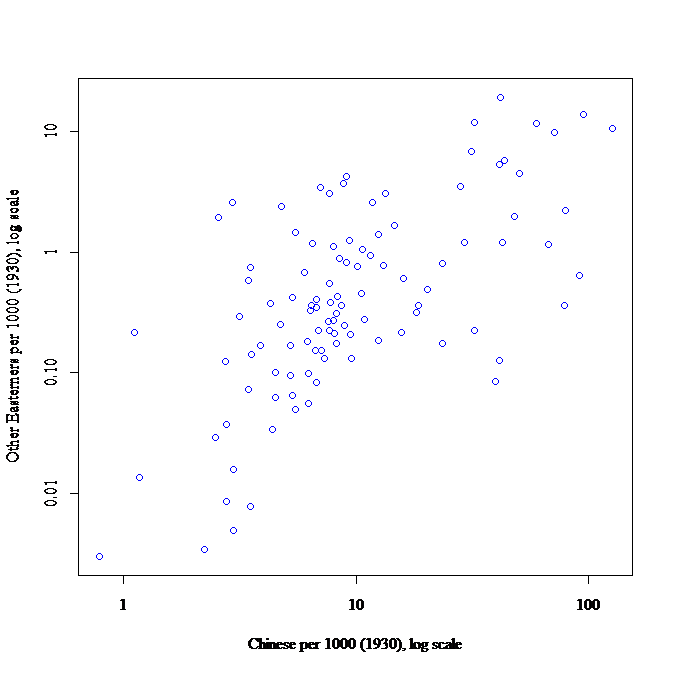
    Foreign Easterners in Java. Data from Volkstelling 1930.

    Such maps and figures are great illustrations of historical data. But some readers have probably guessed that I have a lot more in mind with this than making pretty maps of colonial demographics. I think that this variation in colonial social structure is consequential: it actually explains something important about local politics in Java today. More on that to come, hopefully soon.
  • Decentralization, Accountability, Food Security, and Papua

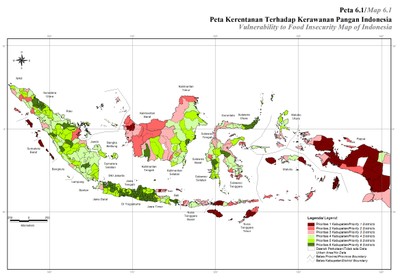
    Yesterday Cornell SEAP series welcomed a visiting scholar from the State University of Papua who presented on food insecurity in Papua on our weekly Brown Bag. The talk was grimly fascinating. Papua and West Papua, the two provinces at the eastern end of Indonesia which occupy Indonesia’s portion of New Guinea, has always been a (literal) outlier for Indonesian studies. The presentation showed clearly that amid abundant natural resources, relatively strong economic growth, nearly every district in these two provinces suffers from dangerously high rates of food insecurity.

    Food Insecurity in Indonesia (source: http://www.foodsecurityatlas.org)

    This is not starvation (although this does happen), but something more like systemic malnutrition or high variance in food availability. There was one image of four Papuan boys suffering from stunting which will stay with me for a long time.

    Since at least Bates 1981, we have known that famines and food insecurity have political rather than environmental or agricultural causes. Just so in Papua. I asked the presenter about how political decentralization in Indonesia has affected the ability of local governments in Papua and West Papua to adopt good developmental policies. I will not post her response here, but suffice it to say that it was not a positive one. Moreover, there was a sense in her remarks that district-level governments in Indonesia (the district being the tier of government most empowered by decentralization, as opposed to the village or province) really aren’t where the main problems lie. Local governments aren’t the one’s responsible for plans to clear huge swaths of land in Papua in order to plant rice for export to the rest of Indonesia, or non-food crops for the rest of the world. After all, Papuans traditionally do not eat rice (although this is changing) and rice does not really grow well there anyway (which is why Papuans traditionally do not eat it).

    All of this dovetails very well with a paper that I recently finished on accountability and Indonesian development in contemporary era. I’ll be presenting it in a workshop on oligarchy and accountability at the University of Sydney this December. I conclude the paper by writing that “We simply do not know enough about the relationship between local policymaking and national politics even to describe the interaction between institutional innovations, the national oligarchy, and informal political power in the regions.” Yesterday’s presentation on food insecurity in Papua tells me one thing: that’s where I ought to go to look.