Category: Indonesia

  • The Proposal to Make Malay an Official ASEAN Language is not Crazy

    Last week the Malaysian Prime Minister Ismail Sabri Yaakob remarked that Malay has the potential to be an official language of Southeast Asia. This feels like a rather surreal moment in Malaysian politics, at least according to most of the popular media coverage I’ve seen. Like of course that’s not going to happen, right?

    I don’t think the idea of Malay as a working language for ASEAN is unrealistic. In fact, it would be entirely reasonable for ASEAN to designate one of the languages of Southeast Asia as an official or working language. And if you had to pick only one language from the ASEAN member states, it would definitely be Malay.

    But of course there would have to be a lot of interesting details to work out. So here’s how to think about what’s going on in Ismail Sabri’s comments.

    The first thing to note is that Ismail Sabri distinguishes explicitly between Bahasa Malaysia and Bahasa Melayu. The former is “the Malaysian language,” in the sense of the language of the state of Malaysia. The latter is “the Malay language,” which refers to a family of loosely related and mostly mutually intelligible dialects, many of which are creoles with various levels of official standardization and recognition. The generic term Bahasa Melayu would include the official languages of the states of Indonesia, Malaysia, and Brunei, the Indonesian regional languages of Jambi and Riau, various dialects of Malay spoken in peninsular Malaysia, and the Middle Indonesians of Jakarta, Medan, Makassar, Manado, Kupang, Ambon, and other cities. One often hears “Malay” used to describe the official language of Malaysia, but Ismail Sabri means Malay in the expansive, second sense.

    This means that Ismail is talking about the first language of hundreds of millions of people across at least seven countries. It is the majority language in Indonesia and Malaysia and Brunei, it is the national language in Singapore, it is a working language in Timor-Leste (a future ASEAN member), and it is a minority language in southern Thailand and the Philippines. No other single language is so important for so many countries in ASEAN; it’s not even close. It would be much more jarring to make such a case for Thai, Vietnamese, or Tagalog as a working language for ASEAN.

    Second, Ismail Sabri’s comments don’t seem to be saying that Malay would be the only official or working language aside from English. It seems reasonable to say that Malay might be one of many, just like German and French are the work languages of the European Union in addition to English.

    Third, the idea that there should be no other official languages for ASEAN besides English is a little colonial. It favors Singapore, and secondarily Malaysia and the Philippines. (This paragraph has levels of meaning that you may excavate at your leisure.)

    The argument against adopting Malay as an official language of ASEAN is that ASEAN is not yet at the stage where difficult, internally-focused conversations are feasible. That is, making the first language of the largest linguistic group the official language requires a level of social trust and long-term institutional commitment that ASEAN member states do not have.

    Put it this way: under what conditions would Vietnam agree to Malay as a working language for ASEAN? Only if it thought that there was a future in which either (1) Vietnamese were afforded such status in exchange or (2) it thought that ASEAN was so dependent on its relations with the Malay-speaking world, and Vietnam so dependent on ASEAN, that this was in Vietnam’s long-term interest.

    One might think about this with reference to Bahasa Indonesia and Bahasa Malaysia, two standardized and official versions of Malay. Malay was a first language of a small minority of Indonesians at independence, although it was spoken as a second language by a larger minority (mostly in urban areas). Making Malay the official language of Indonesia proved to be unifying specifically because it did not favor any of the larger ethnic groups in Indonesia. In Malaysia, where Malay was the first language of a numerical majority of Malaysians at independence, making it the official language has proven divisive for the country’s linguistic minorities. Making Malay the lingua franca of ASEAN would probably be more divisive than unifying among ASEAN members. English, for better or for worse, isn’t so divisive.

    Of course, there is also the question of which Malay. The national languages of Malaysia and Indonesia are close enough that one can understand both with some work,* but they are not identical and differences of meaning can sometimes emerge.** But the Middle Indonesians and Malay dialects of peninsular Malaysia can be highly divergent from those national standards: I suspect that a speaker of Kupang Malay would not be able to converse easily with a speaker of Kelantan Malay. Making Malay the lingua franca of ASEAN would mean developing a generic version of Malay which is probably not any of the standardized forms that currently exist.

    And finally, if we’re going to talk about the political implications of making Malay a working language of ASEAN, we might also pause to consider the politics of Ismail Sabri’s own remarks. He was making them at a symposium on the Malay language being held by Malaysia’s own national language council, Dewan Bahasa dan Pustaka.*** I view Ismail Sabri’s comments as directed internally towards Malaysians, encouraging them to use Malay in Malaysia as the default working language in business, tech, and education. Such an argument wouldn’t be needed for any other national language in Southeast Asia, which is, itself, an interesting observation.

    NOTES

    * I tend to think that the difference between Bahasa Indonesia and Bahasa Malaysia as roughly equivalent to standard American English and Scots. If you speak one you can understand most of the other but you might prefer the subtitles when watching a TV show. It might be easier for non-native speakers like me to switch between them.

    ** Best example is kenyang, which means “full” or “stuffed” in Standard Indonesian, but in Bali Malay means something closer to “tumescent.” Cf. “fanny.”

    *** Official motto: Bahasa Jiwa Bangsa [= Language is the Soul of the Nation]. (Not ethnic group: nation.)
  • Economic Growth Under Authoritarianism and Democracy: The Indonesian Case

    Indonesia is one of most striking cases of economic transformation in modern history. At independence, Indonesia was a low-income country subject to centuries of exploitation and resource extraction under Dutch colonial rule. By the 1990s it was one of the Newly Industrialized Economies of East and Southeast Asia. Today, it is a middle-income country, classified by the World Bank as a Lower Middle Income country but not far from Upper Middle Income status. This economic transformation produced a measurable increase of material wellbeing for hundreds of millions of people. Prior to China by the 2010s, no country’s economy had grown so quickly for so long as did Indonesia’s.

    Indonesia is also a paradigmatic case of economic growth under authoritarian rule. The New Order regime arose in the wake of the brutal extermination of the Indonesian left, and was headed by a general-turned-president who tolerated only limited organized opposition and almost no anti-regime mobilization for over three decades. Soeharto, though, legitimated his rule as providing stability as the foundation for prosperity and economic transformation, eventually becoming known as Bapak Pembangunan or “Father of Development.”*

    Since the collapse of the New Order and the transition to democracy in 1999, following the economic crisis of the late 1990s, many Indonesians have lamented the loss of the feelings of optimism, dynamism, and economic progress under the New Order. Inequality has continued to rise, and the Indonesian economy, today, plainly does not serve all Indonesians equally. And one often encounters a general sense** that the New Order was a time when things were getting a lot better, a lot faster.

    (There is something lurking deeper here about how Indonesians recall the terms of authoritarian citizenship, although that is a post for another time.)

    One possible explanation for the belief that Indonesia’s economy was somehow more dynamic under authoritarianism is that the New Order actually did create higher economic growth than did its democratic successor. Indeed, this is a view that I have often shared in my teaching and in my research—I do not support authoritarianism, but I nevertheless insist that we must look the facts of economic development under Soeharto squarely in the face. But more than 20 years after the transition to democracy, is it actually true that New Order Indonesia grew faster than democratic Indonesia has since?

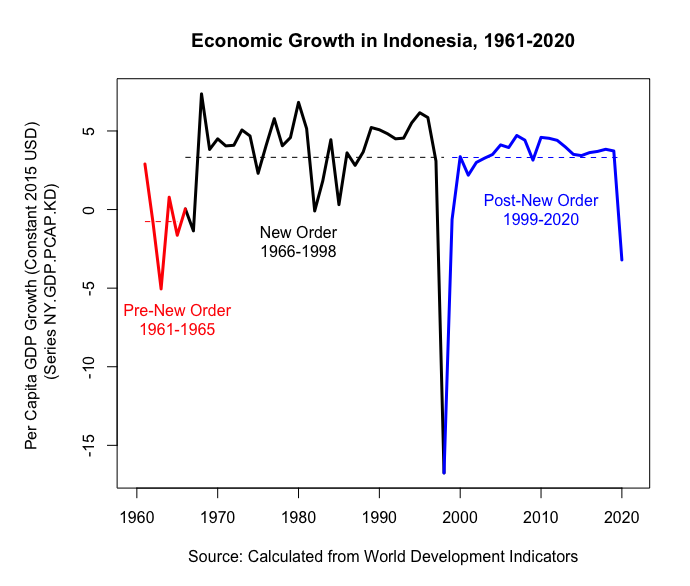
    As it turns out, no. Prompted by an email exchange among some very respected Indonesia-watching colleagues, I decided to do a proper test of the relationship between regimes and economic growth. To do so, I grabbed data from the World Bank on Gross Domestic Product per capita between 1960 and 2020, measured in constant 2015 US Dollars. This ensures that we are doing the proper comparisons over time, adjusting for inflation and purchasing power (although see the caveat at the very end of this post). I then calculated economic growth as the year on year percentage change, and plotted this series over time by separating out the pre-New Order period (1961-1965), the New Order period (1966-1998), and the post-New Order period (1999-2020). Here is what we see.

    The thick lines are yearly growth. The dashed lines are the average within the period in question. And it is clear: average growth from 1966-1998 was no better or worse than average growth from 1999-2020. Measured this way there is simply no evidence that New Order Indonesia grew faster than democratic Indonesia.

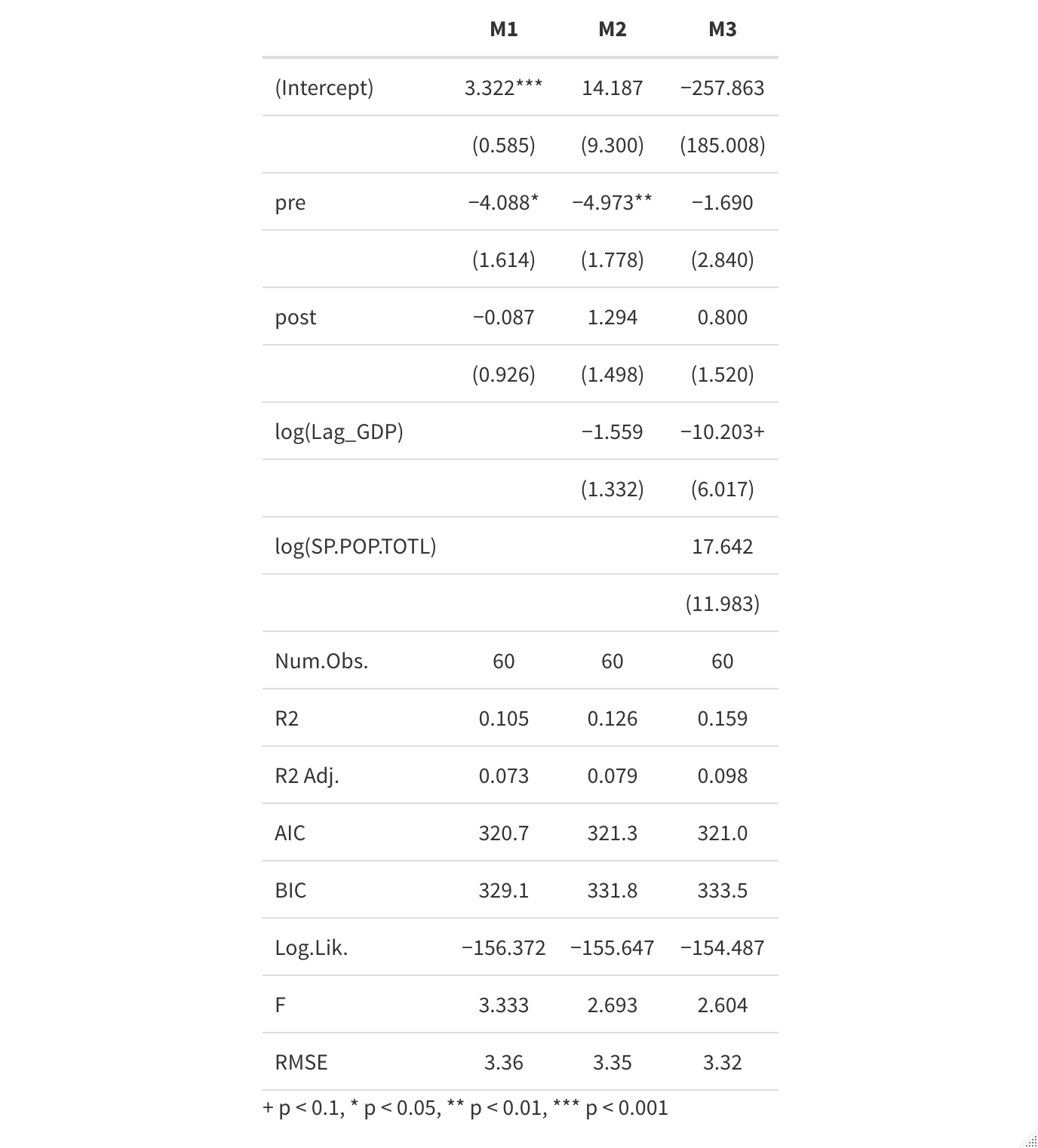
    We can test this in a regression framework too:

    There is no significant relationship between a dummy variable capturing “post-New Order” and economic growth in any of the models. This is true however I model this relationship: M2 above controls for the natural log of the previous year’s GDP in order to reflect the well-known convergence hypothesis of declining rates of growth at higher levels of income, and M3 also controls for the log of Indonesia’s population size.

    All in all, I just do not see any evidence that Indonesian economic growth was faster under authoritarianism than under democracy.

    This matters, and it doesn’t. It matters in the sense that to understand Indonesia’s political economy, we need to appreciate just how much Indonesia has grown after the end of the New Order. That is a lot of sustained economic growth.

    And it matters in a second way too. When you look at the graph above, you also can’t miss that Indonesia’s economic growth has been much more stable under democracy than it was under authoritarianism. That’s not nothing. Indonesia is not lurching from crisis to crisis, the way that New Order Indonesia had a petroleum crisis, then the early 1980s crisis, then the Asian Financial Crisis. People ought to be writing about the general macro-stability of Indonesia’s democratic economic performance, even given a lot of global economic turmoil.

    But these results also don’t matter in the sense that the political fact of nostalgia for a sense of stability and order does not depend on whether the economic facts are consistent with it. People will remember the New Order as a time of order; that, truly, was the point.

    And the other thing is inequality. That might really be the story of democratic Indonesia’s political economy, how such wealth and prosperity can emerge and persist in a country still beset by serious challenges. That said, it is important to recognize not only that there are so many extremely wealthy Indonesians, but also that there are so many nouveau wealthy Indonesians.

    There is an important caveat to all this, though. The data that I’ve used here are derived from the World Bank, which calculates GDP per capita in a lot of different ways but only has real GDP data in US dollar terms. What I would really like to have is the same series, but in the (inflation-adjusted) local currency unit: real GDP per capita measured in constant rupiah. I don’t have immediate access to that, and although I can grab the current data from Indonesian government websites they do not go back in time to the 1960s. So an open call: if you, reader, have access to that data series, I will make the same figure and estimate the same regressions, and report the results here.

    NOTES

    * I doubt that this was a spontaneous expression of endearment. Someone in the regime probably coined the phrase and then encouraged it to spread.

    ** Sometimes called “Indonesian SARS”, which stood for Sindrom Aku Rindu Soeharto [I Miss Soeharto Syndrome].