Category: Indonesia

  • The Legacies of Authoritarian Rule in Indonesia

    My colleague Sharon Poczter and I have just completed a new paper on the legacies of authoritarian rule in Indonesia. Here is the abstract.

    Democratization has fundamentally changed the formal institutional structure of Indonesian politics, but a wealth of contemporary research has demonstrated that the informal mechanisms of power and influence have survived the transition. This paper uses a unique, hand-collected dataset of information on Indonesia’ political elites over the democratic transition to empirically catalogue the changes and continuities in Indonesian politics since democratization. Our results provide quantitative evidence for substantial change in Indonesia’s political economy over the past half century, with the simultaneous rise of capital and decline of military and the state as avenues to political power at the national level. Our evidence also suggests that the origins of this transition pre-date democratization itself.

    There are lots of interesting findings, but to me, the most significant one is the last sentence.

    Marc Bellemare would call this a “determinants of…” paper. He’s right. There is a danger with a paper such as this:

    The issue with “determinants” papers is that they put the ox before the cart, i.e., the author decided to have a bit of fun playing with data, found some interesting partial correlations, and then retro-fitted a story to fit the facts.

    This is not exactly the case here. Our findings about the rise of capital really are consistent with a long line of research on Indonesia’s political economy. The real problem would have emerged if our data had not been consistent with that established interpretation of Indonesian politics. What story would we have told then?

    I also see a difference between a partial correlation between a policy outcome and covariate that is used to inform policy analysis—Marc’s worry—and a partial correlation between two socioeconomic variables that used to describe the variation that we observe in a particular social setting. As we are doing the latter, we heed Marc’s advice in describing the limitations of our findings, and I think that that should suffice for all but the most obstreperous reviewers.
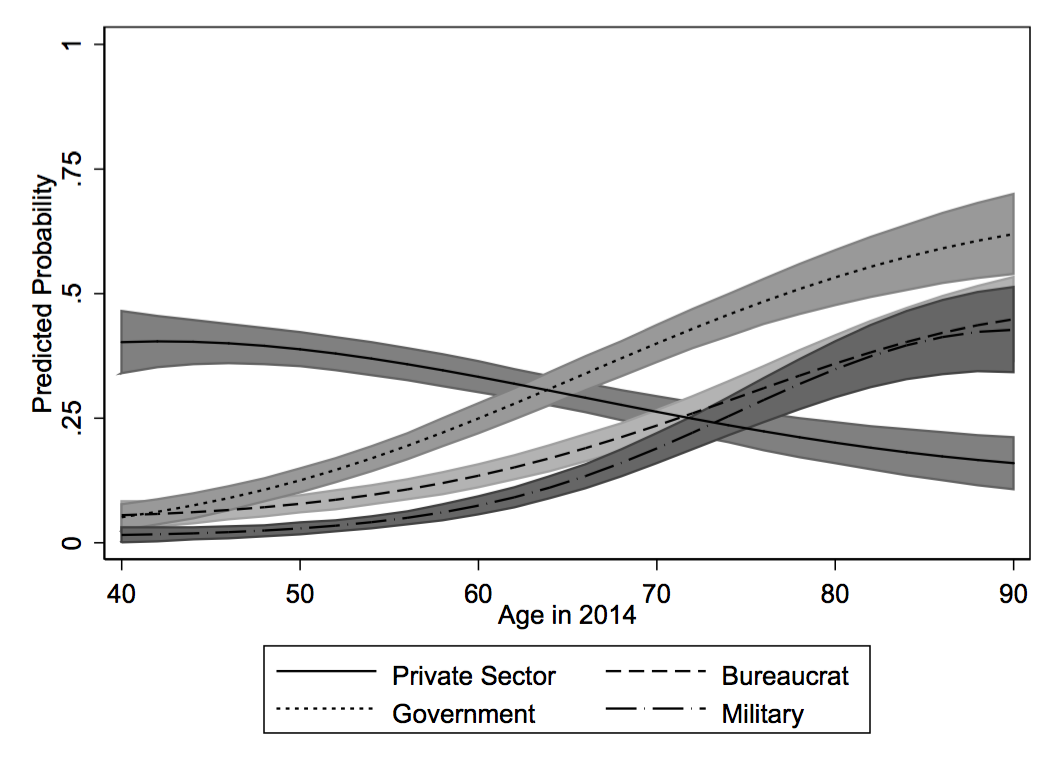
  • The Evolution of Indonesia’s Political Economy in One Amazing Figure

    My colleague Sharon Poczter and I are finishing up a new paper that analyzes the career backgrounds of a large sample of Indonesian political elites. This means cataloguing thousands of careers on elites’ CVs in order to classify them into various types, such as military, private sector, and so on. Because we have such a rich source of data, we can also analyze phenomena such as individuals with multiple types of employment over their lifetime; the predictive power of gender, religion, partisan affiliation, and education; and differences in career patterns over time.

    The last bit means exploiting differences in career histories based on elites’ ages (or implied ages for elites who have died). This is a crude form of cohort analysis, and it allows us to ask if older political elites tended to have different career paths than younger ones. We do this by fitting a series of logistic regression models predicting whether an individual has one of four types of backgrounds—private sector, bureaucracy, government, and military—using with a cubic polynomial of age as the main predictor alongside a series of demographic and political covariates. Here, we’ve plotted the predicted probability that an elite of a particular age has each of the four employment types. We’ve also included 95% confidence intervals. The result is striking.
    margins

    Among older elites—those who rose to prominence under the New Order—military and bureaucratic backgrounds predominate. Among younger elites, who we can infer rose to prominence under the late New Order period or under democratic rule due to their age, private sector backgrounds predominate. This isn’t exactly the “Rise of Capital” that Richard Robison described: he considered the links between indigenous capital and the state to be much tighter than what this figure is describing, and I am not aware of his predicting a decline of military and state as avenues to political power alongside the rise of capital. But the findings are related, and they help to make sense of how Indonesia’s political economy has changed over the past fifty years.