Category: Indonesia

  • Foreign Journalists in Papua: Not So Fast

    Recently Jokowi announced an end to the restrictions on foreign journalists reporting in Papua, Indonesia. This was rightly heralded as major news, “good place for Jokowi to start” (in Ross Tapsell’s words) in making some lasting changes to the sorry situation of Indonesian Papua.

    But sadly, no so fast. Here is Coordinating Minister for Political, Legal and Security Affairs Tedjo Edhy Purdijatno on the security risks that foreign reporters present.

    Ada 2 kelompok. Ada yang memang tulus akan meliput Papua apa adanya. Ada juga yang membawa kepentingan-kepentingan tertentu. Yang membawa kepentingan-kepentingan tertentu inilah yang harus kita waspadai. Aparat BIN kita akan memantau mereka

    There are two groups of foreign journalists. Those who are sincere, they can go around Papua no matter what. There are also those who bring their own interests. Those who bring their own interests, these are the ones that we have to be vigilant against. The intelligence services will monitor them.

    Ah, tertentu. My handy Echols and Shadily glosses this word as “someone or something specific but unnamed,” which is just exactly right. The phrase carries heavy baggage from the New Order era, as the phrases kepentingan tertentu (unnamed specific interests) and pihak tertentu (unnamed specific forces or groups) were frequently used to signal a kind of ominous general threat to order and security. As in, who’s speculating against the rupiah? Pihak tertentu. Why would they have tried to launch a coup? Kepentingan tertentu. Who wants reform? Pihak tertentu.

    And so what might motivate those journalists to report faithfully on local politics in Papua? Kepentingan tertentu.

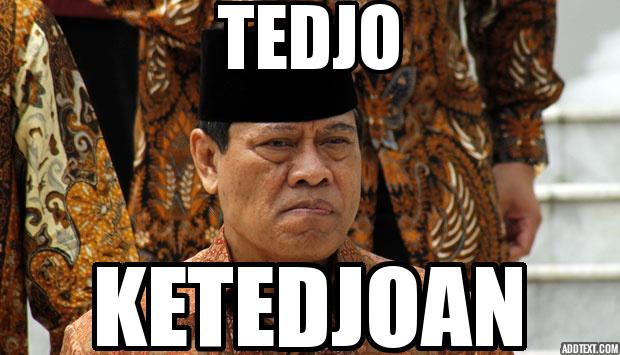
    Indonesian politics rule number one: beware of the kepentingan tertentu of the pihak tertentu. Rule number two: Tedjo’s gonna be Tedjo.
    addtext_com_MTI0NzI1MTI0OTE3

  • How Piety Varies among Indonesian Muslims

    Here are some figures from my current book project on piety among Indonesian Muslims. We—Bill Liddle, Saiful Mujani, and I—have constructed a measure of piety at the individual level that encompasses beliefs, rituals, and behavior. We rely heavily on this indicator to show that individual level piety among Indonesian Muslims ….

    does not explain any of the phenomena that we set out to explain: social identity by aliran, support for Islamic law or political Islam, support for Islamist parties, the use of Islamic financial services, or greater engagement with the Muslim world relative to other world regions

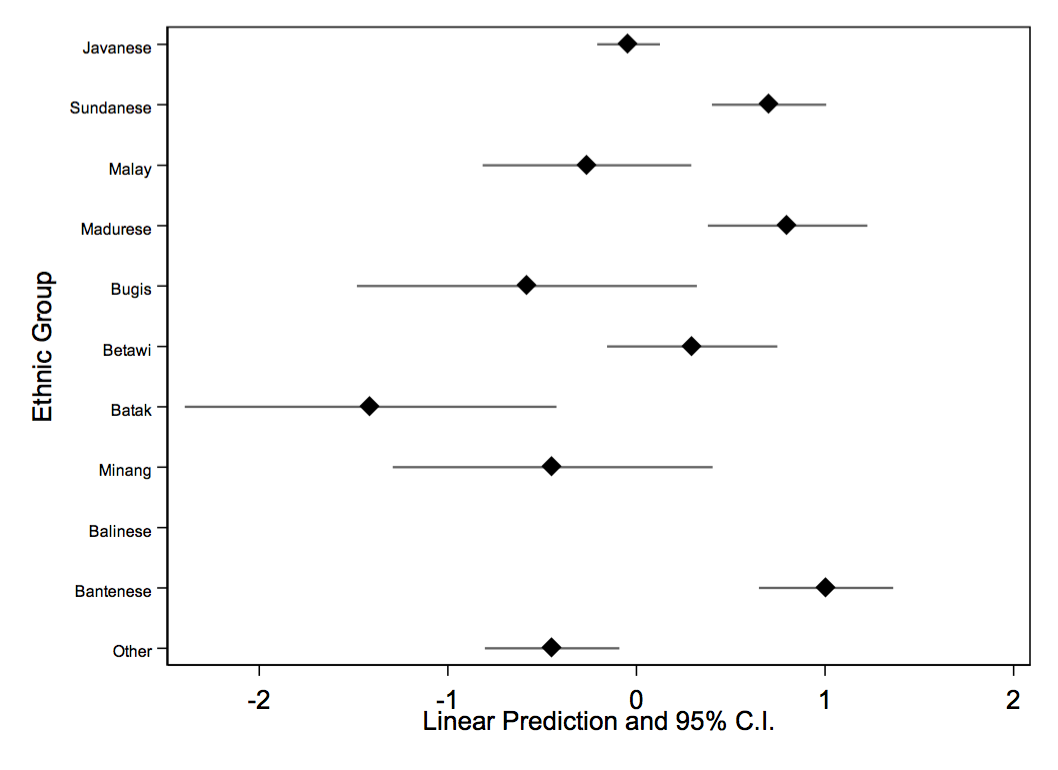
    But we can also use our variable to make some descriptive inferences too. Here, for example, is a plot of predicted piety among respondents in our sample based on ethnicity.
    piety_x_ethnicity
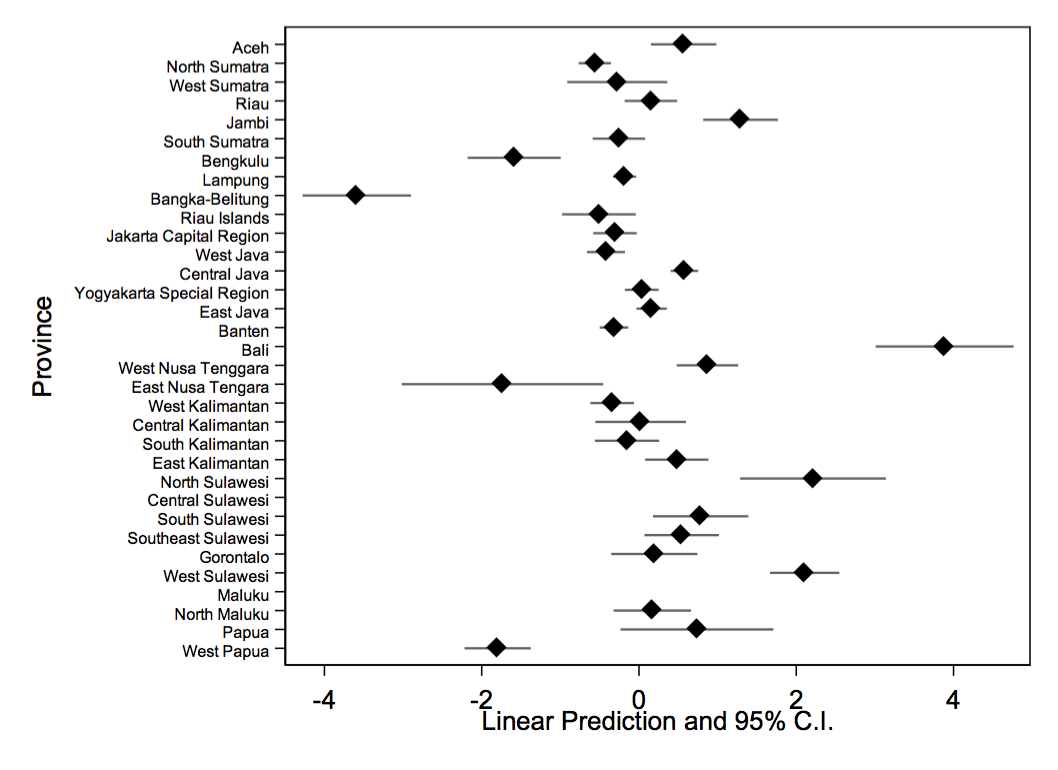
    And here is a plot of predicted piety based on province of residence. (We can go down to kabupaten/kota too but the figure is massive and unwieldy.)
    piety_x_province
    (In case you’re curious, the model we use to generate these predictions contains a full set of dummies for gender, age, level of income, employment status, level of education, number of children, and marital status.)

    This is one of those nice instances in which the quantitative data accord really nicely with our qualitative impressions. Sundanese, Madurese, and Bantenese Muslims tend to score more highly on our piety index than do Javanese Muslims, for example. But there are other, tantalizing bits in here that warrant further qualitative investigation. We see that Muslims in Aceh tend not to be more pious (net of ethnicity) than Muslims in Central Java, although the difference with East Java and Yogya is more pronounced. Muslims in the majority Hindu island of Bali tend to be far more pious—by our metric—than Muslims elsewhere in Indonesia, a pattern that we uncover as well among Muslims in majority-protestant North Sulawesi. Muslims in Bangka-Belitung score lowest on our piety index.

    What explains these findings? There are lots of possibilities, none of which we will be able to answer using surveys. But looking comprehensively at how piety varies is the first step in knowing what questions we need to be asking.