Or in English, Jakarta is like “you need to take a dump, and then you build a toilet.” Let’s break this one down, shall we?
The problems with Jakarta are legion: traffic, pollution, flooding, poor public transportation, massive inequality, irregular housing, and so forth. Being the Governor of Jakarta means you’re always responding to a big problem that is not necessarily your own doing, but rather stems from the city’s poor organization, lack of planning, and extremely rapid growth over the past decades.
Ahok has a reputation for being, well, direct. And also for not hiding his frustration or impatience at city politics. It’s no surprise that he’s frustrated with perpetually reacting to the next big crisis, and that he’d much prefer to start planning well in advance if at all possible. But instead, he finds himself in a situation where his administration is forever responding to crises when they are already underway. Like, only after you realize that “you need to take a dump” do you then realize that “you need to build a toilet.” Get it? Good. Thanks Ahok.
If you’re not an Indonesian speaker, you might be interested to learn that the Indonesian phrase that corresponds to our euphemism “take a dump” is buang air besar [= throw out big water]. I find this one to be particularly colorful.
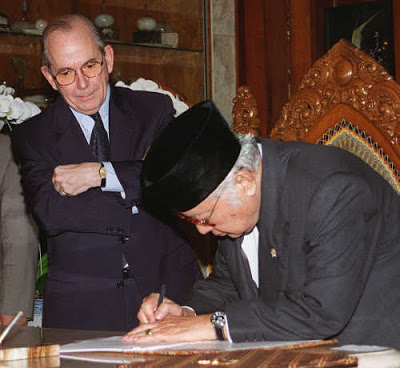
The Iconic Image of IMF Power: IMF Managing Director Michel Camdessus looking on as Indonesia’s President Soeharto signs a second bailout agreement, January 1998
Well, Stiglitz was a forceful critic of the IMF right after the 1998 Asian Financial Crisis. As he wrote in the New Republic in 2000:
I was chief economist at the World Bank from 1996 until last November, during the gravest global economic crisis in a half-century [the Asian Financial Crisis, to which Ulil is referring]. I saw how the IMF, in tandem with the U.S. Treasury Department, responded. And I was appalled.
But Ulil’s point does raise interesting questions. Indonesia’s years of IMF-managed adjustment and austerity were extraordinarily painful. Greeks today have a choice between austerity and autonomy. Shouldn’t we learn from Indonesia’s experience—and the experiences of other countries like Indonesia that have endured painful austerity and adjustment measures—to recommend against the austerity path?
I would not go so far, because Greece 2015 really is different than many of these previous cases, in two key respects.
The first difference is the biggest one: the currency union between Greece and the other Euro members is a political project. Europeans have shown themselves to be incredibly tolerant of austerity for the sake of maintaining the Euro, because the Euro is not simply a very hard peg of the Greek currency to all the other currencies of the Euro area. Leaving the Euro is not the same as a devaluation of the rupiah versus the dollar, because it requires both (1) a strong and nimble Greek monetary authority to create a new currency overnight, and (2) an abandonment of a “certain idea of Europe.” That idea that may have once been held by only an elite minority, but today is widely shared, it has real political meaning, and the Euro currency itself is part of that. Even in Greece.
The second big difference between Greece 2015 and many of the Asian cases—especially Indonesia and Malaysia—is that Greece today is a democracy. This matters at a fundamental level for understanding what policies get made and why (as I argue here). Indonesia’s crisis was so bad for so long in part because the outgoing Soeharto regime struggled mightily not to implement some of the least controversial aspects of the IMF’s adjustment packages.* In Malaysia, the counterfactual case of the country that rejected the IMF and managed to withstand the crisis fairly well, authoritarian stability was a prerequisite for making the difficult decisions associated with heterodox adjustment. The politics, the patronage, and the public outcry along the way were supremely ugly. Greece today cannot count on the strong-arm tactics of a Mahathir Mohamad to keep domestic politics in line. Nor does it need to fear the unabashed kleptocracy of an aging sultanistic dictator. For better or for worse, Greece may look instead to South Korea, a democratic regime whose IMF-mandated rescue turned out to not be quite so bad.**
Does the fact that Greece 2015 is not Indonesia 1997 mean that Greeks should vote to accept the troika’s terms? Not at all. It does, however, help to illustrate just how unique the current Greek situation is. Yes it is true that once again, a small open economy faces a choice between austerity and autonomy, with substantial long-term risks for the very core of its national economy associated with both choices. The austerity package is stark, perhaps unimplementable, and yet to label Greece’s choice in between austerity versus democracy is too facile. I do see a strong argument, however, for greater Europe to shoulder more of Greece’s adjustment risk than it currently does.
Alexis Tsipras and Jean-Claude Juncker: Still friendly after all these months?
NOTE
* Like the plan to abolish rotten son Tommy Soeharto‘s monopoly on clove marketing and exports.
** If you would have told me in October 1997 that by October 2012 I’d be listening to “Gangnam Style” and installing a Samsung refrigerator…


 Tom Pepinsky