
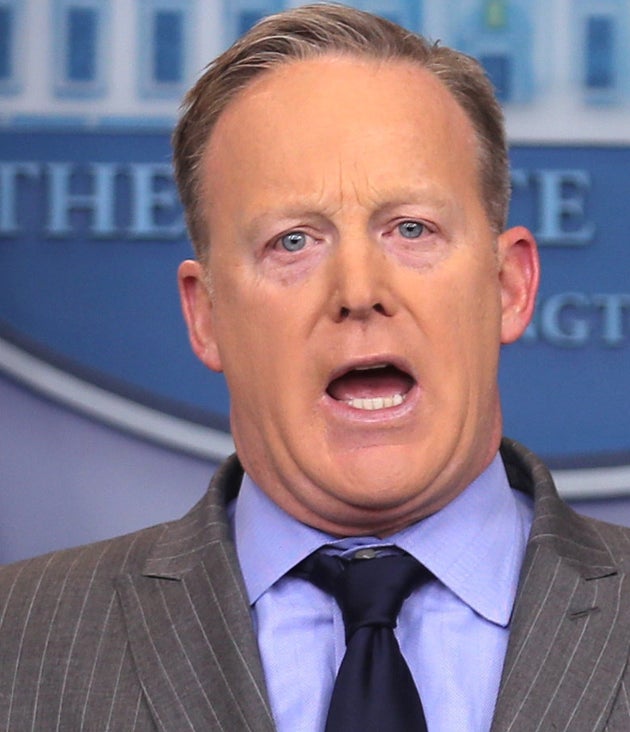
On Saturday, Sean Spicer held a press conference in which he lied about the size of President Trump’s inauguration audience and then refused to take questions. To many, this was just more evidence of the new administration’s authoritarian ambitions (see e.g. here, here, here). In my opinion, there are clear differences.
I reach this conclusion based on my experience studying two authoritarian regimes in Southeast Asia: Malaysia and New Order Indonesia. As part of the research for my dissertation (later this book), I actually did something that many of us never do: I read the news produced by under authoritarianism for several years. Specifically, I tried to read every political and economic story in a series of newspapers both Indonesia and Malaysia between roughly summer 1997 and fall 1999. My goal was to understand the course of events of the Asian Financial Crisis and how they would have appeared in the eyes of everyday citizens in days before the widespread availability of new media.
To be clear, I was not interested in the accuracy of the media itself as part of this exercise, because I assumed that all reporting would be biased and incomplete. Rather, I wanted to complement my other sources of information—rich and detailed secondary sources, interviews with key decisionmakers, and so forth—with what would have been the flow of information in real time. This is important because of the hindsight problem, in which people attribute more coherence and logic to their actions with the benefit of hindsight than they would have at the time. (To see this in action, you can read my commentary on this very exercise, written on an earlier version of this blog back in 2005!)
Nevertheless, I learned quite a bit about how the authoritarian print media work in these two cases. This is useful to contrast to the current media environment and Mr. Trump’s administration.
The first and most important conclusion is that dictators do not lie openly to the media about things that are easy to check. Lies, which are studiously avoided in any case, are reserved for facts that cannot be checked. “Wait, did Soeharto just have stroke???” “Soeharto’s health is fine, and he looks forward to getting back to work.” And even so, the lies are rare. Indeed, I found that much of the everyday reporting about political and economic events was relatively accurate in terms of recording events as they unfolded. The reporting was selective, of course, but that is why other sources of information are so critical.
Second, authoritarian media is about misdirection, not just misinformation. Rather than tell a lie, the authoritarian media wishes to paint a picture. That picture has blurry features here and there, but the point is for the audience to step back to appreciate the picture as a whole. Even at the height of these two countries’ economic crises, most of the news was about lifestyle issues, regular business affairs, sports, and so forth. The purpose of the media is to report on those pieces of information that are consistent with that picture. For example, it is fine to publicize lifestyle debates about traffic or the high cost of schooling just so long as they can be reported as evidence of rapid material progress that justifies the steady hand of the ruling government. Negative or damaging news doesn’t generate lies or outbursts in response, it is simply not covered at all.
Third, authoritarian media focus on motivations rather than actions. A president or prime minister is pure hearted, dedicated, hard-working, and intelligent. The details of what he actually does are important only insofar as they reflect these qualities. By contrast, the opposition are stupid, craven, and disloyal. Even when their actions may have good consequences, coverage must question their intentions.
Fourth, to be effective, authoritarian media cannot have competition. One of the most interesting conclusions I reached from my exercise is that no one would read these new stories if he or she had any alternative. This does not mean that the regime is busy writing stories and force feeding them to various news outlets; rather, it means that the regime must cultivate a media landscape where real critical investigative journalism is not available. One does this by political ownership and control over the entire media landscape and liberal use of the courts to silence not just critics but also their publishers. 90% control won’t do, it must be complete.
So how do these differ from what we saw Saturday? To me, the differences are clear. No successful dictator would send a minion to berate the press about an easily checked fact. A dictator would ignore it entirely, and focus on something else. Only someone singularly obsessed with the display of dominance would insist, against all evidence, that he was more popular by some opaque metric than anyone else in American history. That’s what a narcissist or a bully does, not a dictator.
That said, there is one important similarity: President Trump does completely follow the authoritarian’s template that “media focus on motivations rather than actions.” Just look at this morning’s tweet.
Busy week planned with a heavy focus on jobs and national security. Top executives coming in at 9:00 A.M. to talk manufacturing in America.
— Donald J. Trump (@realDonaldTrump) January 23, 2017
Mr. Trump seems to thrive on the notion that he must portray himself as successful and intelligent (“Trust me, I’m like a smart person.”). The U.S. mainstream media have adopted that narrative as well—the debate has focused more on whether he is really successful or not (in yes-no-yeeeees! fashion), rather than on what he announced that he would do in office. In my view that is a mistake. I will note that this is consistent with Masha Gessen’s advice to “believe the autocrat,” which reaches a different conclusion than my own.
We have also for some time lived in a world of U.S. politics in which intentions dominate actions in the political media. Plenty of people believe that Secretary Clinton and President Obama are crooked. Plenty of people have also long believed that President Bush was an idiot and Vice President Cheney was evil.
Nevertheless, dictators are often also narcissists and bullies, so this similarity between Mr. Trump and the authoritarians warrants careful attention. But the U.S. media landscape already contains within it a useful check on any administration’s authoritarian tendencies, which is the fragmentation of the media landscape combined with the profit-driven search for ratings and sales on all sides. No contemporary media outlet in the U.S. wins viewers or readers by reporting facts or beliefs from the Government Information Bureau. Even those whose partisanship tilts towards one party or the other need opponents to argue with to gin up interest, and hence ratings. Talk radio is the closest thing to an exception, but the money in talk radio pales in comparison to the money in traditional media. And without a doubt, the broadcast and print media have proven absolutely thrilled to cover Mr. Trump, and critically so. That’s not ending any time soon.
Thinking about narcissism versus authoritarianism also provides some suggestions for how to respond. The strategy for combating authoritarianism in a controlled media environment is very tricky. The strategy for combatting a bully is pretty straightforward: bloody his nose and show everyone how he cries.
It is the strategy for covering a narcissist which is the most delicate. The narcissist’s dilemma is that he requires constant media attention, yet must simultaneously convince his audience that the media cannot be trusted. My advice is to remember that if there are no questions, then it is not press conference, and does not need to be covered. Just don’t look. Take away the media and the narcissist will beg for it to come back.
The challenge for today’s media is that the very fragmentation that makes political control hard also makes collective action difficult.
 Tom Pepinsky