As my contribution to a recent conference on the State of Indonesian Democracy, held here at Cornell and hosted by the Southeast Asia Program, I wrote an essay that interprets contemporary Indonesian democracy using the tools and frameworks of comparative political institutions. You can read a first public draft of that manuscript, entitled “Cleavages, Institutions, and Democracy in Indonesia: Consensual Presidentialism in Comparative Perspective,” here. The abstract is below.
Indonesian democracy is characterized by large governing coalitions and a dominant presidency, coupled with weak parties with few programmatic differences. This model of democracy—usefully summarized as consensual presidentialism—is the product of a presidential form of government and proportional representation with high district magnitudes. The core features of Indonesian party politics and electoral competition can be explained by applying the comparative literature on electoral institutions to Indonesia’s social structure and political cleavages. By treating Indonesia like a normal country in which politicians respond to electoral incentives given existing rules and social structure, we gain a better insight into the roots of Indonesia’s democratic decline and the pathways towards reform.
My thinking on these issues has evolved over many years of thinking about comparative politics and Indonesian politics alongside one another. My take is that recent Indonesianist scholarship—which I admire, read, cite, and largely endorse—has been searching for an explanation for why Indonesia’s democratic practices are so different from the practices in liberal democracies, like the United States and Australia. I think that focusing on what we know about electoral institutions can clarify certain features of Indonesian democracy, such as the programmatic weaknesses of political parties and the prevalence of oversized governing coalitions across presidential administrations. In my view, these are not inherently pathological features of Indonesian politics. Rather, they are what you would expect if, as I write, “all we knew about Indonesia was that it is a presidential democracy whose legislature is elected under proportional representation with an average district magnitude of about 7.”
Interesting (at least to me), my use of the term consensual presidentialism is inspired by the work of Arend Lijphart, who is almost certainly the most well-known empirical democratic theorist from the Netherlands, Indonesia’s former colonizer. His Patterns of Democracy is a source of endless insight and inspiration, and guided my thinking about Indonesia only after I started thinking about democracy elsewhere.
Thanks to a generous gift from a long-time friend of Cornell, I have the great honor to host an international workshop on the State of Indonesian Democracy to be held in Ithaca on August 1-2 of this year. In addition to organizing the event, I will also be presenting some of my own research on how to interpret Indonesian democracy a quarter century after the fall of Soeharto. I will have lots to say, so watch this space.
Having spent the last couple of weeks really digging into the electoral returns (special thanks to Nick Kuipers and Seth Soderborg for figuring out how to get access to these data*) it is clear to me that I have more to say than I can fit into 6000 words. Fortunately, this blog is a nice repository for extra thoughts and figures. Today I want to share some interesting and perhaps surprising results about partisanship and election behavior in Indonesia’s very complicated legislative elections.
Background: Many Parties, Weak Partisanship
There is a large body of excellent academic scholarship on elections and partisanship in Indonesia, much of it based on close qualitative study of campaigns and elections, and some based on qualitative interpretations of how electoral politics translates into governing and coalition-building. This work is strong and convincing, and a consistent theme is that partisanship and electoral behavior in Indonesia is not like partisanship in many other consolidated democracies.
This fits with most observations about Indonesian politics since democratization. Parties collaborate with one another (some might say that they collude) regardless of their ideological differences. Parties’ programmatic politics are often vague. Indonesian voters tend not to espouse strong partisan identities in surveys. There are cleavages in Indonesian politics that matter for voting behavior and party branding, but they are basically about Islam versus pluralism.
Because there are more parties than their are cleavages, and because the parties do not work very hard to oppose one another, partisanship is generally not considered a major force in everyday politics in Indonesia. It clearly matters for elites and oligarchs, who must capture (or create) a party in order to have a chance at holding office at the national level. But just about any party will do.
Now add that Indonesia is a multilevel democracy: there are elections for president, national legislature, provincial legislature, district legislature… and more besides. Given the necessity of coalition-making at all levels, even if if you wanted to vote for PDI-P in national parliamentary elections, and could guarantee that it wouldn’t partner with an Islamist party within the DPR, you could not guarantee that PDI-P in your district wouldn’t partner with an Islamist party at the district level.
Everything that I’ve written above suggests that weak partisanship ought to be the norm. Votes can be bought; candidate quality is paramount; district magnitudes require multiparty coalitions at all levels; and oh yes, presidentialism weakens legislative parties as well. The question that I have been pondering is whether Indonesian voting behavior points to the same conclusion.
Here is my idea. If partisanship really doesn’t matter to voters, then there should not be a strong correlation between how people vote in national legislative elections, and how they vote in district (kabupaten/kota) elections. But if there is a correlation between those, then that suggests that something is going on—partisanship matters, despite all of the factors listed above.
A Peek at the Data
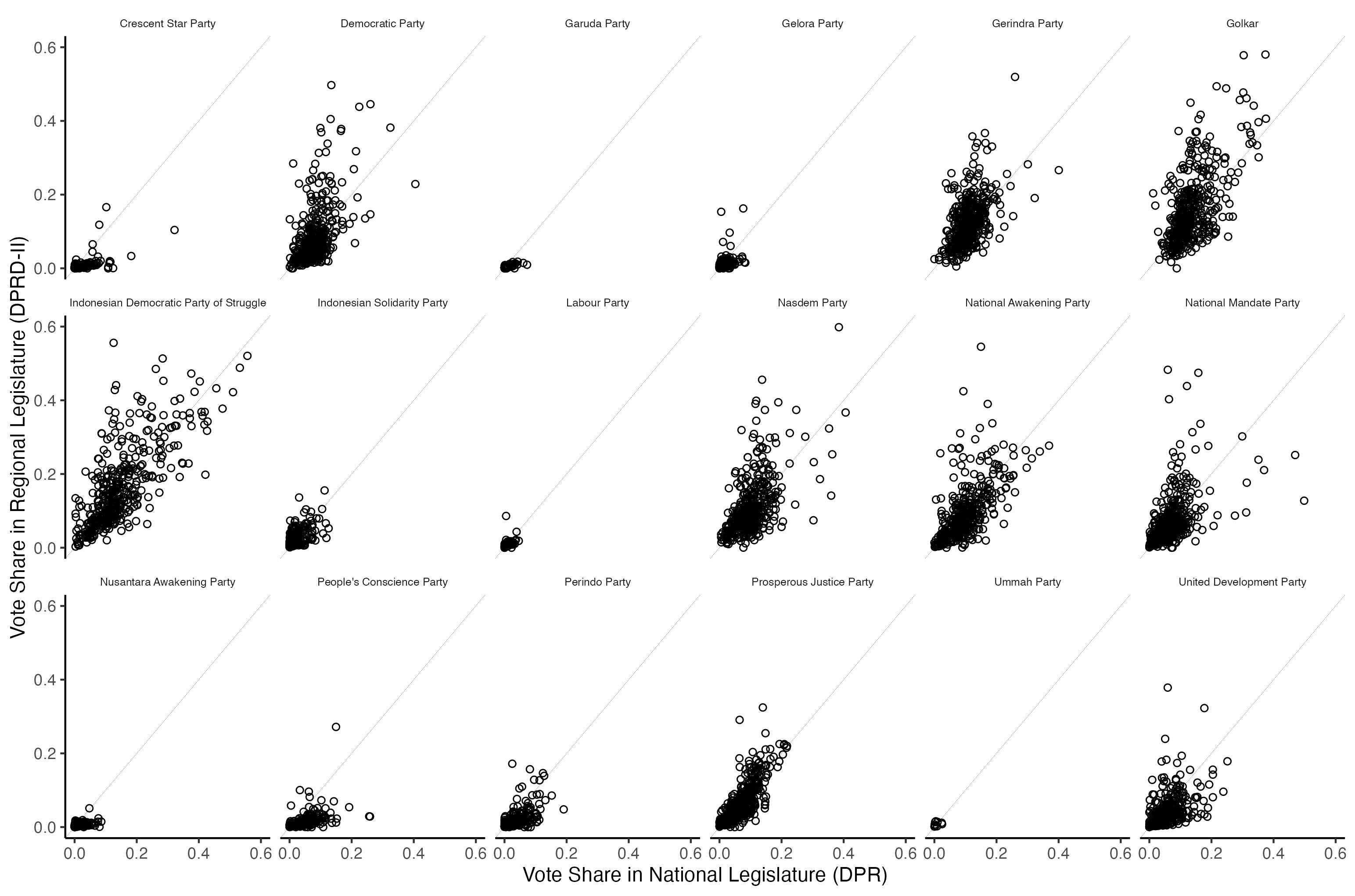
Using data scraped from the Indonesian Election Commission website, I decided to check to see if these two variables were correlated. What you see below is the correlation between the vote share received by each party in Indonesia in district legislative elections (DPRD-II, y-axis), and the vote share received by each party in that district for the national legislative elections (DPR, x-axis). Note that these are separate elections that happen at the same time, and each point is the result for a single district.
You can see a faint gray line at a 45-degree angle. That represents a hypothetical perfect relationship between votes for each party in the DPR and DPRD-II. It is clear that there is a lot of variation out there in how parties fare across elections, especially among big parties. But you can also clearly see that the two variables are positively correlated. The same parties that do well in the national DPR elections tend to do well in the district DPRD-II elections.
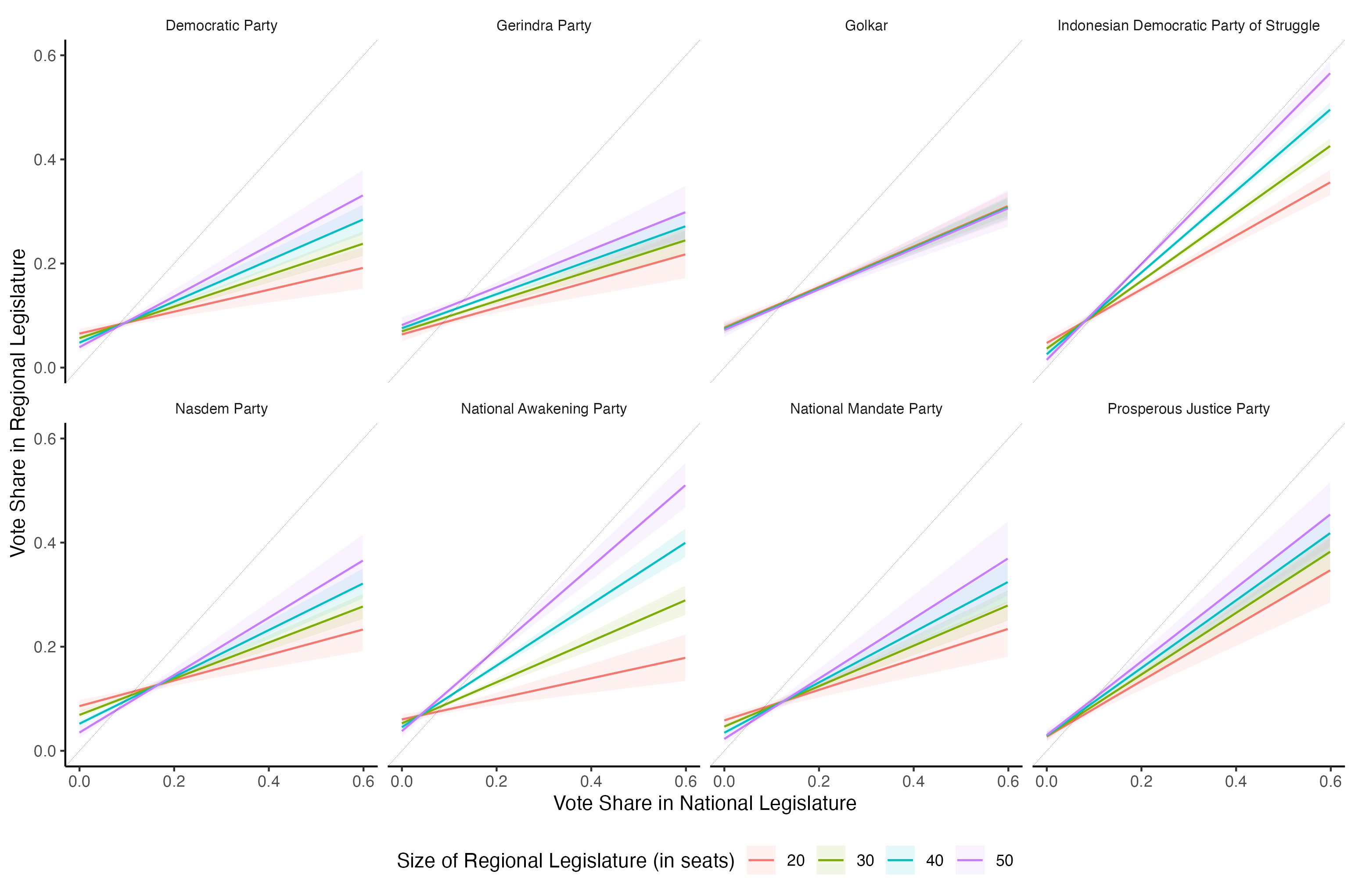
Now let’s get more systematic. I’m going to predict the DPRD-II vote share for each party in each district as a function of that party’s DPR vote share in that district. I will then interact DPR vote share with the size of the DPRD-II in terms of seats and a dummy variable for each party. The logic of the interaction with the number of seats is that district legislatures vary in size, and the smaller the legislature the greater the incentive to vote strategically (because you cannot divide a seat into pieces), so the less correlation between your local vote and your national vote. The logic of the interaction with the party is that the strength of partisanship across levels of government might differ across parties, for any number of reasons. I will also add fixed effects by province, because obviously politics varies across regions. And thanks to Vincent Arel-Bundock’s wonderful marginaleffects package, I can create a neat plot that summarizes what we care to learn from this exercise.**
As expected, the strength of the relationship between DPR and DPRD-II results varies by party. It also varies by district magnitude in ways that are entirely consistent with expectations: the bigger the district legislature in terms of seats, the stronger the correlation between party results in national and district legislatures. But the central point here is, partisanship in one election predicts partisanship in another. It does not look like candidate-level factors like money or personality, or regional levels factors like economic development, overwhelm the effects of partisanship on election behavior. We can’t learn why partisanship matters just from looking at this graph, but across parties—and especially for parties with distinct brands like the Indonesian Democratic Party of Struggle (nationalist), the National Awakening Party (Javanese Islam), and the Prosperous Justice Party (modernist Islam)—we see the voters are voting the same ways across elections.
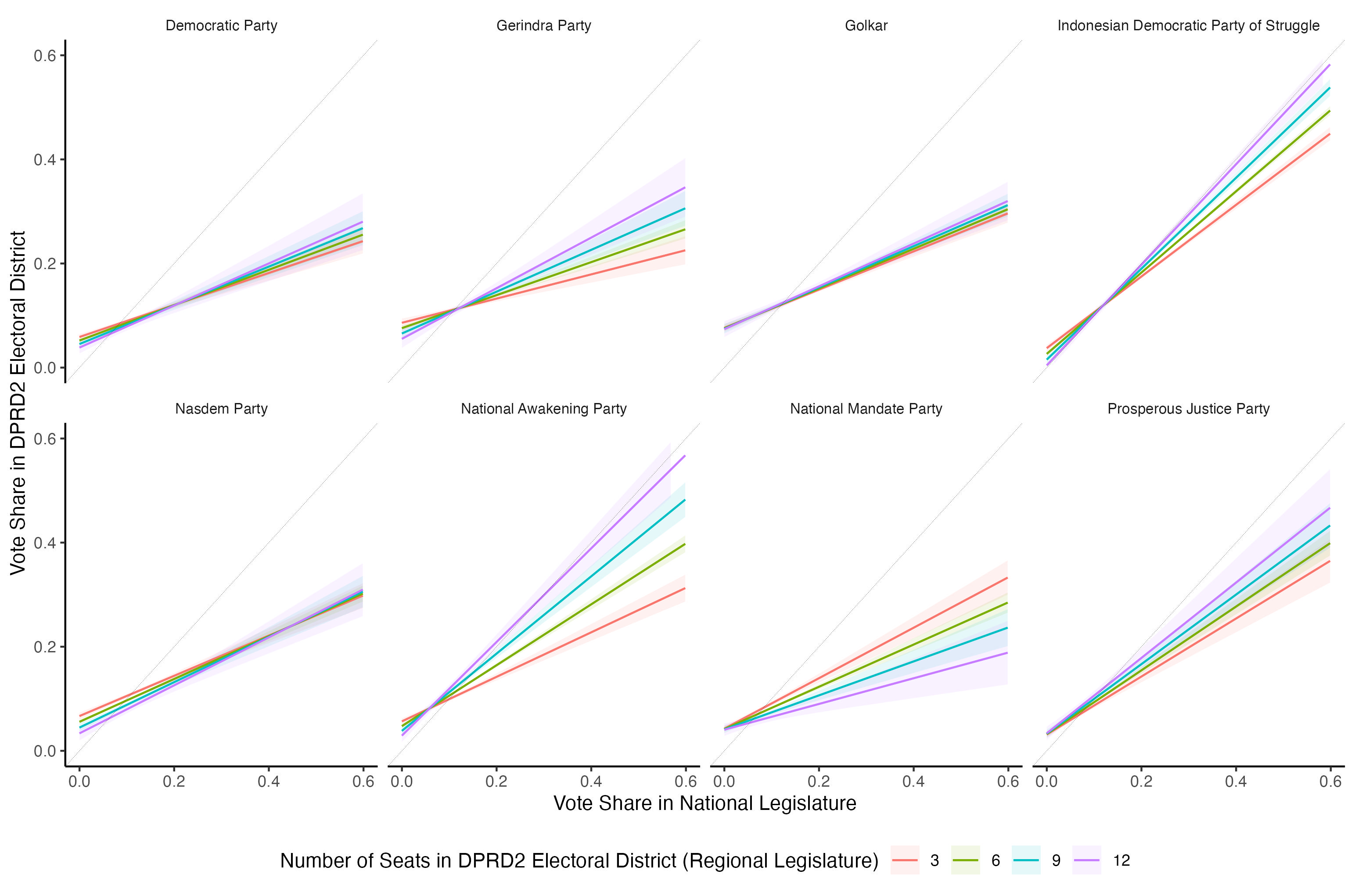
I can dig even further into these results by exploiting proportional representation within district-level elections. Rather than taking the unit of analysis to be the district, I will analyze results for electoral districts (daerah pilihan, or dapil) in DPRD-II elections. These local electoral districts vary in district magnitude in the same way that Indonesia’s national legislative election districts vary in district magnitude, with voters sending between 3 and 12 seats to the district legislature depending on the district. I will now correlate party vote shares at the DPRD-II election district (dapil) level with party vote shares for the DPR at the district (kabupaten/kota) level,*** interacting the latter with party and district magnitude in the DPRD-II election. Just for fun, I’ll also add in kabupaten/kota fixed effects, so I am only using variation in vote shares and district magnitude within districts.
Look at that: same patterns, especially among the parties named above. And, same moderating effect of district magnitude. The only truly puzzling result is for the National Mandate Party, where the conditioning effect of district magnitude works opposite to expectations (and opposite to the effect of legislature size at the DPR level). I have no explanation for this.
Aside from that, these patterns are remarkable. They are very consistent with what we know from the comparative study of electoral rules. But they are also surprising from the perspective of Indonesian party politics. Indonesia’s parties share power with any party that will allow them to be in government, they are subject to the whims of elites, and they have little ability to counteract personalist demands in a candidate-centric political system. And yet at the ballot box, voters still treat parties as if they matter. There is much to ponder about why this is, and what its implications are.
NOTES
* Nick and Seth figured out how to scrape the data from the KPU website. I then adapted their scripts to suit my purposes. Credit goes to them, but any errors are mine.
** I will only show the larger parties, because they are the ones that are most consequential. The patterns differ for smaller parties.
*** In principle, I could align the units of analysis by looking at DPR vote shares disaggregated to the DPRD-II level, but that is an unusually large pain in the neck, and it won’t change anything.

 Tom Pepinsky