Category: Food and Drink

  • How to Eat in Jakarta

    Tyler Cowen went to Jakarta recently and has provided his advice on how to eat well there. It makes sense to look for his advice: Cowen has a very interesting book on the economist’s take on good eating. Now, the “economist takes on some unrelated field and writes a trade book” genre is so very tiring, despite the very attractive promises that these economists can optimize my life. That said, Cowen’s food book is pretty good, and very sensible about most things. His advice about eating in Jakarta, though, misses the mark.

    Some principles:

    1. Sanitation is a mess in Jakarta. Street food—real street food—will very frequently make you sick[*] unless you stick only to bakso. I mean really sick. Typhoid or hepatitis sick. The problem is that many dishes are served lukewarm, or with lukewarm sauces or sambals, or with raw vegetables as garnishes (common in Sundanese cuisine, from the region surrounding Jakarta).
    2. As a rule, regular restaurants are no better. On average you are less likely to get sick at a “restaurant with walls” but this is really only a statement of averages. Mall restaurants, and especially padang food restaurants, can be very dangerous.
    3. There is a category of food-for-sale that lies between cart (kaki lima) and restaurant: the warung. I suspect that this is what he means by “street food.”

    There are plenty of lousy restaurants in Jakarta (my favorite example is Bakmi GM). But as a rule, restaurants and more established warungs completely and totally dominate street food. There are good examples of street food (of the warung variety) that is tasty, but here’s the funny thing: the best street vendors morph into more regular establishments! It ceases to be “street food” in the customary sense of the word because entrepreneurs know how to make money, and it’s not by doing street food.

    Examples: Nasi Goreng Kambing Kebon Sirih has a website and offers catering! Another favorite Menteng warung of mine, Warung Ngalam, also has a website, and twitter.

    This means that Cowen’s final sentence is exactly wrong:

    Knowledge of specific restaurants is not the key here.

    On the contrary, knowing specific restaurants is absolutely key. That’s how you know a tasty and safe warung from a typhoid warung, and also how you know which of many warungs with the same name in the same place is the “right” one. It’s also, obviously, how you know a good restaurant from an average one.

    Another issue that Cowen touches on is malls and buffets. I think he’s on firmer ground here, although I will say that I’ve never had good Indonesian food at any Indonesian buffet. You can get really, really good food at a nice Indonesian hotel buffet, but it’s good Chinese, Japanese, Indian, or Western food.

    So if the goal is to eat good Indonesian food in Jakarta, and you’re a newcomer, I don’t at all recommend following Cowen’s advice. Instead, you need recommendations from trusted and experienced sources. Do not waste your time with real street food: any version of anything you can find on the street will probably taste better at a restaurant. But even then, be careful, because four walls and air conditioning is no guarantee of safety. Malls are fine, and upscale malls are the most likely to be safe. But the best restaurants and warungs are still the stand-alone kind, and to figure out which ones are worth the time and effort to get there, you need an expert.

    [*] You often hear the recommendation that you should eat street food in foreign countries even if it makes you sick. I agree that it’s an interesting experience, but there should be limits to this. And especially if you’re new in town, or only have a few days, spending three of them in bed with a horrible stomach bug does not seem like the best use of your time. Having experienced that myself, I can assure you that nothing for sale on the street in Jakarta tastes that good.

    The same is not true in Kuala Lumpur, where the food is tastier and less likely to make you sick. Go to Jalan Alor or Bangsar or Masjid India and have at it.
  • Subsidies that Work; or, Why is Good Food So Cheap in Germany and Expensive in Australia?

    Two summers ago we traveled as a family to Australia, where we were based in Canberra for five weeks. This month we are in Germany, based in Freiburg. We love to travel, but since having kids, we’ve noticed that travel has become a lot more expensive. Nothing illustrates this more than our grocery bill.

    At least, that’s what we’ve come to expect. Here in Freiburg, we have been floored at how inexpensive our food bill has been. Some illustrations:

    1. We always have to stock a kitchen when we arrive in a new town. In Canberra, it cost us AUD245 in June 2011. In Freiburg in June 2013, our bill was EUR62. This is the case even though we also have one more kid this time, and little AP’s diet is pretty strict (and her favorite food, avocados, is hardly a local product).
    2. One Starbucks breakfast in Sydney cost us AUD28: that’s one tea, one long black, one yogurt, and three pastries. Our dinner last night at Hausbrauerei Feierling cost us EUR23: that’s one large fresh organic beer, one fresh-pressed organic apple cider, one bitter lemon, one large fresh soft pretzel, a basket of very good bread, two Landjäger, two Weißwürste, two Bauernwürste, and a salad. This is at a biergarten, yes, but it’s the most touristy one in Freiburg and the food was very good.

    Now in U.S. dollar terms, some of the comparisons might be overstating things. The $ / AUD exchange rate was about 1.2/1 in 2011, which was as bad as it’s been. The $ / EUR exchange rate right now is around 1.3/1, which is great by recent standards. Also, when it comes to stocking our kitchen, we had to be more aggressive in Canberra because we couldn’t walk to the Supabarn, whereas we can walk to the Rewe in about 7 minutes.

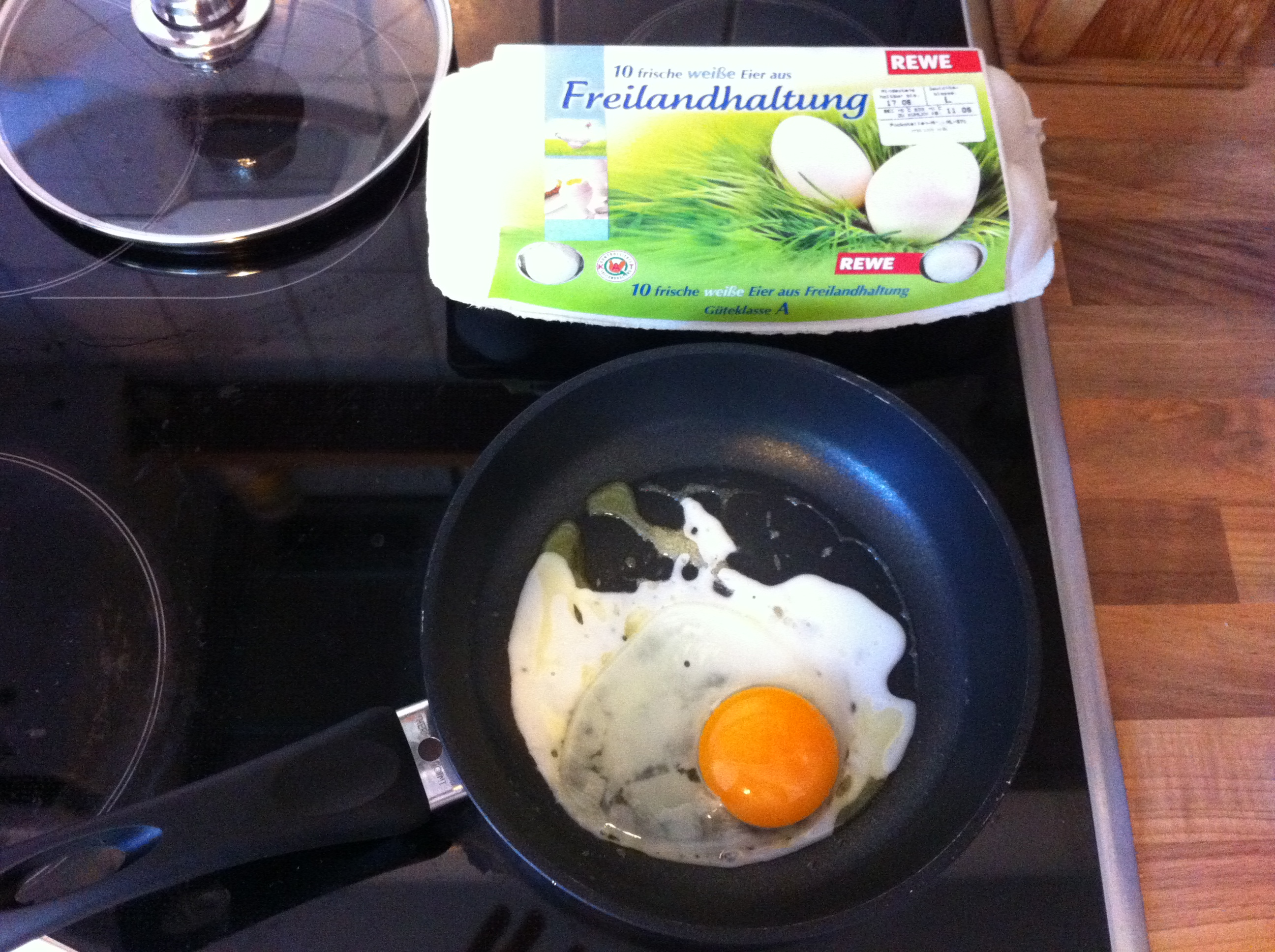
    But those differences don’t begin to explain the stark differences in the price of food between Freiburg and Canberra. Moreover, these inexpensive foods that we’re buying here in Freiburg are tasty and nutritious. If you don’t believe me, take a look at this fried egg, which is just a normal organic cage free egg from the grocery store. 10 of these cost EUR1!

    Deep orange yolk = extra delicious

    Subsidies in the U.S. seem to be producing huge amounts of grains, leading to a superabundance of white flour, corn syrup, and corn-fed beef. Here, they seem to be producing nutritious, locally-grown, organic vegetables, tasty dairy, cage free poultry, and free range meat.

    I see two questions here. One is why food is so expensive in Australia but so cheap here. One might think it’s just about subsidies—Australian farm subsidies appear to be very low—but don’t forget that Australia is a big sunny country with no one living in it, and (especially in Queensland) the land is incredibly fertile. Even with low subsidies, and a center which is useless for commercial agriculture, Australia is a net agricultural exporter. Agricultural subsidies in Germany are a big deal, and farmers are very powerful, yet this does not translate into either higher food prices or an abundance of lousy and unhealthy food.

    Which leads us to the second question: why, given the extensive subsidies to German farmers, does this not translate into industrial farms producing bland and unhealthy corn/wheat/soy by the kiloton? The most productive farm areas of Germany would produce approximately the same types of crops as would the most productive farm areas of the U.S. Yet farmers are growing a wide range of healthy, natural foods, and for the same price.

    I’ve asked around a bit, and I have some hypotheses. But none seem satisfactory.

    1. The “Freiburg” Effect. It’s possible that our experience is not a German experience, it’s a Freiburg experience. Freiburg is a very environmental town, and numerous people have explained to us that French culinary traditions shape Freiburgers’ approach to food. Maybe if we were elsewhere in Germany, we’d see fresh produce, dairy, and meats with the high prices that we expect. It’s possible that this is true, as neither JMP nor I have been anywhere else in Germany than Freiburg. But we doubt it: Germany is a capitalist economy with incredibly functional domestic transportation system, so it’d be hard to imagine that prices would differ that much in one city because competition would tend to equalize them. (Also, Freiburg is very close to France, so it should also experience competition from there as well.) This would probably only work as an explanation if the premium on local agriculture elsewhere were so high as to make it impossible to sell Freiburg’s local agricultural products elsewhere at nearly any price.
    2. EU Agricultural Subsidies. It’s also possible that EU agricultural subsidies just really work well, and that the low prices for food are just the consequence of high taxes, which we as tourists don’t see. Could be, but that doesn’t seem quite right, for one reason. German agricultural policy is made in Brussels, and we’ve been elsewhere in Europe (France, Italy, the UK) around this time of year, and seen tasty and nutritious food, but the prices were much higher prices.
    3. Farm size. One economist explained to me that German farms in what was formerly West Germany tend to be small. This creates stiff price competition, and inhibits mass production of cheap grain on an industrial scale. The former seems exactly wrong to me: small farms should be less cost-efficient, on average, than large ones. But there is perhaps something to the second argument. One piece of evidence in favor of this argument might lie in the large farms in the former East Germany, which are large as a legacy of collectivization under the GDR. Perhaps they act more like U.S.-style industrial farms, leaving the smaller farms in the former West producing other types of agricultural products that just happen to be better. But still, this does not explain why oranges (from Spain) and avocados (from Peru) are still so inexpensive.

    In all, we’re stumped. But happily so: eating well and feeling healthy without breaking the bank. And it makes me wonder how agricultural subsidies here are working so well, given their incredibly distortionary effects on food production in the U.S.

    UPDATE:
    An old friend who is also both German and an economist writes the following:

    The low price of groceries compared to really anywhere else always puzzled me, too. Even Switzerland and England are very different. Compared to the US, it’s especially striking since basically everything else is cheaper in the US. The comparison to Switzerland is the most baffling, since Switzerland has free trade with the EU. No trade economist I asked had a good explanation…What people in Germany often say is that retailing is very concentrated. But why is this market power only used to push upstream prices down, and not also used to push up retail prices? Again, I haven’t seen a good explanation or model for this…