Category: Current Affairs

  • Final 2014 Polls and Predictions

    Tomorrow, Indonesia conducts its third direct presidential elections. The race between Joko Widodo-Jusuf Kalla and Prabowo Subianto-Hatta Rajasa is close, something that few analysts predicted as recently as three months ago. This election is also momentously important for the future of Indonesian democracy. The stakes for Indonesia’s future are starker than I myself would have predicted three months ago.

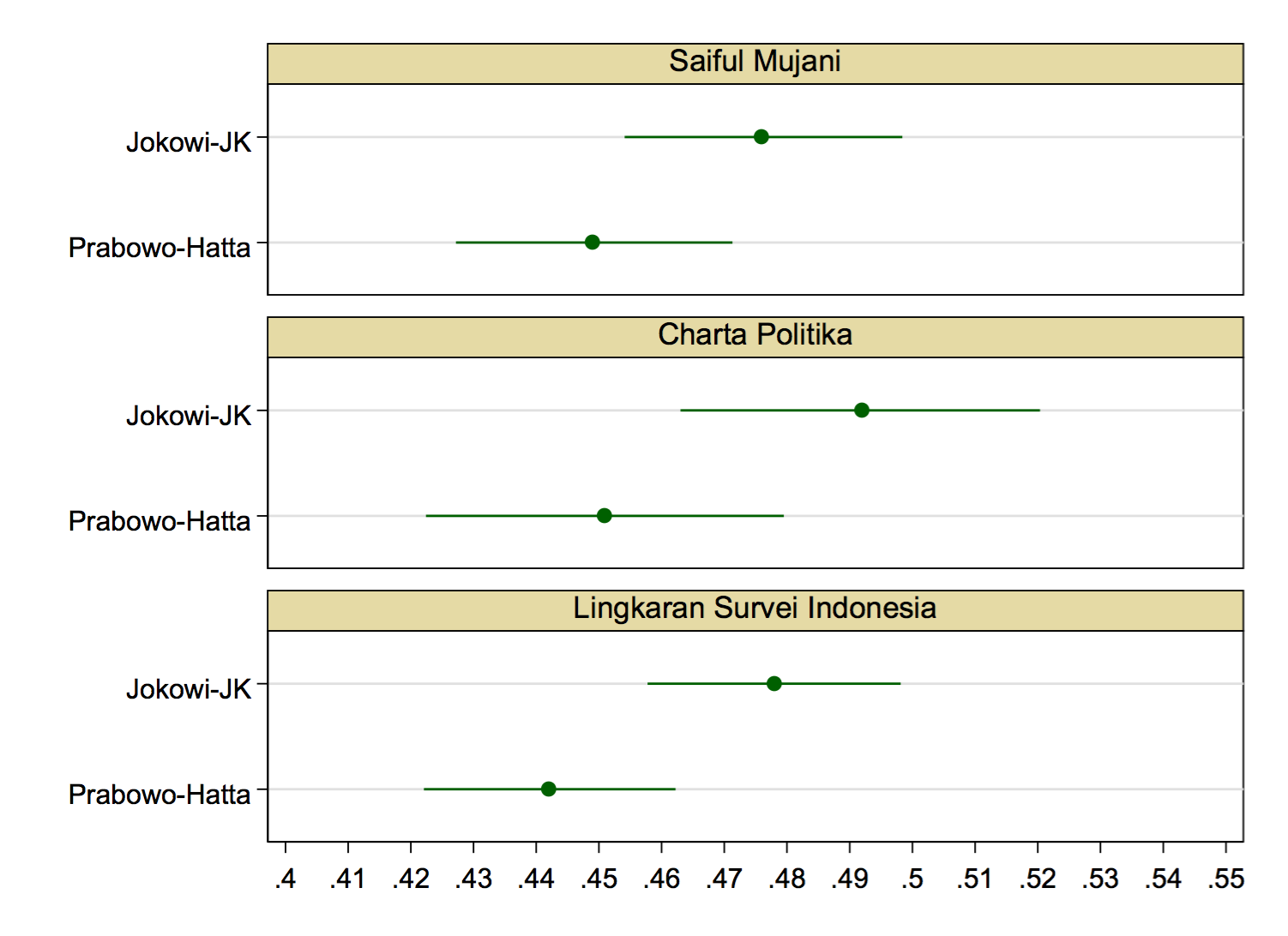
    The latest polls have Jokowi-JK narrowly ahead. Here are the latest polls by Saiful Mujani Research and Consulting, Charta Politika, and Lingkaran Survei Indonesia, with estimates and 95% confidence intervals plotted (see here how we get the confidence intervals).
    Percent Support, by Pollster
    Percent Support, by Pollster

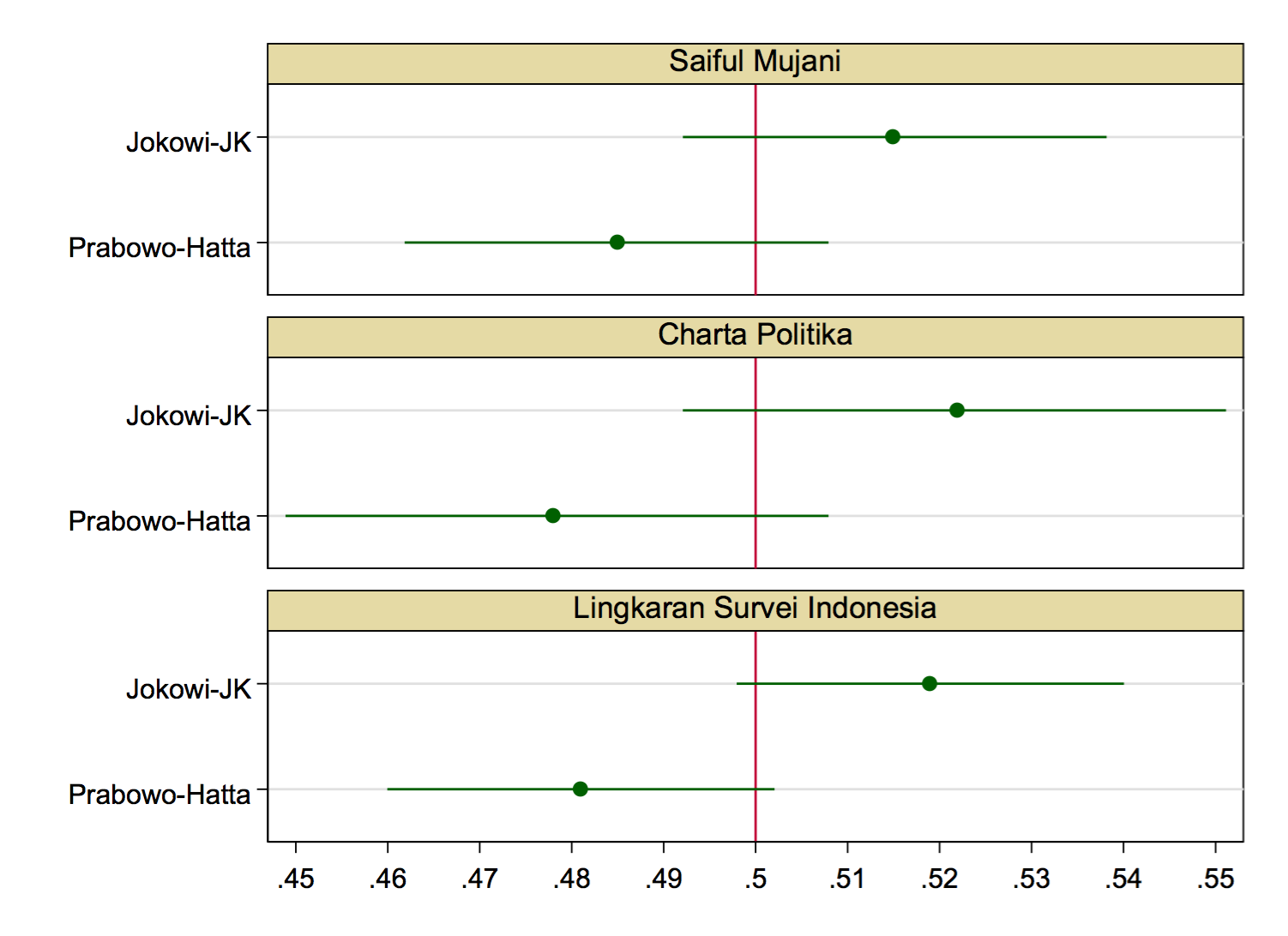
    Looking at these results, you should conclude that Jokowi’s lead is not commanding. Our best guess based on the polls is that he will win, but the confidence intervals around these point predictions overlap slightly. However, those figures are the percentage of survey respondents choosing each ticket—they do not add to 1 because they include undecideds. So, I have calculated the “two-ticket vote share,” which appears below (in calculating the CIs, I have adjusted the sample size by removing undecideds).
    Two Party Vote Share, by Pollster
    Two Ticket Vote Share, by Pollster

    We see more clearly here that that our best prediction based on these polls is a Jokowi-JK victory, but that the margin of error is large enough in these polls that the two confidence intervals overlap. If Prabowo-Hatta were to emerge victorious, it would not contradict any of the polls.

    Readers will note that I have been careful to stipulate that these are predictions “based on these polls.” Why? Because in this election (like in every other election anywhere in the world) the undecideds will prove crucial. However, unlike many other elections in consolidated democracies, last-minute vote buying may be the decisive factor. Prabowo-Hatta has an advantage here: bankrolled by his brother and other extraordinarily wealthy businessmen-politicians like Aburizal Bakrie, he has more resources available to buy votes (and turnout) tomorrow. Moreover, none of Prabowo’s actions in the past three months suggest that he would be averse to buying his way to victory through direct cash payments to voters.

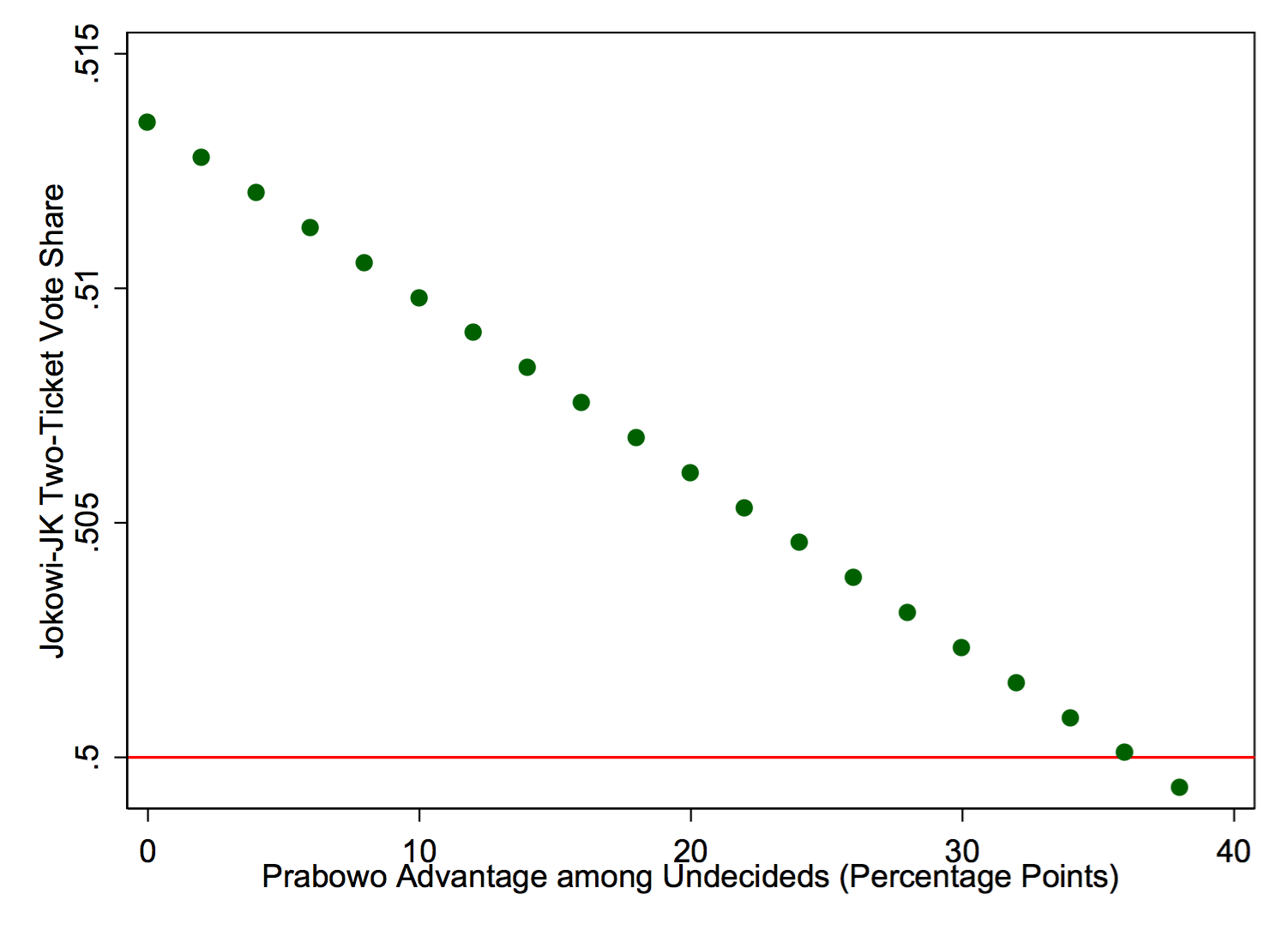
    We can’t tell exactly how much of an advantage among the undecideds Prabowo would need to win the election. However, we can calculate how much of an advantage he would need to have among the undecideds in order to equalize his chances. I will use the Saiful Mujani Research and Consulting poll to illustrate. We know that the poll has 7.5% undecideds; with a sample size of 1997, this means 149 people. If we divide the undecideds evenly between Jokowi and Prabowo, this leaves our best guess as 1025 respondents for Jokowi and 972 for Prabowo.

    Now let’s say that 60% of undecideds go for Prabowo—a 20 percentage point advantage for Prabowo. That leaves 1011 respondents for Jokowi and 986 for Prabowo, with our best guess still that Jokowi wins, but with a lower two-ticket vote share of only 50.6% (and accordingly more overlap in the CIs). We can keep going, adding more of an advantage for Prabowo. As it turns out, it takes about a 36 percentage point advantage for Prabowo among the undecideds (68% go for him) to equalize his chances, as the graph below illustrates.
    undecideds
    Such an advantage for Prabowo does not strike me as out of the question given the sheer amount of financial resources he has at his disposal. If Jokowi’s team is smart, they will do everything they can to mobilize their ground game tomorrow to keep vote buying at a minimum. Suffice it to say that this also depends on whether the Indonesia’s security forces remain neutral in tomorrow’s elections, and it is a worrying sign that civil society groups have to make this demand explicit.

    We’ll learn a lot more when the elections take place tomorrow. Watch this space for more.

  • Shleifer and Vishny (1993) meet Prabowo (2014?)

    In my conversations in Jakarta last week, I began to see some of the factors that are driving popular support for presidential candidate Prabowo Subianto. Time and again I heard about the concept of “control” and “order” with respect to Indonesia’s political economy. The focus on Prabowo as the tegas [= decisive or resolute] candidate only captures this partially.

    The specific argument was about corruption and uncertainty, and it was uniformly expressed to me by people in Indonesia’s upper-middle to upper classes. The idea is not that Prabowo is smart, or that he is capable, or that even that he is reasonable—no one holds these views. Rather, the idea is that Prabowo would be strong and ruthless enough to clamp down on the rampant corruption that plagues post-Soeharto Indonesia. He would not eliminate corruption, he would organize and “regulate” it.

    This view recalls an important literature on corruption in post-Soeharto Indonesia associated with Ross McLeod (see here), Andrew MacIntyre (see here), and drawing on the theoretical insights of Shleifer and Vishny (1993). Describing their basic hierarchical model of corruption in places like the Philippines under Marcos, they write

    It is always clear who needs to be bribed and by how much. The bribe is then divided between all the relevant government bureaucrats, who agree not to demand further bribes.

    This is the Soeharto model. However, there is another scenario:

    Here, the sellers of the complementary government goods, such as permits and licenses, act independently. Different ministries, agencies, and levels of local government all set their own bribes independently in an attempt to maximize their own revenue, rather than the combined revenue of the bribe collectors…This problem is made much worse in many countries by free entry into the collection of bribes. New government organizations and officials often have the opportunity to create laws and regulations that enable them to become providers of additional required permits and licenses and charge for them accordingly. Having paid three bribes, the buy of these inputs learns that he must buy yet another one if he wants his project to proceed. In some cases, the officials who have collected the bribe previously come back to demand more.

    This is closer to the current state of affairs in Indonesia. I have written about this here and here. The point is not that the Soeharto model is “good,” or even that it is “good corruption,” it is simply that given the choice between living in a decentralized web of bribery and influence peddling versus a hierarchical of extortion, many in the business community would prefer the former.

    This is an example of what I called for several weeks ago, a non-tautological argument for why a class of people would support Prabowo’s candidacy. You can start to see something of the group of voters coming out in favor of Prabowo based on their calculations of what they believe that they will benefit from his rule.

    Now, none of this means that Prabowo could make actually such a change to Indonesia’s political economy. My guess is that he cannot, not without doing a lot more than winning the upcoming election. Constructing the New Order under Soeharto required two things: the systematic elimination of organized political opposition, and the centralization of coercive power under the office of the president. The former will be made difficult by the simple fact that aside from Prabowo’s brother, all of his elite political supporters are opportunistic, without any interest whatsoever in seeing Prabowo consolidate power. (Contrast this to Thailand’s conservatives, who share a common vision of Thai-style democracy.) The latter will be made difficult by the fact that Soeharto rose to power through the military itself, whereas Prabowo was discharged from the military in 1998 and would have to face a more difficult political task of reestablishing the kind of military authority that Soeharto unquestionably faced. These observations, though, are cold comfort for Prabowo’s opponents who understand just how “Soeharto’s ghost” continues to haunt Indonesian politics.