
Several days ago I wondered about our ability to understand the support that Prabowo Subianto’s presidential campaign is getting. Since then, we have had two very useful contributions, one by Ed Aspinall and another by Nicholas Herriman. Both come very highly recommended.
Another source of information is the imagery that the two campaigns use. This can help us to understand what messages Prabowo’s campaign thinks will appeal to voters. I’ve tried to capture this with some pictures taken during my morning stroll along Imam Bonjol/Diponegoro street in central Jakarta. (Forgive the lousy picture quality…these were all taken on a phone.)
We begin with the headquarters of PPP, an Islamist party (note the Ka’aba on their logo) which supports Prabowo.
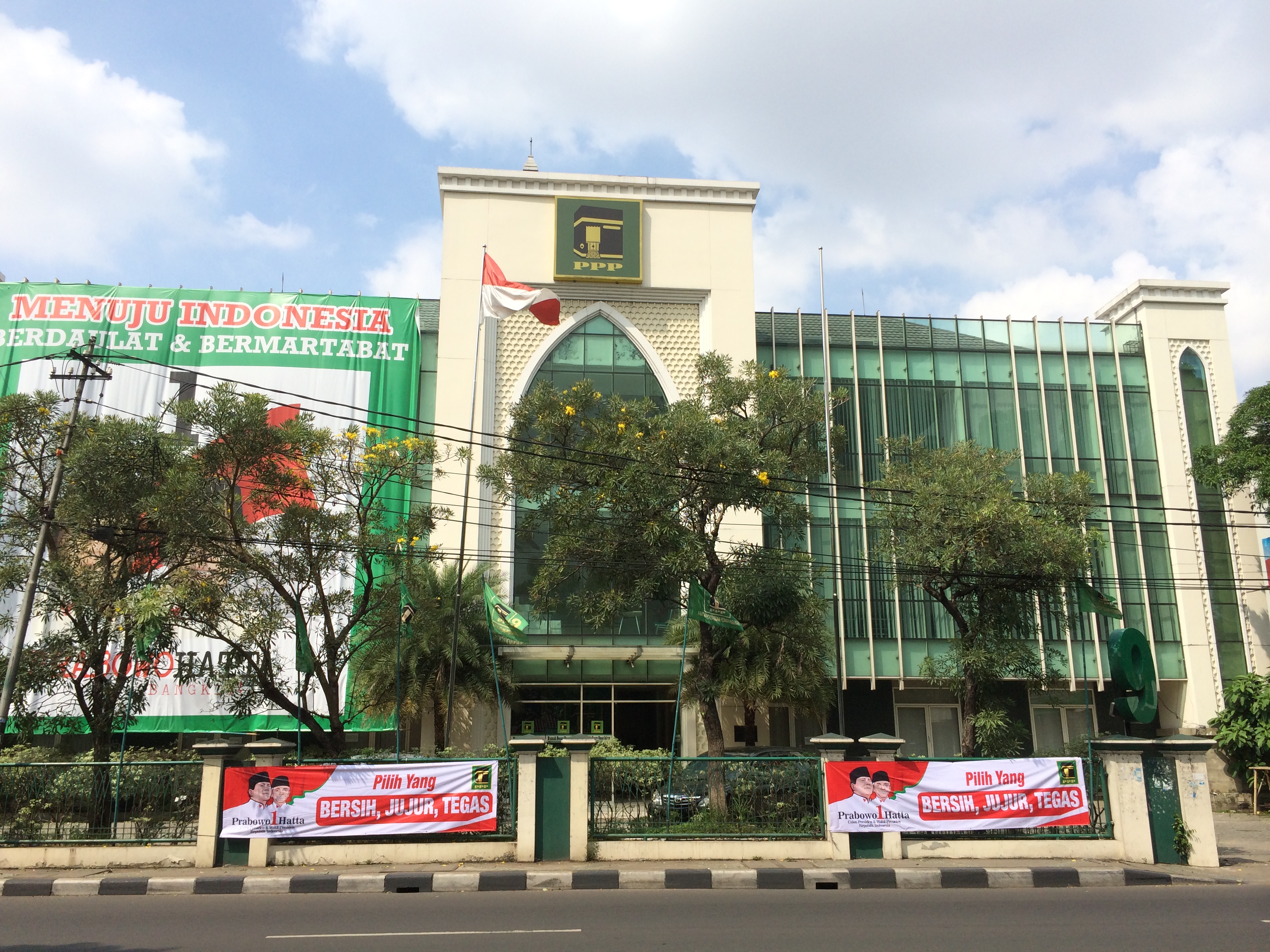
They’ve gone with Pilih yang bersih, jujur, tegas [= choose the ones who are clean, honest, and resolute]. This is interesting because jujur (honest) is one term almost always associated with Jokowi. Indeed, right across the street, we have a Petisi pendukung Jokowi-JK [= Petition of Jokowi-JK supporters]
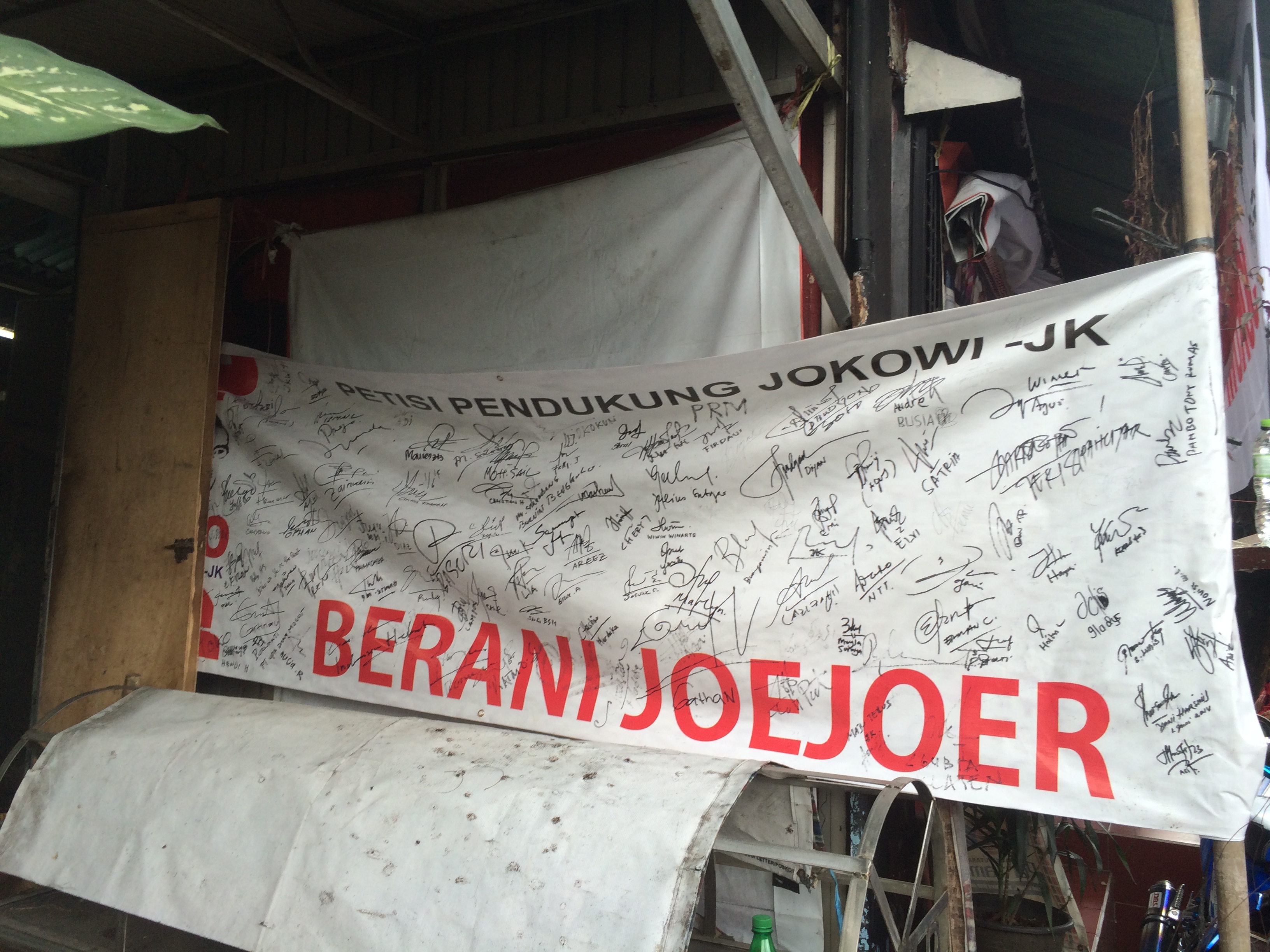
At the bottom we see Berani Joejoer [= brave honest]. I’m not sure what meaning the old-style spelling conveys. Around the corner, one of my favorite images of Soekarno, now partially obscured by a Jokowi banner:

Further down the street, we get a more typical Prabowo banner from FKPPI, a youth group connected to a military retirees association.

The picture is lousy, but you should be able to make out Anak Prajurit Dukung Prabowo: 1 Komando Semua [= Soldiers’ Children Support Prabowo: One Commando for All], which I suppose is a little ironic when you take into account that Prabowo was summarily dismissed from his position as Kostrad commander right after his father-in-law stepped down.
Further on down, at the headquarters of Hanura, we see banners in support of Jokowi. Hanura is the party founded by Wiranto, the general who dismissed Prabowo back in 1998 and who has run himself unsuccessfully several times for president.

The shadows obscure a little wordplay, with the phrase Kopi Jokja, or Konferensi Pemuda Indonesia untuk Jokowi Jusuf Kalla [= Conference of Indonesian Youth for Jokowi and Jusuf Kalla]. The pun is that this sounds a lot like “Yogya coffee,” recalling the central Javanese city of Yogyajakarta.
A bit further down the street, another one for Prabowo.

There’s a lot going on here.
- Islamic imagery, with Marhaban Ya Ramadhan written in a kind of Arabic-looking Latin script complete with randomly placed diacritic dots.
- Some traditional Javanese imagery, with Dwi Tunggal [roughly = two in one] evoking Indonesia’s first President and Vice President pairing of Soekarno and Mohammad Hatta.
- Coblos No 1 demi harga diri bangsa Indonesia [= Choose No 1 for the pride/self-worth of the Indonesian nation] reflecting the narrative that Prabowo will help Indonesia to be a stronger and prouder country.
And to bring my walk to a close, one more for Prabowo.
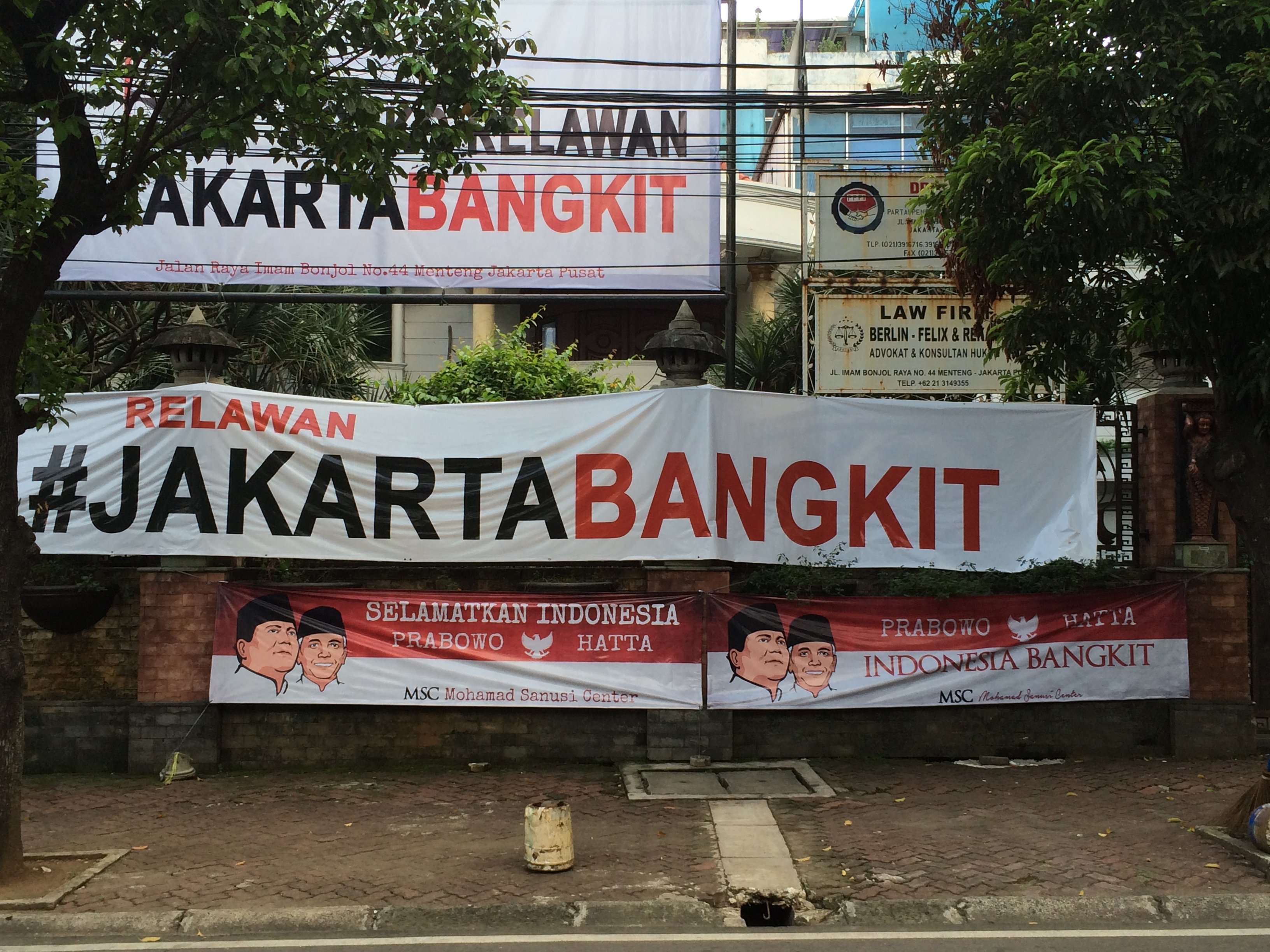
We see voters urged to Selamatkan Indonesia [= Save Indonesia], and Indonesia Bangkit [= Indonesia awakens]. The hashtag #JakartaBangkit [= Jakarta awakens], looking on Twitter, is associated with comments that criticize Jokowi’s performance as Jakarta Governor.
So there we have it. Over the course of about half a mile along one of Jakarta’s most prosperous downtown streets, a wealth of imagery conveying the tone of each campaign. It’s no substitute at all for the kinds of deep analysis that Aspinall and Herriman provide, and it doesn’t at all answer my question about why such messages generate support for Prabowo, but it does give a very basic sense of what’s going on.
Update
I caught one final picture on my walk to dinner. This is taken at twilight, and the busy street kept me from getting too close, but it is perhaps the most interesting Jokowi banner.

This reads Nasionalis sejati pasti menghargai pluralisme [= a true nationalist certainly values pluralism], followed by Jokowi adalah kita [= Jokowi is us]. Using pluralisme for pluralism rather than some Indonesian equivalent like kebhinnekaan conveys a strong message. I leave it to the reader to make sense of the larger meaning behind this.

