Category: Current Affairs

  • “Malays are the Real Immigrants”: On Malaysia’s Political Taboo

    The past several days have seen a growing debate in Malaysia about ethnicity and indigeneity. The proximate trigger is a speech delivered by M. Kulasegaran, Malaysia’s Minister of Human Resources and a Malaysian of Tamil heritage. The Malay-language newspaper Utusan Malaysia reported that the speech—delivered in Tamil—contained the following statement:

    Kebanyakan orang telah lupa, orang Hindu mula jejak negara ini 2,500 tahun dulu. Apa buktinya? Sekiranya anda pergi ke Lembah Bujang, ke­semua bukti terdapat di sana. Terdapat banyak kuil lama yang ditemui di sana.

    Apabila kitalah yang berada di negara ini terlebih dahulu, maka, merekalah (Melayu) yang sebenarnya pendatang! Kita dan Melayu adalah setaraf. Ini tanah air kita!

    Most people forget, Hindus first forged the trail of this country 2500 years ago. The proof? Head to Lembah Bujang, the evidence is all there. There are many temples that have long been there.

    If we were in this country earlier, then they [the Malays] are the real immigrants. We and the Malays are the same [EDIT: a better translation might be “the same level”]. This is our homeland.

    Kula has vigorously contested Utusan‘s coverage, arguing instead that he was merely pointing out the long history of Indians in peninsular Malaysia, subsequently clarifying that he meant to apply the term to those who stir up racial hatreds, and finally apologizing and offering to withdraw the statement.

    Whatever the facts of these particular comments are, Kula’s interpreted comments touch on core issues in Malaysian politics that are almost taboo in public discussion. Most of the online commentary and reaction focuses on the question of whether or not the fact that Hindus from the subcontinent were in Malaya for thousands of years somehow challenges Malay supremacy. But the taboo is not that: the taboo is suggesting that Malays themselves are immigrants, which is what pendatang [= immigrant] precisely means.

    How could Malays, Malaysia’s titular ethnic group and one of the country’s “sons of the soil,” be immigrants? The answer is to realize that the term Malay has several uses: as a crude term for the “race” of people of island Southeast Asia; as a term that covers the ethnic group speaking one of the variants of the Malay language found in peninsular Malaysia, parts of Sumatra, and in parts of Borneo; and as a political category referring to the ethnic group living in peninsular Malaysia that is neither Chinese, nor Indian, nor “other” (Portuguese, Thai, orang asli, etc). These categories of usage overlap, and Malaysian politics has worked to elide the second and third understandings in particular. But the definition of Malay enshrined in the country’s constitution specifically does not mention land or territory, rather language and custom and religion.*

    The question of why the constitution would not refer to land or place in defining what a Malay is requires further discussion, but the consequence is that the political category of Malay may legitimately encompasses the descendants of many peoples, not just those with “ancestral ties” to the Malay peninsula. The tension that follows is clear: “Malay supremacy” evokes and is justified by a relationship between people and place, but “Malay” as a political category does not require it.

    That Malays today have a plural heritage is not a secret, nor is it politically problematic in and of itself.** But raising the issue of Malays as pendatang means questioning the indigeneity of the political category “Malay”, and with it the logic of enshrining Malay special rights on behalf of community whose members may have only lived in the country for a generation or two. Enshrining Malay special rights in the constitution is an act of politics—it was a political choice. And even talking about it tangentially is taboo precisely because since independence, Malaysian politics has attempted to erase the history of choice and the politics around it.

    NOTES

    * See Judith Nagata’s classic constructivist account of Malayness for more (PDF).
    ** Here, for example is Dzulkifli Abdul Razak raising this point in an opinion piece just yesterday.
  • #GE14: The Malaysian Tsunami in Figures

    Malaysia’s 14th General Elections saw the incumbent Barisan Nasional regime ousted from power in an election broadly described as a “Malaysian Tsunami.” This term recalls earlier descriptions of waves of anti-BN voting as a “Chinese tsunami” or a “Malay tsunami,” and makes the case that Malaysians off all ethnic backgrounds turned out to vote against the regime.

    The figures below tell the story of the Malaysian tsunami using electoral return data (see this previous post for a description). For the purposes of this analysis, I focus on peninsular Malaysia only. Not because Sabahans and Sarawakians are not Malaysians—they too contributed to the Malaysian tsunami by voting in unprecedented ways for non-BN parties—but because important differences in party competition between peninsular Malaysia and East Malaysia make a unified analysis difficult (Sabah and Sarawak are regions of exception).

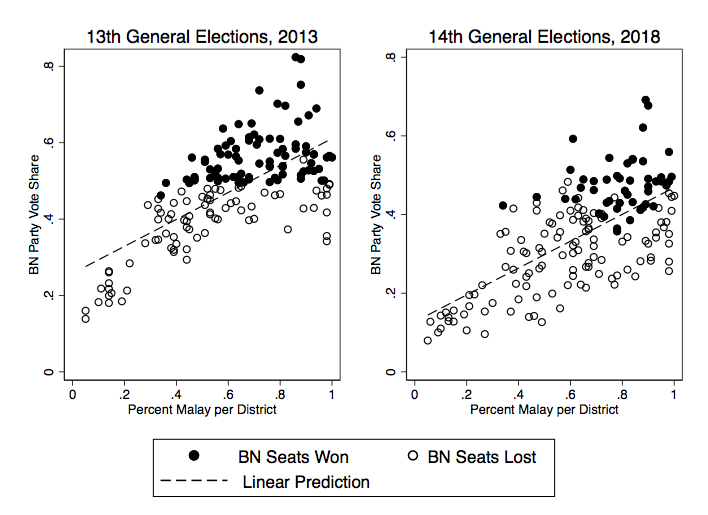
    The 2018 Malaysian tsunami is best described by comparing vote returns from GE13 (2013) and GE14. As I have argued previously (see here (PDF) and here (PDF)) ethnicity plays a central role in Malaysian electoral politics. First, we can compare the relationship between the ethnic composition of an electoral district and support for the BN candidate in 2013 versus 2018.

    We see here that there remains a strong correlation between district Malay population share and BN support… but that the overall baseline level of support for the BN has simply dropped all across the board. This suggests a broad rejection of the BN across districts.

    We can also look at the relative change in BN support from 2013 to 2018. The figure below compares the percentage change in BN support—that is, (BNSupport2013 – BNSupport2018) / BNSupport2013—to both 2013 BN support and 2018 Malay population per district.

    We see here that the BN suffered more of a percentage decline in vote share in places where it had previously done poorly, and in places that (statistically) had been unlikely to support BN parties (that is, non-Malay majority districts).

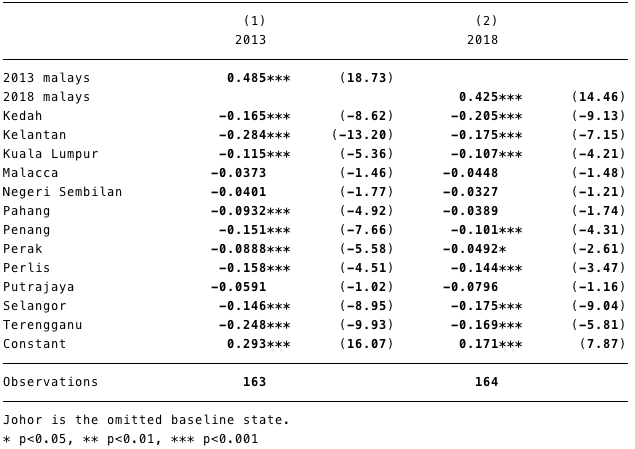
    Now, one thing to note is that not all Malay-majority districts are the same. Some Malaysian states, such as Kelantan in the northeast, have never been UMNO/BN strongholds. A multivariate analysis can allow us to account for how states differ, and to see if that affects our conclusions about the relationship between ethnicity and BN support. First we can look at the simple regression output:

    The coefficients on Malay population by district (2013 malays and 2018 malays) are remarkably similar. So too are many of the state fixed effects. Where we see the biggest differences between GE13 and GE14 is in the intercept: a dramatic decrease in baseline support for BN candidates. The next figure compares predicted levels of BN support across states from these two regression analyses.

    The patterns are very similar—just shifted to the left in 2018. Notable additional differences are Kedah and Selangor, which swung more sharply against the BN relative to other states. But it still remains the case that Johor is a relative BN stronghold, and Terengganu and Kelantan are not.

    One final issue is urbanization, which is a common argument about what drives BN support in Malaysia. It is sometimes viewed as an alternative to arguments about the ethnic basis of Malaysian electoral politics; this is a debate I discussed here and here in the context of GE13. Ng, Rangel, Vaithilingam, and Pillay (2015) argues that we should consider urbanization the prime mover of Malaysian politics in 2013. Using data that they kindly shared with me, I’m able to test if their own coding of districts as urban, suburban, or rural shapes our conclusions about ethnicity in 2018.

    To do this, I interacted the Malay population variable above with their district urbanization coding, and plotted predicted levels of BN support in 2013 and 2018 by urbanization and district Malay population share.

    Rural Malaysians continue to be more pro-BN than urban Malaysians in 2018. But it also remains the case that regardless of the level of urbanization, district Malay population is a prime driver of BN vote share. The difference simply is that the predicted level of BN support is lower, all across the board.

    These results present a quantitative overview of a Malaysian electorate that swung broadly against the BN: Malays and non-Malays, urban and rural, across the entire peninsula. A Malaysian tsunami indeed.