Category: Current Affairs

  • Malaysia 13th General Elections Preview (9)

    Malaysia’s Indian community has not fared well under BN rule. They are numerically fewer than the Malay and Chinese communities on the peninsula, and on the whole, Tamils and other South Asian communities have whole not enjoyed the fruits of development that other Malaysian communities have. Lumped together with Chinese as non-bumiputera, their particular concerns and grievances have long been obscured. Hindu places of worship are commonly closed without cause, or alleged to be illegal in some way (this is the proximate origin of the Hindu Rights Action Force). It does not help that the BN’s Indian party—the Malaysian Indian Congress—is perhaps the most ineffectual of all BN parties. (“Ineffectual” is  pleasant way of saying corrupt and incompetent.)

    I argued several years ago that a key part of Malaysia’s 2008 political tsunami was the near complete rejection of the BN by Indian voters. That represents the culmination of decades of neglect, and my favorite sources on this are Sucked Oranges, the academic work of P. Ramasamy, and Cage of Freedom by my Cornell colleague Andrew Willford.

    But a persistent structural problem is the fact that Indians are always and everywhere a minority, in every district. The figure below illustrates this perfectly.
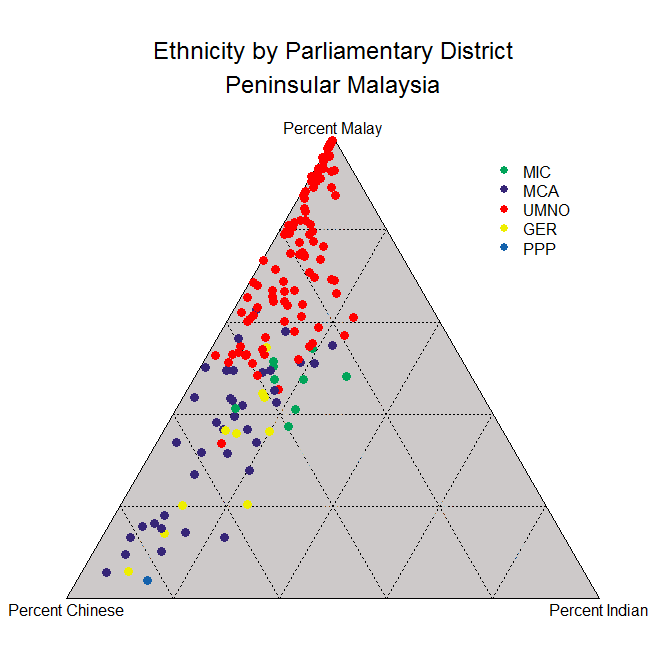
    Plots like this—ternary plots—can be hard to read if you’ve never seen them before. So let’s walk through this one. For every district in peninsular Malaysia, we know the percent Malay, Chinese, and Indian, the triple (M%, C%, I%), from the data described in my last post. The sum of the three numbers, of course, is 100. The ternary plot just plots the distribution of the triples in two dimensions. An overwhelmingly Malay district (98,1,1) will fall near the top. An overwhelmingly Chinese district (1,98,1) will fall at the bottom left. A mixed district (33.3,33.3,33.3) will fall in the exact middle. A multiethnic district of type (40,40,20) will fall closer to the northwest side.

    The plot shows just how dispersed the Indian population in Malaysia: there is no Indian majority district, nor an Indian plurality district. The colored dots indicate which party was nominated in each district, and we do see that MIC candidates are nominated in just those districts where Malays and Chinese are roughly equal in size and Indians are fairly prevalent. But note, in districts where Indians are equally numerous as those few MIC districts, but Malays and Chinese are not so evenly divided (so the district falls closer to the bottom left or top, but along the same southwest-to-northeast diagonal), the UMNO or MCA always contests.

    The conclusion that emerges is the size and distribution of the Indian population in Malaysia leaves is structurally incapable of winning more than juts a handful of seats. That is, of course, just so long as coalitions nominate parties based on ethnicity.

    Earlier in the series: Preview (1) | Preview (2) | Preview (3) | Preview (4) | Preview (5) | Preview (6) | Preview (7) | Preview (8)
  • Malaysia 13th General Elections Preview (8)

    Nomination Day was April 20: we now know the full list of candidates for all 222 parliamentary races and 505 state assembly races. Election Day is less than two weeks away now. Some very interesting analysis of the Nomination Day results is available at Malaysia’s Dilemma, especially this recent piece by Bridget Welsh. We can appreciate this and other analyses better by looking at all of the data together, something which I’ll begin to do here.

    This wouldn’t be possible even ten years ago, but Malaysia’s online media have done a great job of providing data on these elections. I’ve grabbed the data on candidates from the Electoral Commission. Let’s look first at the head-to-head contests: given that these are SMD elections and that both the incumbent BN and opposition PR are contesting in every district (except for one district in which the UMNO candidate didn’t file his papers on time), these will be the matchups that matter.

    Parliamentary Elections, Peninsular Malaysia

    PR
    DAP PAS PKR Total
    GER 8 1 1 10
    MCA 25 1 12 38
    BN MIC 1 1 7 9
    PPP 1 0 0 1
    UMNO 1 61 44 106
    Total 36 64 64 164

    Looks similar to old patterns, with the Malaysian Chinese Association and (largely Chinese) Gerakan up against the (largely Chinese) DAP and UMNO versus (largely Malay) PAS. However, we see here a real attempt by PKR to continue to break the ethnic politics mold, with significant numbers of PKR candidates against both UMNO and MCA. Let’s see if this holds at the state level:

    State Assembly Elections, Peninsular Malaysia

    PR
    DAP PAS PKR Total
    GER 18 1 10 29
    MCA 69 3 16 88
    BN MIC 5 2 11 18
    PPP 3 0 1 4
    UMNO 0 215 91 306
    Total 95 221 129 445

    In short, it does. Now let’s take a look at the parliamentary races in East Malaysia, where the partisanship is so very different.

    Parliamentary Elections, East Malaysia

    PR
    DAP PAS PKR Total
    LDP 1 0 0 1
    PB 0 1 0 1
    PBB 3 4 6 13
    PBRS 0 0 1 1
    BN PBS 1 1 3 5
    PRS 0 0 6 6
    SPDP 2 0 2 4
    SUPP 6 0 1 7
    UMNO 1 1 13 15
    UPKO 1 0 3 4
    Total 15 7 35 57

    There are two things to take away from these tables. First is the simple fact that PR is contesting in every constituency, which is a new and striking development. Second is that PKR is really taking it to UMNO, which faces PKR in 13/15 of its races (which are all in Sabah and Labuan). I interpret this as a direct attempt to head off UMNO’s expansion into valuable territory.

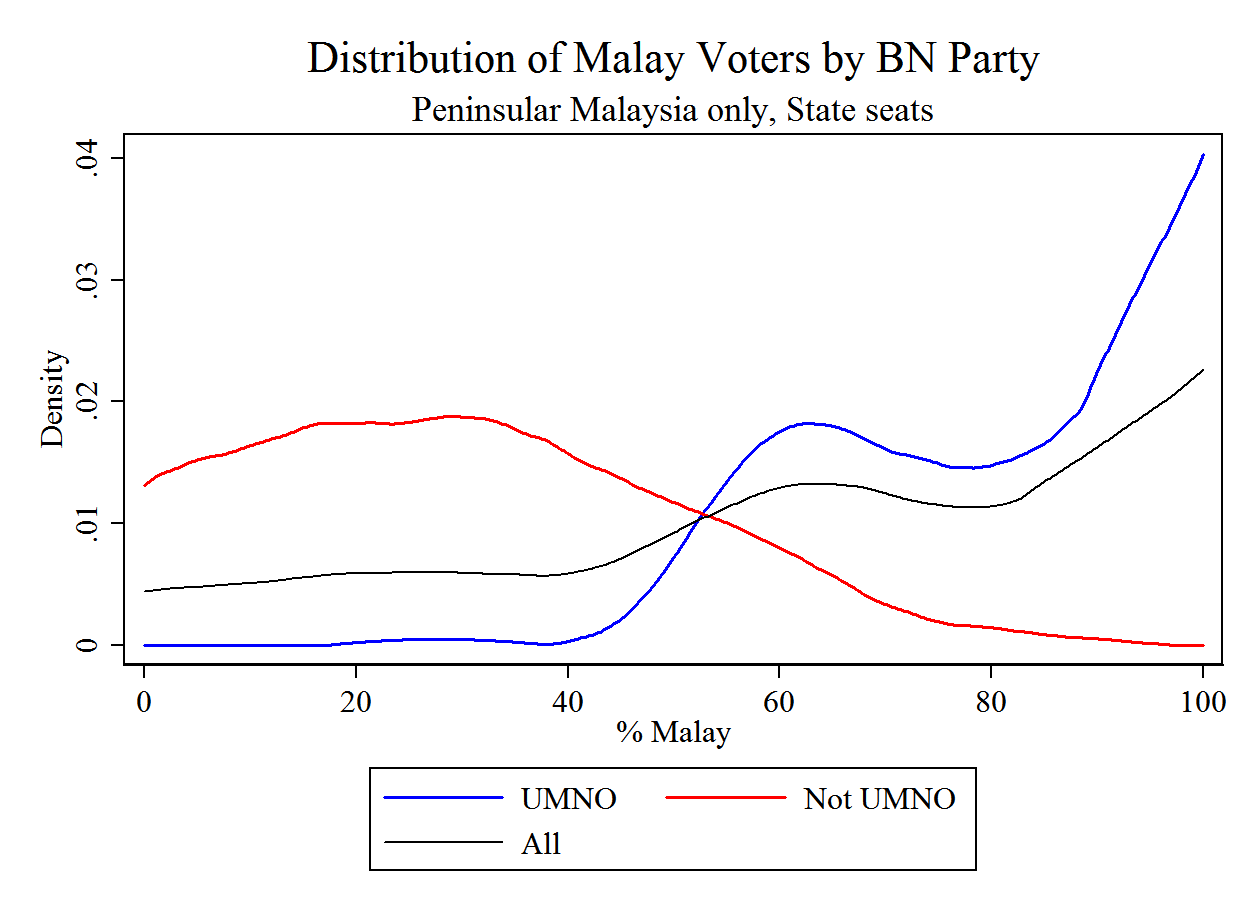
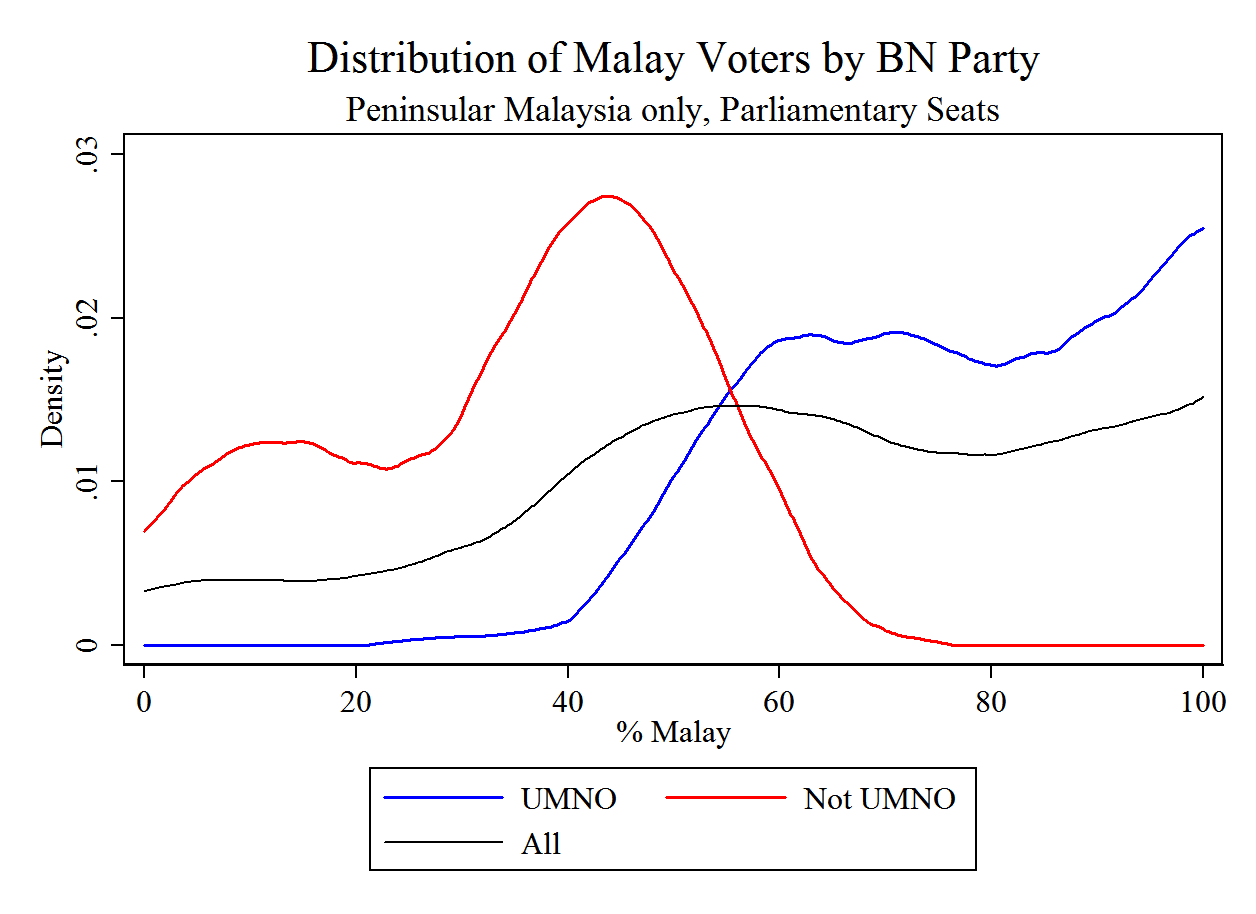
    So how much do party nominations reflect “their” ethnic constituencies? Recall that most of Malaysia’s parties have clear ethnic bases, and this is especially true among the ruling Barisan Nasional coalition and in the peninsula. I was able to find data on ethnic composition by each electoral constituency from Utusan Malaysia‘s online GE13 portal. Let’s look first at the percentage of each district’s population which is Malay, comparing its distribution across UMNO and other BN parties in the peninsula. First, parliamentary districts, then state assembly districts.


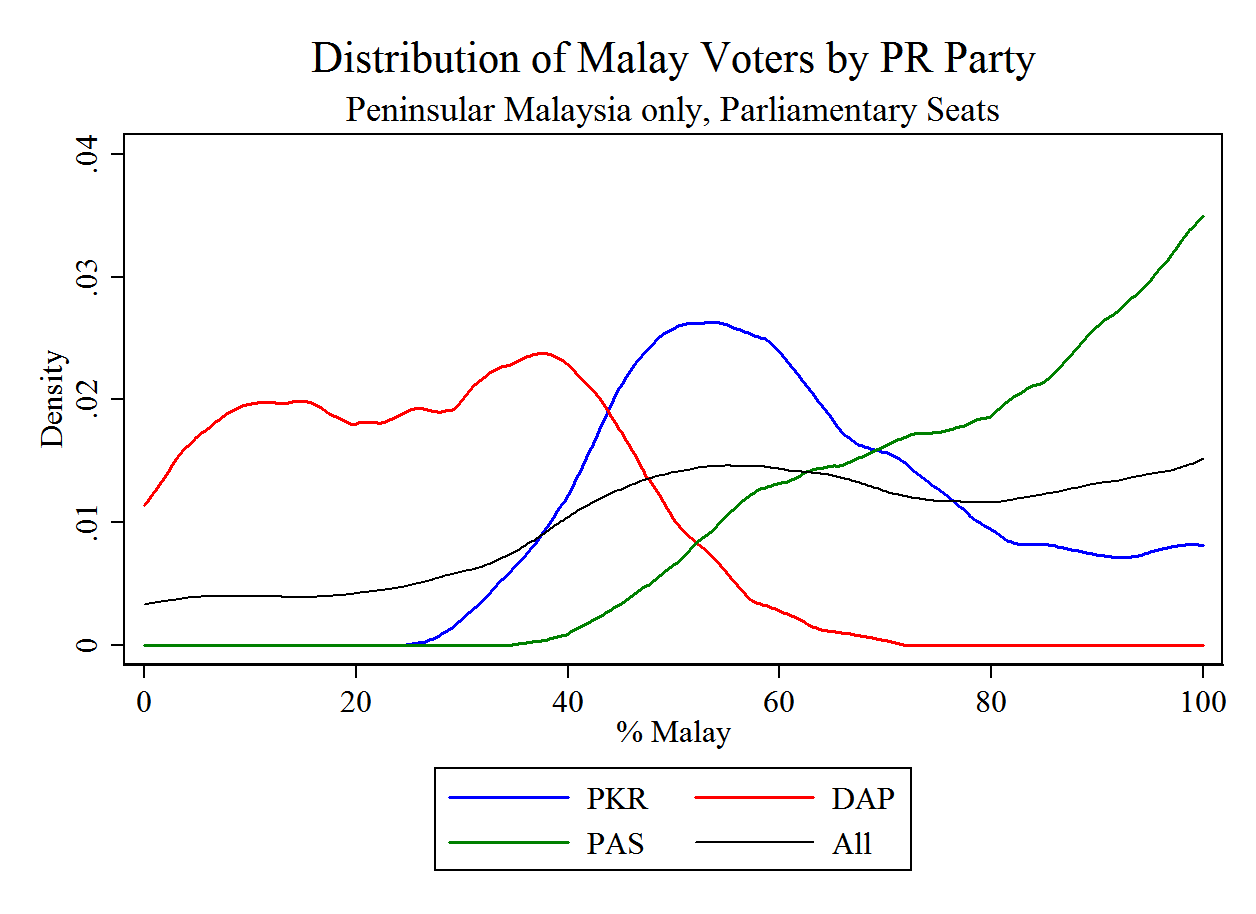
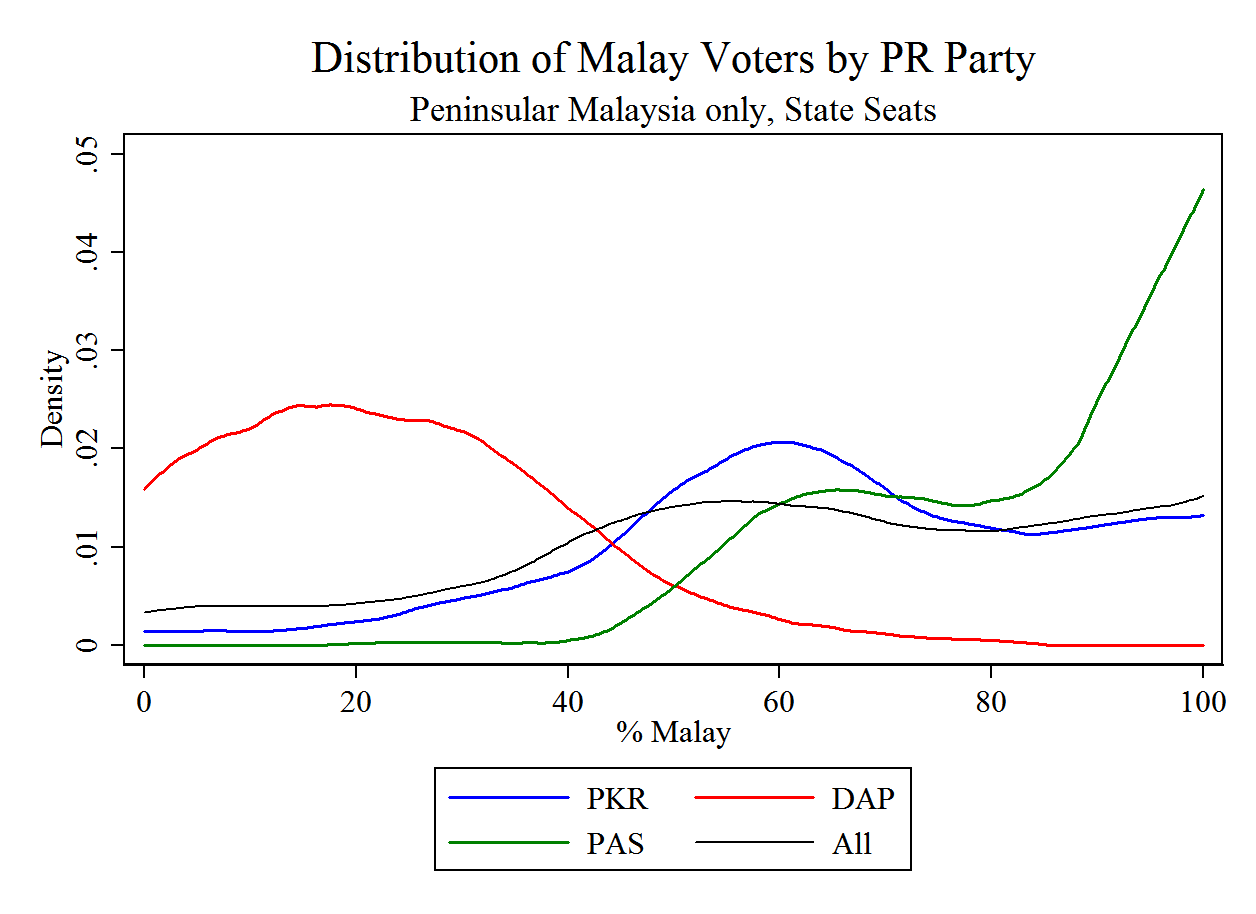
    (These are kernel density plots, but they look a bit different than you might expect because the distribution of percentages is bounded on [0,100].) It is abundantly clear here that UMNO gets to represent the Malay majority districts. How does this compare for the three parties in the DR? Let’s repeat the exercise.


    These results are also quite clear: PAS tends to get the districts with a big Malay majority, DAP the districts with small Malay minorities, and the PKR tends to occupy the middle range. The only exception is that in state races, there is not as large of a divergence between PKR and PAS at the highest ends of the distribution of Malayness. These seats are still largely contested by PAS, but not exclusively.

    The final topic I’ll take on today is the prevalence of third (and fourth, and fifth…) party candidates. These are sometimes independents, sometimes not. Let’s look at how these break down.

    Third Party Candidates by Region

    Parliament
    East Malaysia Peninsula Total
    No 16 116 132
    Yes 41 49 90
    Total 57 165 222
    State Assembly
    East Malaysia Peninsula Total
    No 1 324 325
    Third Party Yes 59 121 180
    Total 60 445 505

    These figures indicate that third-party entrants are normal in East Malaysia, and relatively uncommon in the peninsula. We can also detect differences in party competition from non-BN and non-PR parties.

    Independents among Third-Party Candidates

    Parliament
    East Malaysia Peninsula Total
    No 23 3 26
    Independent Yes 18 46 64
    Total 41 49 90
    State Assembly
    East Malaysia Peninsula Total
    No 29 11 40
    Independent Yes 30 110 140
    Total 59 121 180

    This shows us that among districts with third-party entrants, in Peninsular Malaysia these entrants were almost always independents. In East Malaysia, districts with third-party entrants had a mix of both independents and true third-party candidates representing parties like SAPP and STAR.

    In all, lots to be learned from just the publicly available data, but of course this should all be combined with the excellent contextual analyses being produced by scholars in from Malaysia and analysts in the field. But a couple of strong conclusions emerge: (1) ethnicity matters in both coalitions, (2) regional differences in party competition remain large, and (3) the PR has mounted a unified and truly national campaign, with PKR continuing to try to break down the Law of Party=Ethnicity that has characterized Malaysian politics since independence.

    Earlier in the series: Preview (1) | Preview (2) | Preview (3) | Preview (4) | Preview (5) | Preview (6) | Preview (7)