
The Indonesia Documentation Project yesterday released a wealth of recently declassified documents on Soeharto’s last year in office and the collapse of the New Order regime. As always, these documents are a treasure trove of information, but this release is of particular interest to me because they cover the Asian Financial Crisis, economic reform, the fall of Soeharto, and key personalities in Indonesian politics today like Prabowo Subianto.
Here are my three top highlights.
Prabowo on Politics, and the Military, and Soeharto
This document contains a report of a meeting between Assistant Secretary of State Stanley Roth and Prabowo Subianto, who was then Soeharto’s son-in-law and a rising power in the Indonesian military. He recently ran for president, coming in second, and will run again in 2019. At this meeting, Roth and Prabowo discussed the future of Indonesian politics and the military’s role in it, and Prabowo took it upon himself to represent a moderate reformist position.
Prabowo’s generation of ABRI [Indonesian armed forces] leaders want to follow the examples of South Korea, Taiwan, and Thailand. “I hate politics. I want the military out of politics,” he said.
I leave it as an exercise for the reader to decide what is the most ridiculous thing in that passage. But it is important because it establishes how Prabowo was maneuvering himself to succeed Soeharto. Here is a summary of Prabowo on Soeharto from the same meeting:
Soeharto’s background was as a soldier. He had no foreign training and little formal education, but he is extremely intelligent and has a photographic memory. However, the president does not always understand world concerns and pressures. From Prabowo’s perspective, it would be better of Soeharto stepped down in March 1998.
In the event, Prabowo got closer to Soeharto after March 1998, when he was appointed to head of the Army’s strategic reserve command. Right after Soeharto resigned, Prabowo was removed. As I’ve argued elsewhere, using Prabowo as an example, mixing family and politics can be quite dangerous because it insulates leaders from information that they might need about their popularity and the effectiveness in office. Here’s a summary of Prabowo again:
Below the surface, there are already intrigues underway by people who know they are not strong enough to challenge the president directly.
Indeed.
Also fascinating is how Prabowo invokes the contemporaneous example of the breakup of Yugoslavia as a possible future for Indonesia. The idea is to paint the country as vulnerable, and in need of some sort of stabilizing force to accompany the transition. We often forget that many very reasonable people worried at the time that Indonesia would split apart in the event of a transition.
CLINTON AND SOEHARTO TALK ECONOMIC REFORM
This document details a phone call between Soeharto and President Bill Clinton, on January 9, 1998, during which they talked about economic reform during the Asian Financial Crisis as well as the challenges the Soeharto faced in implementing these reforms. Clinton represents an orthodox view that holds that the only way to fight massive currency depreciation is to keep interest rates high. He also emphasizes how important signaling is—implementing tough but unpopular reforms can communicate that the Indonesian government is serious about reform (as I’ve observed elsewhere, Soeharto’s government did implement those reforms that were unpopular with most Indonesians, he just didn’t implement those that put him at risk of alienating key supporters or his rotten children).
But that is not the interesting bit in this document. Much more interesting is how much of Soeharto’s commentary remains censored. I don’t know why this would be, but I am incredibly intrigued by what he could have been saying. We can infer from President Clinton’s responses that Soeharto is talking about speculators and about trying to raise private funds from local sources. This would be at the exact same time that Indonesia launched the “Love the Rupiah movement” and also just a couple days before we started hearing reports about “rats” who were betraying the Indonesian economy. Perhaps it is customary for declassified reports to not include the remarks of foreign leaders. Or maybe he was talking about the Riady family! Any rate, there is plenty of fodder here for a creative conspiracy theorist.
CLINTON AND SOEHARTO TALK CURRENCY BOARDS
This document details another phone call, this time on February 13. Here, the two presidents discuss the idea of a currency board as a way to address the continued deterioration of the rupiah. This conversation comes right after the dramatic spike in the IDR/USD exchange rate in late January 1998.
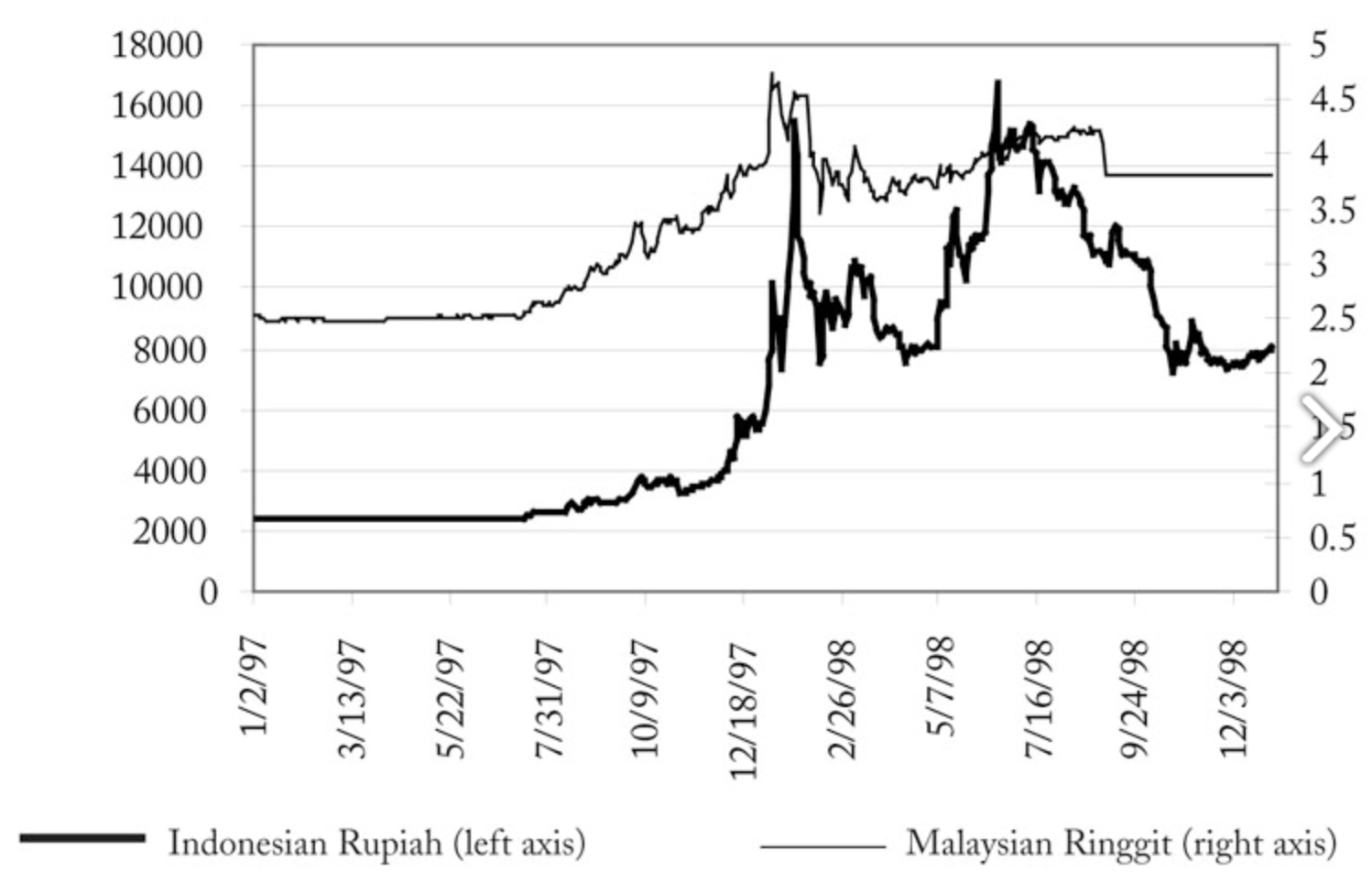
The currency board idea was very controversial at the time, and was ultimately never implemented because it would have meant sacrificing all monetary policy autonomy at a time that the government desperately wanted some tool to expand the economy. But President Clinton didn’t focus on that, rather he focused on the problem of defending the country’s shaky reserve position. This quote is particularly pithy:
If the rupiah falls, you will lose your reserves. And if the currency board is caught short and falls, you will lose the reserves as well, just quicker.
It’s not clear to me whether this comment made much of a difference in Soeharto’s thinking, but what follows from President Clinton is quite direct:
I want to go back to the G-7 and the IMF and talk to them about alternatives. I want this to work out and am worried the currency board will be an open target. I am worried about collapse.
What does Clinton mean with “this”? Indonesian economic reform, probably. What does he mean with “collapse”? Probably not the exchange rate. And also, probably, not the New Order regime. I think this has to be read as a statement about the collapse of Indonesia itself, and I suspect that Soeharto heard it that way. He responds
Thank you for your pledge. We need to make a decision soon as the people are demanding that their President do something to fix the situation and save the country.
Save the country, not just save the exchange rate. At about this time, in a parallel development, the “Love the Rupiah” movement was being rebranded the “Love Indonesia” movement, a delicious instance of international political economy synecdoche.
There is lots of other interesting information in yesterday’s release, including real-time reactions to the deteriorating situation of May 1998 and some fascinating (if oddly superficial and late-to-the-game) research on the political, economic, and social positions of Indonesia’s ethnic Chinese minority. We owe the Indonesia Documentation Project a debt a gratitude for this outstanding archival research.
 Tom Pepinsky