
A number of recent essays have noted just how divided the American experience with COVID-19 is—by geography, by state, and (as my coauthors Shana Gadarian and Sara Goodman have argued) by partisanship. As America starts to open up again, it is doing so unevenly, creating what Ed Yong recently called a “patchwork pandemic.”
Although my coauthors and I have emphasized partisan differences, and taken special care to ensure that what we identify as partisan differences aren’t just geographic or other kinds of differences that happen to be correlated with partisanship, COVID-19 itself has been experienced very differently across parts of the country. In places like New York City, where the outbreak has been so severe, we might not find partisan differences at all because the objective facts of the crisis are so plain for all to see. It is reasonable to ask if these partisan differences that we’ve uncovered are just temporary or incidental due to the spatial unevenness of the COVID-19 outbreak.
It could be, then, that if we see more localized outbreaks of COVID-19 around the rest of the country, partisan differences in health behavior will disappear there too.
To check if this is plausible, we investigate below six health behaviors where we observed strong partisan difference in late April/early May: wearing a mask, self-quarantining, avoiding gatherings or contact with others, washing hands, and purchasing hand sanitizer. We use logistic regression to estimate the probability that someone reports doing each of those things, controlling for basic demographic facts as well as a demanding set of state-by-urban/rural fixed effects. This means that we are comparing, in essence, people at the same level of urban versus rural in the same state, so we don’t assume that the effect of being in a rural area is the same in, say, New York versus Wyoming.* Importantly, we also allow the effect of partisanship to vary by the county-level COVID-19 diagnosis rate as of May 1 (right near the end of our survey). And we find this:
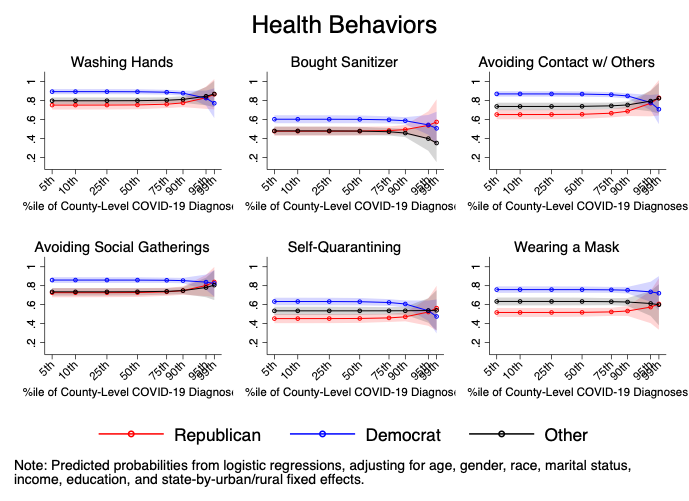
Partisan differences are statistically significant no matter how severe the outbreak of COVID-19 is… just until it is the most severe. Then, above the 90th percentile or so of COVID-19 severity, partisan differences disappear.
These results don’t tell us what will happen if places that have heretofore been spared from a severe outbreak find themselves beset by a rash of new diagnoses.** But they do say that when the outbreak is really bad, partisanship no longer predicts health behavior. It is left as an exercise for the reader to decide if that’s a good thing or a bad thing.
In fact, probably a more interesting thing to observe in these figures is that the baseline likelihood of many of these differences is pretty high—greater than 50%—regardless of respondents’ partisan identity. We can interpret this one of two ways. In one account, most people are doing these things, so we can focus on the fact that majorities of all parties are adopting or supporting pro-social behavior. In another, the one that we have been emphasizing, we draw attention to the partisan differences.
Both of these observations are true, but to my way of thinking, the existence of this strong party divide is a distressing sign of what’s to come. And I hope it doesn’t take a severe COVID-19 outbreak to erase that divide.
NOTE
* Thanks to Ben Ho for the suggestion.
** So the title of this post is actually an unanswered question. It’s a waiting game right now.


 Tom Pepinsky