Author: tompepinsky

  • Law, Order, and Threats to Democracy: The US and Indonesia Compared

    The United States and Indonesia both find themselves in an unenviable spot at the moment: confronting existential threats to liberal democracy. In the Indonesian case, the hardline Islamist group Front Pembela Islam (Islamic Defenders’ Front) has recently been banned as an organization by the Jokowi administration. FPI has been responsible violence against Indonesia’s non-Muslims, against liberal and progressive groups, and others. In the US case, a riotous mob of Trump supporters invaded and occupied the Capitol yesterday, causing death, widespread destruction of property, halting the work of the Congress, and shocking the world.

    These are obviously not the same problem: one is a bunch of hardline Islamists who reject the rights and liberties provided to all Indonesians under the country’s 1945 constitution, the other a bunch of MAGA/Proud Boys who honestly oppose the peaceful transfer of power via constitutional means. And yet they both force us to to grapple with a singular question: what is the proper way to respond to groups that not only violate the law, but do so in opposition to liberal democracy and the established constitutional order?

    I have argued that Jokowi’s banning of FPI is mistake (here is an article in Indonesian that covers a Twitter thread). Not only will banning FPI as an organization not address the ideological support that FPI draws upon, not only will it create a narrative that the organization is being unfairly singled out, not only will it fail to address the structural preconditions that explain the emergence of groups like FPI, but it is also fundamentally illiberal. The approach that the Jokowi administration should follow—which is unlikely, for reasons that need not detain us here—is to use Indonesia’s criminal justice system to try FPI members for acts of violence and incitement, and to punish those convicted aggressively, publicly, and transparently. Although I’m unclear on the specifics on Indonesian law on organized crime, FPI as an organization could be handled as a kind of criminal syndicate.

    It does not make me a “FPI defender” or “FPI denier” to make a case for using the criminal justice system to confront FPI rather than to treat it as a threat to the Constitution and national security and ban it for that reason. Indeed, it is precisely because I find the group so abhorrent that I urge Indonesians to find an effective, permanent, and public solution to the threat that FPI poses to all Indonesians as individuals, and to Indonesian democracy as a whole.

    The same thoughts cross my mind as I consider how best to respond to the riotous Americans who attempted to stop the final Congressional certification of the 2020 presidential election. I do think that these events plainly call into question the American constitutional order and the peaceful transfer of power.* I want to know why those who stormed the halls of government and threatened the lives of the Vice President and Members of Congress (to say nothing of the staffers and workers there) were not met with live fire on the Capitol steps.** Everyone who downplayed the threat of Trump and Trumpism for American democracy needs to take a sober look at American politics this morning, and listen to all of us who did.

    And yet I am uninterested in classifying yesterday’s events as a coup, rather than a riot, a coordinated mass action, or something else. Although my thoughts are not yet settled, I support an approach that views these acts as criminal rather than treasonous (even if I believe that they probably are treasonous). Describing the rioters as treasonous coup-makers feels satisfying in my gut, as capturing what I feel about what I saw, but it has the effect of recognizing their demands even as it rejects them.

    Americans should not look at the pathetic assembly of rioters as a mass of wannabe John Browns and Patrick Henrys, and Americans should reject any framing of the events that suggests as much. There should be no outs, even suggesting that their actions had legitimate political standing according to some perspective. The response should be to identify each and every participant, charge them with the crimes for which they are responsible, and try them in a court. And the current president ought to be removed from office via constitutional means for encouraging their behavior.

    Postscript

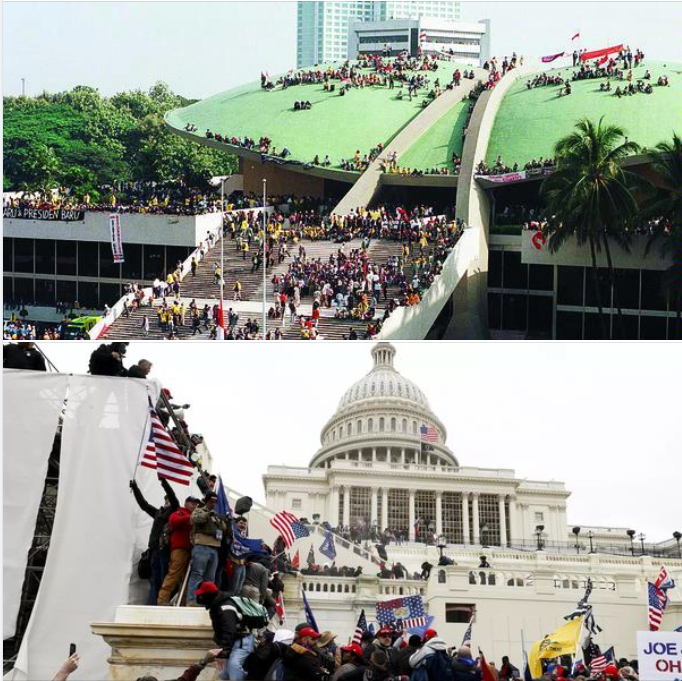
    An Indonesian friend shared this on Facebook last night: a comparison of the 1998 students’ occupation of the People’s Consultative Assembly (top), and the 2021 Capitol riot (bottom).
    Note

    * I don’t think the outcome of a Biden presidency was ever in doubt, even in the very worst moments when guns were drawn.

    ** I am not exaggerating.

  • Weak Parties Endangered American Democracy — And Then They May Have Saved It

    The transition from Trump-Pence to Biden-Harris is now moving full speed ahead. Even though the president’s lawsuits to overturn the election results continue, it is now very difficult to imagine how exactly even a successful lawsuit would overturn the results of the 2020 presidential election. Barring a truly unexpected turn of events, Biden and Harris will be sworn in as President and Vice President on January 21, 2021, just as expected.

    Two weeks ago I reflected on the state of American politics, asking whether or not political scientists had overestimated the fragility of American democracy in the face of the Trump presidency. There are still a lot of questions to sort out—in particular, would I feel so sanguine had Biden-Harris’s Electoral College margin been slimmer?—but I remain convinced that political scientists ought to reevaluate their prior beliefs about just how vulnerable American democracy is to a Trump-like threat.

    This is not the same as saying that there’s nothing wrong with American democracy.* Rather, we should think analytically about what precisely made Trump’s all-out assault on American democracy fail this November. And to be clear, that is exactly what Trump’s attempt to overturn the election results is: an assault on American democracy.

    The two most common answers that I encounter to why Trump’s efforts are failing are (1) because Trump and his team are a bunch of incompetent nincompoops who couldn’t figure out how to steal an election properly, and (2) because vigilant Americans sounded the alarm about the depth and scale of Trump’s threat to democracy, and then a handful of Republican heroes stood up for their principles when it counted in Georgia and Michigan. Without denying either of these, I’d like to propose that we can draw some lessons from the comparative experience about what sorts of preconditions are necessary for an incumbent president like Trump to steal an election.

    How to Autogolpe

    It is obvious—but sometimes easy to forget—that stealing an election or suspending democracy is not something that can be accomplished by a single individual politician. It requires coordination and collaboration throughout a country’s institutions. One can imagine someone a president declaring “I have won this election”** but this statement has no authority unless people act as if it did. And in democracies, people and institutions expect that it is the votes that determine the outcome of an election rather than the statements of incumbent politicians.

    Now, in other cases of presidential or prime ministerial self-coups, this hasn’t stopped incumbent chief executives from suspending parliament, reversing elections, or declaring a state of emergency or martial law. But doing so requires tools and structural preconditions that the American president does not currently possess.

    For example, it helps if one has operational command over the domestic deployment of the armed forces, like Thai Prime Minister (and former General) Thanom Kittikachorn had. But the American president does not have that sort of operational command over the Army or the Marines. The National Guard may be federalized under particular circumstances, and the American president might conceivably employ federal paramilitary forces under institutions such as ICE or the U.S. Marshals to achieve particular political ends, but to accomplish this would require institutional collaboration as well. Indeed, one notable precondition for Alberto Fujimori‘s autogolpe was a sustained domestic insurgency that had reinforced the unity of the Peruvian military and encouraged it to support Fujimori in order to crush what was perceived to be an existential threat to Peruvian national security.

    Without the tools to unilaterally suspend democracy or stop the counting of ballots by force, President Trump’s efforts to reverse the results of the 2020 presidential election required him to find a way to overturn election results, which in the United States are administered through a dizzying array of state and local institutions. This means that he needed to find willing collaborators in the electoral administrations in key battleground states.

    Weak Parties in a Federal System

    If you want to compel key actors to steal an election for you, and you cannot do it using military force, it does not suffice to rage about conspiracies. You actually need a mechanisms to ensure that key actors comply with your directives. The comparative record gives us plenty of cases in which incumbent politicians have responded to disappointing electoral outcomes by suspending democracy, such Malaysia in 1969***, without relying on the military. And the recent histories of Hungary and Poland show us how incumbents can erode meaningful checks and balances through deliberate strategies of opposition harassment, court packing, and legislative actions that tilt the playing field in favor of the incumbent and his party.

    What prevented President Trump from succeeding in these efforts? We already have one piece of the puzzle: America’s federal structure makes it difficult for our national politicians to police the actions of local and state electoral officials. President Trump and his team cannot fire uncooperative county clerks. They cannot withhold pay from the Georgia Secretary of State for failing to disqualify Fulton County ballots. The best they can do is to make public pleas, to impugn their reputations, and to attempt to bribe them. No doubt these strategies might have worked, but it is a far cry from what is possible in a unitary system where the national government directly oversees election administrators. I have no doubt that, counterfactually, had President Trump been able to fire Brad Raffensperger and replace him with a toady, he would have.

    For the second piece of the puzzle, I rely on insights I’ve learned from Julia Azari‘s analysis of how America combines weak parties with strong partisanship. America’s political parties are very weak—and for seven decades this has been something of a bugbear for political scientists. The weakness of American political parties is evident in their inability to prevent partisan outsiders such as Donald John Trump**** from securing the GOP’s nomination, and Bernie Sanders—who was not even a member of a major political party—from nearly securing the Democratic Party’s presidential nomination twice. America’s political parties simply do not have the internal discipline and top-down control that is characteristic of political parties in other advanced democracies.

    But here is the hidden upside. To wit, without strong top-down political control over his copartisans, President Trump cannot use the party’s resources or authority to effectively punish any copartisans who might not toe his line. In a strong party system, even if President Trump were unable to fire an uncooperative official, he could arrange for their expulsion from the GOP. His team could ensure that these officials never were again allowed to run for office by denying them a position on a party list. These things happen in democracies strong party systems with some frequency, and it is the threat that they might happen that allows aspiring autocrats to use their political parties as weapons against their opponents both within and outside of the party.

    As it is, the only tool that the President Trump has to punish uncooperative Republicans is the threat that the voters will punish them later. This is the threat that a loyal elected GOP official will be primaried by a Trumpist. This is indeed a threat that many GOP officials probably take seriously. But, but, and once again, but… even though Trump is a formidable campaigner, this threat is less credible once Trump is out of office. And GOP officials need not openly defy Trump, they can claim instead that they are simply “following the rule of law.”

    Viewed in the American context, the threat of being primaried later seems like a very powerful tool in President Trump’s arsenal. But viewed comparatively, it’s just not that effective. Even as Trump vies for control over the institutional GOP, it is striking how little power this gives him over the actions of his copartisans, even when the chips are down.

    Without stronger political parties or a unitary system of government, there’s just not much that the president can do to stop GOP election administrators from acknowledging that he lost the election. There are plenty of ways in Trump’s administration can (and is) doing lasting damage to America’s democracy. But perhaps surprisingly, the same weak parties that helped give us Trump are now helping to show him the door.

    NOTES

    * THERE ARE AUTHORITARIANS. Look around.

    ** Indeed, the president has said this a couple of times.

    *** Note, however, that even here, the incumbent ruling coalition had won the election, just not with the parliamentary supermajority that it desired.

    **** That’s right, the casino guy! From TV!