
The official results of the 2009 legislative elections are in. Here is the breakdown of all the parties that got enough votes to get seats in parliament.
| Party | Perc. | Seats |
| Democratic Party (PD) | 20.85 | 148 |
| Party of the Functional Groups (Golkar) |
14.45 | 108 |
| Indonesian Democratic Party–Struggle (PDI–P) |
14.03 | 93 |
| Prosperous Justice Party (PKS) |
7.88 | 59 |
| National Mandate Party (PAN) |
6.01 | 42 |
| United Development Party (PPP) |
5.32 | 39 |
| National Awakening Party (PKB) |
4.94 | 26 |
| Great Indonesia Movement Party (Gerindra) |
4.46 | 30 |
| People's Conscience Party (Hanura) |
3.77 | 15 |
These results show a couple of things. First, the biggest parties by far are the non-Islamic ones (these are the first three). Second, the personal parties of former military leaders do surprisingly well, given that with the exception of PD they were formed just about a year ago (these are the last two). Let's look now at the development of parties over time.
Three Rounds of Democratic Elections
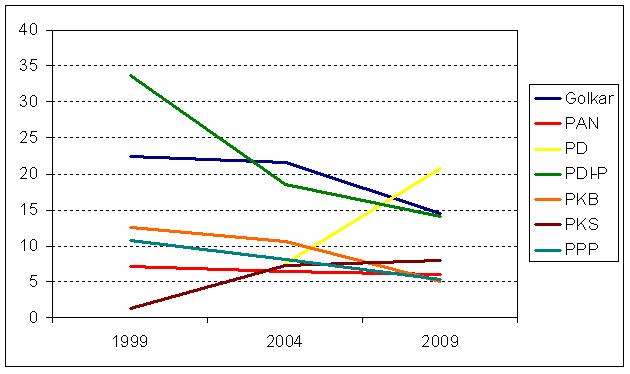
I leave off Hanura and Gerindra because trends don't make sense with one data point each. But if you look at the trends over time, you can that there are only two parties that have increased their vote shares since 1999: PD and the conservative Islamist PKS. (In 1999 PKS ran under a different name.) All other parties have seen their support eroding: the nationalist ones (Golkar and PDI-P, the moderate Islamic-nationalist ones (PKB and PAN), and the Islamic one (PPP). (Two additional conservative Islamic parties, PBR and PBB, did so poorly in this election that they no longer have seats in parliament.) Even PKS, though, didn't do great…it's vote share is up less than 1% from 2004, and in absolute terms it actually received fewer votes compared to 2004. The only party that really increased its vote share is PD.
I'm trying to wrap my mind around what this all means. One might read this as encouraging: Islamist support is dwindling. I think that this is right, but there's another, less optimistic way to read this. The traditional nationalist powerhouses are becoming obsolete. The newcomer nationalist party is doing very well, but we know that it won't survive to 2014 because it's purely a personal vehicle for SBY. There's no successor being groomed, and SBY can't run again in 2014, so we can't expect PD to draw any support in 2014. So who will step up? A lot of civil society people worry that if Golkar and PDI-P can't reverse their steep declines–and I don't foresee them being able to do this–the most likely option will be PKS, whose on-the-ground organization is the envy of all other parties (even if its popular support right now isn't very high). This would be worrying.


