Author: tompepinsky

  • Building Singapore

    Due to the relative lack of anything interesting, I will not be writing about Singaporean politics while I'm here. Suffice it to say, the news this morning reported that Minister Mentor Lee Kuan Yew went to China to have a nice dinner at Jiang Zemin's house, and that PM Lee Hsien Loong had a productive meeting with Indonesia's President Yudhoyono.

    But that doesn't mean I can't reflect on history a bit. So here goes. It is a peculiarity among American scholars of Southeast Asia to say that you "don't like" or "don't enjoy" Singapore. Part of it is that Singapore is so developed and modern (almost postmodern, really) that it doesn't really feel like Southeast Asia. There's no villages. You can drink the water right out of the tap. The subway is clean and organized and goes wherever you need to go, and moreover, it interacts seamlessly with the bus. Something like 1/3 of all residents of Singapore are foreigners…probably more if you count the many domestic workers. Basically everyone you meet speaks English.

    But there's something more than that. Rather than just indifference–sort of like what China scholars think about Hong Kong, which is quite similar–I detect an active disdain for Singapore among many SE Asianists. Many resist coming here, or complain about it in non-specific terms as a place that they "don't like." I've never shared that sentiment myself. I've always found Singapore to be interesting. It's not an old country, as independence from Malaysia came in 1965. When independence came, no one thought it was a viable political entity, a tiny, largely Chinese, English speaking island sandwiched between two really big non-Chinese neighbors. But it's worked out well for Singapore. And for someone like me who wonders how in the world some countries get to be prosperous while others don't, Singapore's amazing success over the past 40 years can't help but seem interesting.

    I thought about this as I rode across the island/country today on my way to the think tank where I'm based. It reinforced to me just how small the country is. Its land area is only 700 square kilometers total. At the widest part it's maybe 20 miles or so wide. Despite that, it has to have all the things that a regular country has, like for instance a training ground for its very large military. (From my hotel room I've been enjoying watching the Singaporean Air Force F15s practice their maneuvers.) Gazing out the window of the bus, I had to think, what were the Singaporeans thinking when they became independent? Sure, they had a better go of it than most newly independent countries, being located at a vital trade route, having had good institutions built under the British, and being small enough to govern pretty easily. But still, all that can give you some economic advantages, but doesn't build a state for you. And my impression is that the independence generation here had a laser-sharp focus on making sure that Singapore would be able to fend for itself as a country. These guys woke up every morning, went downstairs, and built a modern state. That's pretty cool to think about–and that's obviously flipping hard, given that few others newly independent states were anywhere near as successful, and a good number of them failed spectacularly.

    So given that Singapore was successful at the very thing that its leaders and its people feared the most, and at creating the type of prosperity that so many other Southeast Asians dream about, why the disdain for Singapore among my colleagues? I have a couple of ideas, but nothing conclusive. One is that Singapore is actually a relatively conservative place, both socially conservative and also quite materialist and certainly constructed to appeal to your average Australian or British tourist. Related to that, perhaps its fact that the ruling People's Action Party–formerly an explicitly socialist opposition party–morphed into a party of big business and single party, pro-establishment politics. Perhaps its the explicit classism that is rather evident at times (the people at ISEAS where shocked that I took the bus there). Perhaps its a romanticized version of what Asia is "really" supposed to be like, that is to say, exotic and strange, not comfortable and familiar. I'm not sure what it is. But even if you don't like Singapore because it reminds you of any other generic cookie-cutter modern megacity, I think it's unquestionably important to think about how Singapore got this way.
  • NRT-SIN (Tokyo to Singapore)

    Jetlag woke me up at 3:30 AM this morning, which left me with a big chunk of time before my flight to Singapore at 11:00. Fortunately, I had a plan: head down to Tsukiji, the world's largest wholesale seafood market, to check out the action and snag a bite of super-fresh sushi. I would have preferred to have slept until 4:30 or so and gotten up in time for the first subway (left the nearest station at 5:04 AM), but since I was up far before that I decided to leave early and to walk.

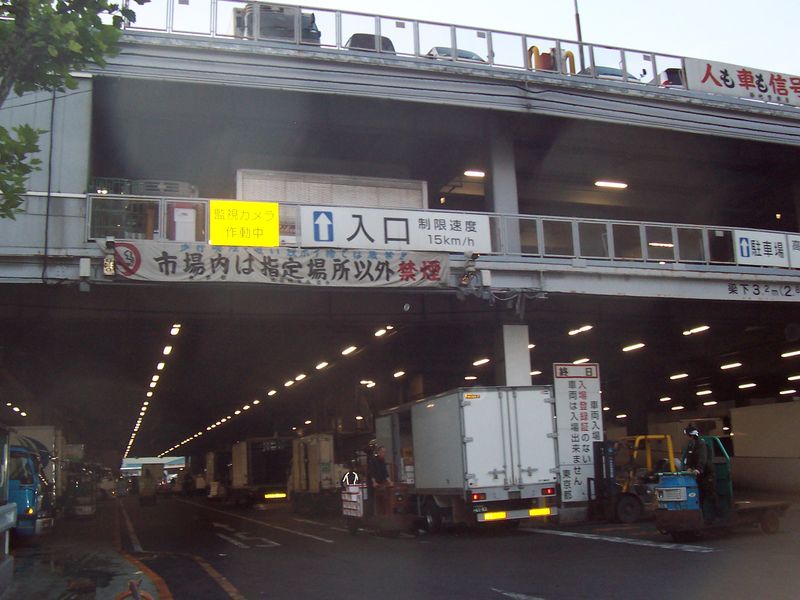
    I arrived at the market at 4:39 AM, which I thought was going to be way too early, but the place was packed with people and fish. This place is a big tourist draw, so it's a bit disorienting to learn that the place is nothing more than a big warehouse complex crawling with forklifts and semis. There's nothing charming about it in terms of a market. 

    Tsukiji Fish Market

    5-17-10.1

    The charm, it turns out, rests in the little alleys off to the side of the market, where little tiny stalls do a brisk business in the freshest sushi that you can imagine.

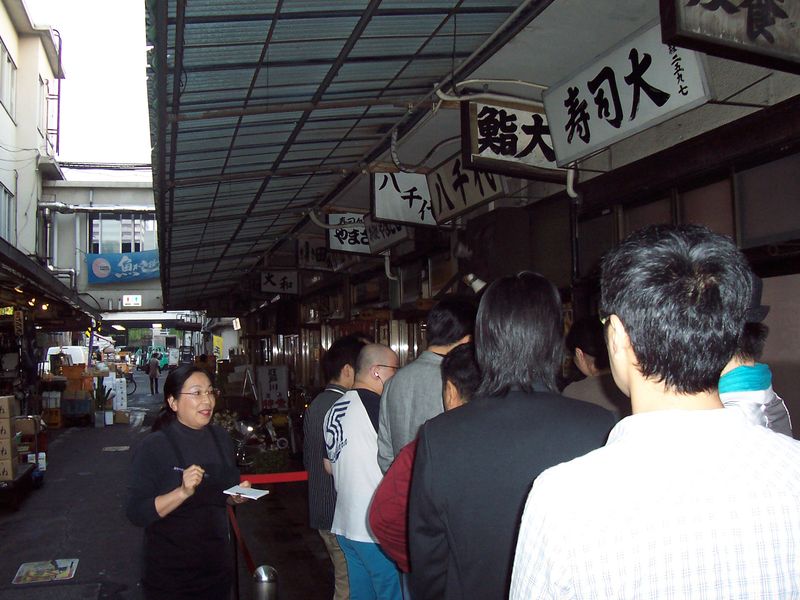
    On the recommendation of several Japanese friends, I decided to try a particularly famous one called "Sushi Dai." I had heard that it opens at 5:00 AM so I thought that it was good that I made it there so early, but it turns out that I wasn't the only one with this idea. When I strolled up around 4:50 or so, this is what I saw: a big mass of Japanese hipsters and salarymen, out for a last bite after a long night of carousing the town.

    Wait Line for Sushi Dai, 4:50 AM on a Monday

    5-17-10.2

    The woman with the pad is taking orders. The way it works is, she tells you that you can have whatever you want, but everyone orders the Chef's special…she relays that to the three sushi chefs inside, who make your sushi right at the tiny bar (which is, truth be told, only slightly bigger than our bathroom at home, and seats no more than 12 people). They take their time: the special comes with 11 pieces, and it takes about 45 minutes to an hour to go through it. Had I arrived any later it would have been way too late–I didn't get a seat until 5:45, and by 5:00 the line behind me had 30 more people in it.

    A problem arose, though. I'm allergic to shellfish, and this is one of their specialties. I had a friend write up a big long note about this to give to the chef or the waitress, and it is currently sitting at home on my printer. So, last night I took it upon myself to learn how how to say "don't kill me with shellfish" in Japanese. Here's what I pieced together from various internet forums (apologies if this is horribly impolite): Sumimasen. Watashi wa koukakurui no arerugi ga arimasu. Sakana wa OK desu. Osusume wa nan desu ka? Literally, "Pardon me. I have an allergy to shellfish. Fish is OK. What do you recommend." I whipped this out for the waitress and it seems to have worked perfectly, for the chef kindly substituted interesting fish choices for the three shellfish items he was giving out (live shrimp sushi, sea urchin roe sushi, and live octopus sushi).

    OK, enough of that, after waiting for all that time, how did it taste? I can't say that I'm the world's leading expert on sushi, but numerous Japanese people have told me that this is the best sushi in Japan, and that means that it has to be in the running for best sushi on the planet. It was clearly the best sushi that I've ever had. Everything was fantastic: so fresh, so perfectly soft, so simple and good. The biggest surprise was not the high grade fatty tuna, which was delicious, but rather the sleepers like smelt, flounder, sea bass, and my favorite, Spanish mackerel. If you've had mackerel before, you know it can be off-puttingly oily and fishy tasting. This stuff, though…the chef lightly brushed it with a sweetish salty glaze and topped it with scallions, and gave me firm instructions not to eat it with soy sauce. Nothing fishy or oily about it, just clean and tasty.

    Spanish Mackerel Sushi

    5-17-10.3

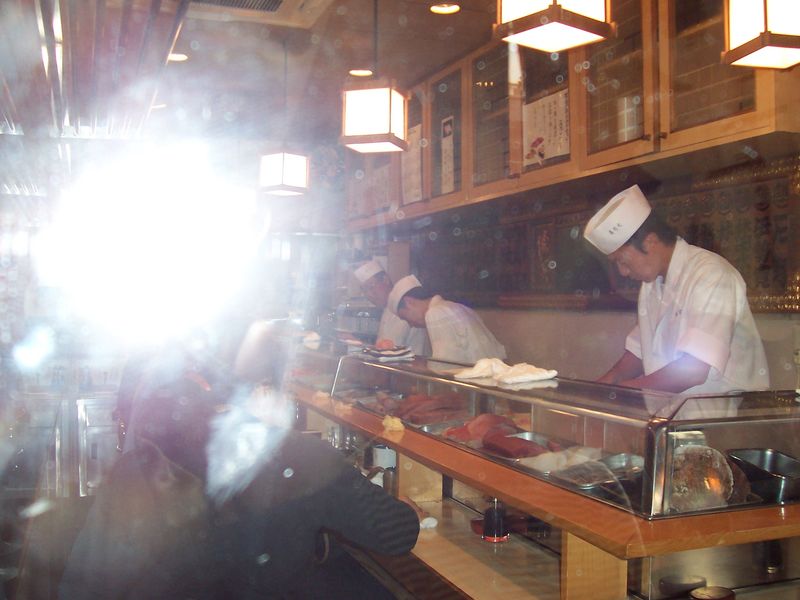
    The scene at the tiny little restaurant was also great, with Japanese chefs working their gigantic knives while screaming Japanese things at you (which, truth be told, only mean "HERE IS SOME SEA BASS" and "I HOPE YOU LIKED THAT" and "THANK YOU FOR COMING").

    The Chefs at Sushi Dai (Pardon the Flash)

    5-17-10.4

    After that great meal, I made my way back to Narita for my flight here to Singapore. This was uneventful, although it was JAL business class so it was quite nice. From one big Asian metropolis to another, then. Tomorrow the real work part of the trip begins.