
This is the second in a series of short reviews on modern Southeast Asian fiction. There will be spoilers. As always I’m pleased to have had the chance to develop these thoughts as part of a course, so credit is due to my student as well.
Previous review:
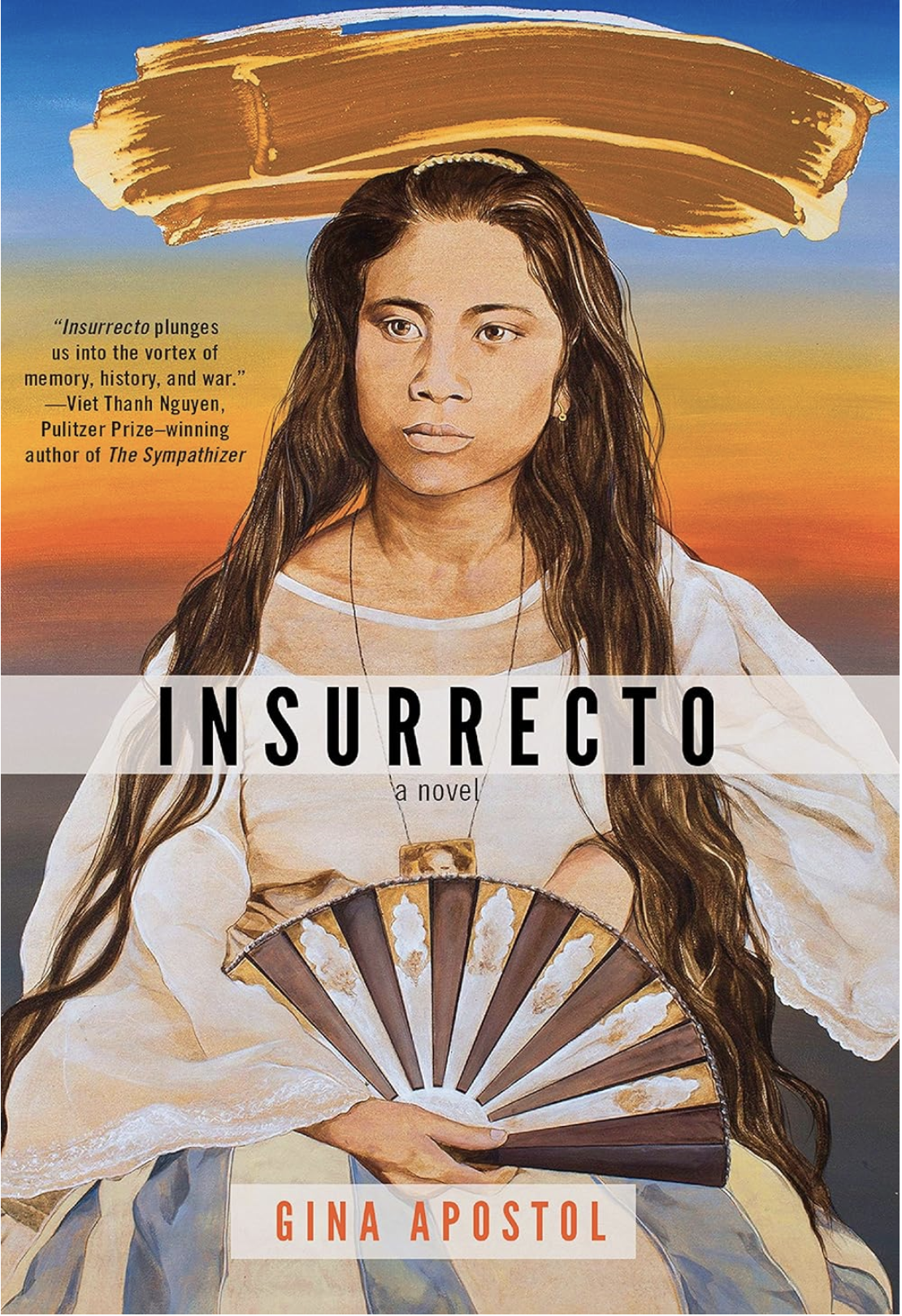
Gina Apostol, Insurrecto
This is one of those books that you read about before you read. Gina Apostol is a giant of modern Philippine literature, and Insurrecto is a heck of a book.
The early chapters, much like the reviews, hinted at just how many layers of meaning would be revealed throughout the course of the book, but upon encountering this passage I knew that Apostol was going to be throwing heaters with every pitch:

This is wickedly funny stuff. There are levels.
Rather than try to summarize Insurrecto‘s plot, or to explain what the book is about, let me instead just describe some of what’s “in” it. (It will be for you, the reader, to read and organize all of this for yourself.) At one level, it is the story of two contemporary women, one American and the other Filipino, who are writing—and not exactly collaboratively—a screenplay about a massacre of Philippine villagers by American occupying soldiers in 1901. They have different interpretations, different points of emphasis. The American, Chiara, is writing a screenplay based on a movie her father, Ludo Brasi, had made about the same massacre, in the 1970s. The Filipino, Magsalin, lives in New York but is enlisted by Chiara to help with her script. They travel to Samar, the location of the massacre, Ludo’s film, and Magsalin’s home region. This happens in the contemporary period, under the brutal Duterte administration.
Questions of authenticity abound, and also questions of perspective, all intertwined. We read various scripts not as scripts, but as descriptions of the events, which are themselves invoking the broader questions of authenticity and perspective, as in a passage where an American photographer in 1901 describes the veracity of the images his camera takes to a Filipino counterpart who describes his own eyes as perfectly capable of capturing what the camera captures. Or discussions of a beach town as a trompe-l’œil, like a film set to conjure what a beach town is supposed to feel like, but nevertheless with real people, real flowers, real guns.
So, as you can see, levels. Instead of reading my opinions you should just wade right in, splash around, and enjoy the whole thing. There will be bits that you get, and there will be bits that you miss (like me), and there will be bits that make you think differently, and then you’ll immediately second-guess those—and then, you’ll wonder whether or not you actually do get those bits that you thought you got. As Viet Thanh Nguyen writes in his back-cover endorsement, the book is “meta-fictional, meta-cinematic, even meta-meta.”
One thing I found especially enjoyable about the book was the writing, how Apostol uses language and dialogue to conjure a sense of whimsy and humor in the context of a lot of heavy themes. Take this exchange:

“the plate like petals, a corolla of carbs” is just excellent—the book is full of such expressions. But the dialogue here makes the whole thing even better. You can pay attention to no other part of the book and still really enjoy all the exchanges like this. You can even enjoy Apostol’s witty dialogue at otherwise difficult passages:

Here again are those themes of authenticity and perspective. What’s real? Who decides? But also, LOL, “that’s the wrong texture. Meth is fine and bright.”*
It’s not all heavy. You can also enjoy the parts that discuss how the Ewoks in Return of the Jedi speak Tagalog. You can enjoy knowing that Chiara is obviously Sophia Coppola, and Ludo is Francis Ford Coppola, and that Apocalypse Now was filmed in the Philippines: a story about Vietnam that’s a retelling of a story about Africa was filmed in the Philippines.** You can even enjoy the parts that describe young American soldiers who are as naive as can be—sometimes attempting to be principled, oftentimes not, but never heroes. That said, there are no heroes in Insurrecto. No character is entirely sympathetic, no character is pure. Casiana Nacionales, the insurrectionist after whom the book is titled, is the only exception.***
I take two things away from Insurrecto. Not themes exactly, but rather impressions.
One is interconnectedness. No specific passage in the book does this, but I am left with the impression that we are to understand the massacre of 1901, the history of the Philippines, and our efforts describe it and narrate it to others, as being connected far beyond the islands themselves. There is no way to describe the Philippines on its own, from an aperspectival perspective. References to Magellan, to the similarities between lechon and porchetta, to American soldiers communicating with the village chief in a basic Spanish learned in Cuba… and of course, the fact of travel, of living abroad, of working across distance, both real and virtual, which is a constant theme for every character. Even the proliferation of terms and phrases in Tagalog and Waray, this reminds the reader that there is always translation of some form, and that we make our way through our connected worlds with, at most, an imperfect and incomplete view of those connections and how they made the world we inhabit.
The other is honesty, about perspective, about history, about our ability to comprehend. The camera never captures reality, the script never records it, but our eyes don’t either. I truly appreciate how thoroughly Apostol establishes this point: we are never “inside” the history, we are always outside it. We have roles in history****, not places in it. Magsalin tells Chiara, who cries out for justice for two victims of Duterte’s drug war,
do you think you will exact it in the middle of the road in a town where no one knows you, a woman in short shorts and bloody platform sandals, with even your continuity in question, do you think that is your role right now, to be the avenger in a time that does not give a fuck?
Magsalin is speaking to us, yes, but I believe that she is also speaking to herself. Look how she breaks that fourth wall, right there without even making a big deal about it. Roles, not places.
NOTES
* One example of where I’m not sure if I get it, or if the levels are too subtle for me, is Chiara’s description of crack as meth. Crack is a cocaine product; meth is called crank. Is that another level? I am pleased to learn, however, that shabu means the same thing in Tagalog as it does in Indonesian. (For the of completeness, let me also note that shabu-shabu is something else entirely.)
** And if you click here and fast-forward to 2:45, you can hear 5-year old Sofia Coppola sing the Philippine national anthem. Hand to God.
*** Read Apostol herself on this point, she might not agree with my view. I do agree that she is the character that we need to “side with,” because—indeed—“atrocity happens, this war happened.” That, if nothing else, pins the novel down as being more than just a literary exercise.
**** Obligatory reference to how history comes from the same root as story goes here.

 Tom Pepinsky