Author: tompepinsky

  • When Do Civilizations Climb Mountains?

    One of the most important books in modern Southeast Asian studies is James Scott‘s The Art of Not Being Governed. This book draws on the term Zomia, coined by Willem van Schendel, which describes the upland areas of mainland Southeast Asia that had never been completely incorporated into the lowland civilizations associated with the kingdoms and empires of Pagan, Funan, Champa, Sukhothai, Dai Viet, and so forth.

    In the Southeast Asian context, then, civilizations are lowland things. (In the islands things are slightly different, but the lowland/upland distinction does emerge around the Malay terms hulu [=source, interior] and hilir [= downstream] to describe riverine polities in Sumatra, see here for more.) An early draft of Scott’s book circulated under a title that was something like “Why Civilizations Don’t Climb Mountains.”

    I am fascinated, though, by the limits of generalization from the Southeast Asian experience. Nothing holds the Southeast Asian cases in more relief than the Incan and Aztec Empires, located in upland areas and no less “civilizational” than lowland empires of the Mayan and Moche. But the case that really stands out is the Merina Kingdom on Madagascar. Here we have a case of a kingdom founded by Southeast Asians—the first Malagasy people came from Borneo—but politically and socially centered in the highlands of an island with a noticeable coastal/interior divide. Like many who have worked on politics in island Southeast Asia, Madagascar ranks pretty high on my research bucket list for this very reason.

    Now, I am certainly not the first to have noticed that there are highland civilizational counterparts to the riverine civilizations of Southeast Asia and others settings like China, India, and Egypt. But I’m not familiar with any direct answer to the question in the title of this post. Do we know, when do civilizations climb mountains? Is there a big Jared Diamond-style biogeographic perspective on the conditions under which empires form in upland versus lowland areas (which could tell us why, for example, Borneo and New Guinea never developed Merina-like highland civilizations)? Something more prosaic? Or is this just a case of variation that has no single explanation? I’d love to know the answer.
  • How Piety Varies among Indonesian Muslims

    Here are some figures from my current book project on piety among Indonesian Muslims. We—Bill Liddle, Saiful Mujani, and I—have constructed a measure of piety at the individual level that encompasses beliefs, rituals, and behavior. We rely heavily on this indicator to show that individual level piety among Indonesian Muslims ….

    does not explain any of the phenomena that we set out to explain: social identity by aliran, support for Islamic law or political Islam, support for Islamist parties, the use of Islamic financial services, or greater engagement with the Muslim world relative to other world regions

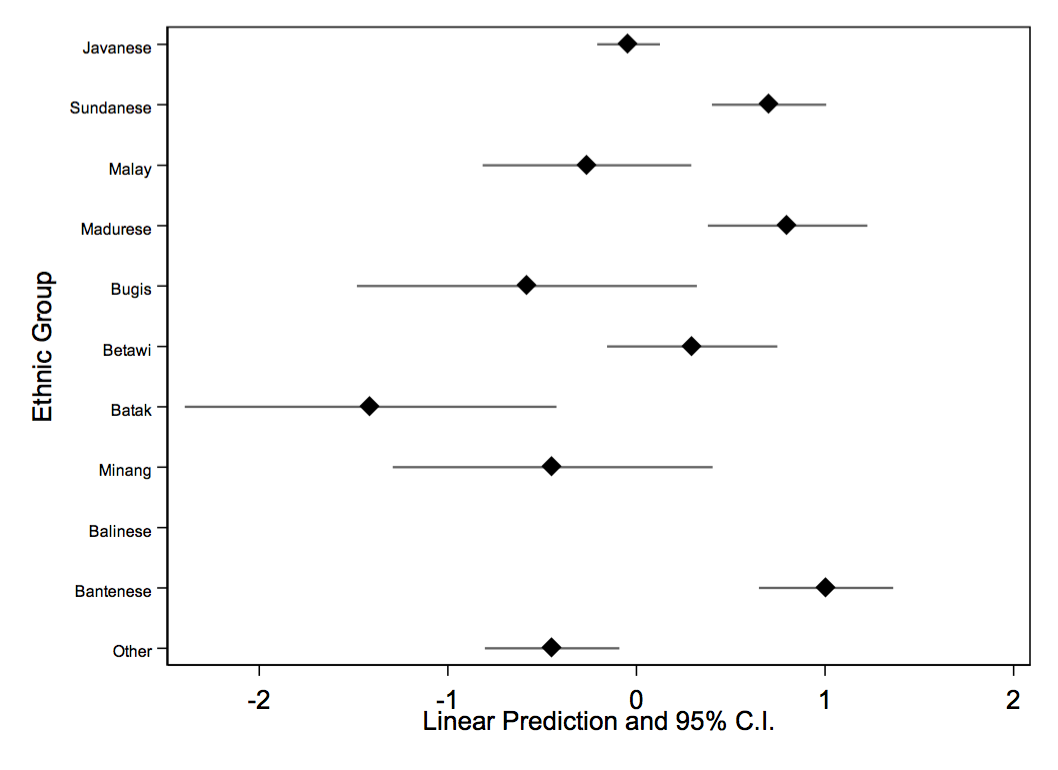
    But we can also use our variable to make some descriptive inferences too. Here, for example, is a plot of predicted piety among respondents in our sample based on ethnicity.
    piety_x_ethnicity
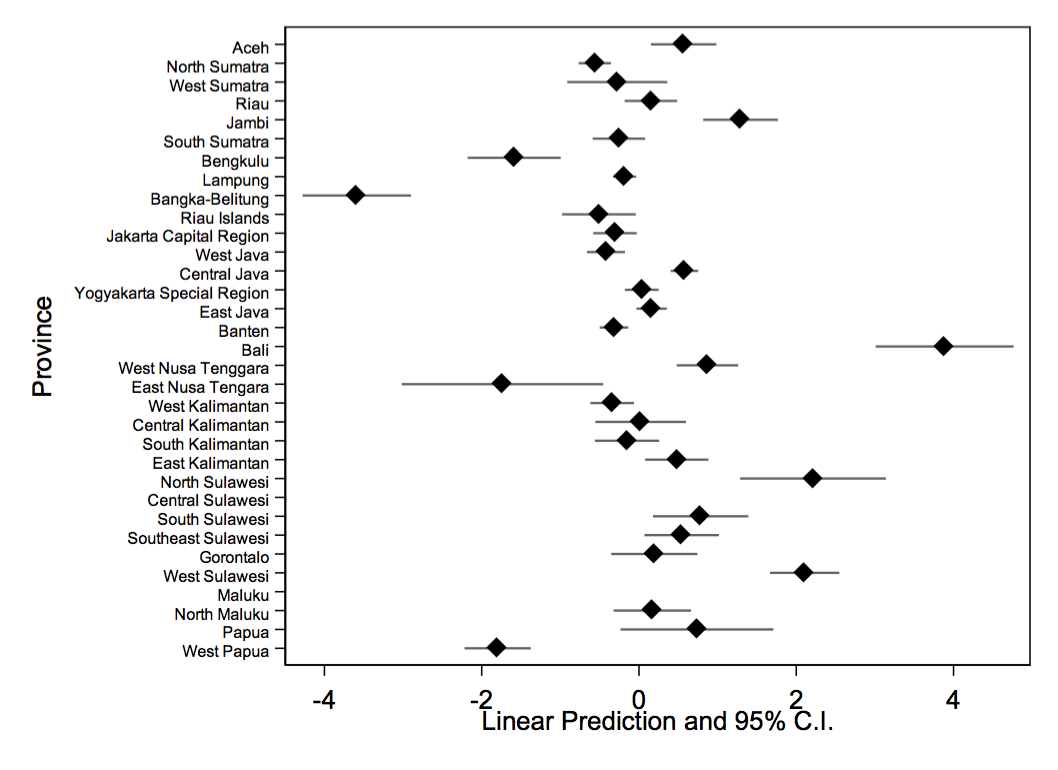
    And here is a plot of predicted piety based on province of residence. (We can go down to kabupaten/kota too but the figure is massive and unwieldy.)
    piety_x_province
    (In case you’re curious, the model we use to generate these predictions contains a full set of dummies for gender, age, level of income, employment status, level of education, number of children, and marital status.)

    This is one of those nice instances in which the quantitative data accord really nicely with our qualitative impressions. Sundanese, Madurese, and Bantenese Muslims tend to score more highly on our piety index than do Javanese Muslims, for example. But there are other, tantalizing bits in here that warrant further qualitative investigation. We see that Muslims in Aceh tend not to be more pious (net of ethnicity) than Muslims in Central Java, although the difference with East Java and Yogya is more pronounced. Muslims in the majority Hindu island of Bali tend to be far more pious—by our metric—than Muslims elsewhere in Indonesia, a pattern that we uncover as well among Muslims in majority-protestant North Sulawesi. Muslims in Bangka-Belitung score lowest on our piety index.

    What explains these findings? There are lots of possibilities, none of which we will be able to answer using surveys. But looking comprehensively at how piety varies is the first step in knowing what questions we need to be asking.