Author: tompepinsky

  • Short Reviews of Modern SEA Fiction (4): Tash Aw, We, The Survivors

    This is the fourth in a series of short reviews on modern Southeast Asian fiction. There will be spoilers. As always I’m pleased to have had the chance to develop these thoughts as part of a course, so credit is due to my student as well.

    Previous review:

    1. Short Reviews of Modern SEA Fiction (1): Rachel Heng, The Great Reclamation
    2. Short Reviews of Modern SEA Fiction (2): Gina Apostol, Insurrecto
    3. Short Reviews of Modern SEA Fiction (3): Ayu Utami, Saman

    Tash Aw, We, The Survivors

    The problem with writing a review of Tash Aw‘s recent novel We, The Survivors is that I am biased, due to the plain fact that I find the subject matter to be intrinsically interesting. It covers so much in such a tightly written book: Kuala Lumpur, inequality amidst modernization, ethnicity and language, the mechanics of illicit economies, migration and citizenship. It is the truest book I have read so far this semester. Every character, every situation, every place, I can picture it in my mind. That the novel describes a wholly realistic tragedy and the hard lives surrounding it makes its realism particularly meaningful for people know Malaysia. I suspect that if you don’t know Malaysia at all, you will still find something to love about this book.
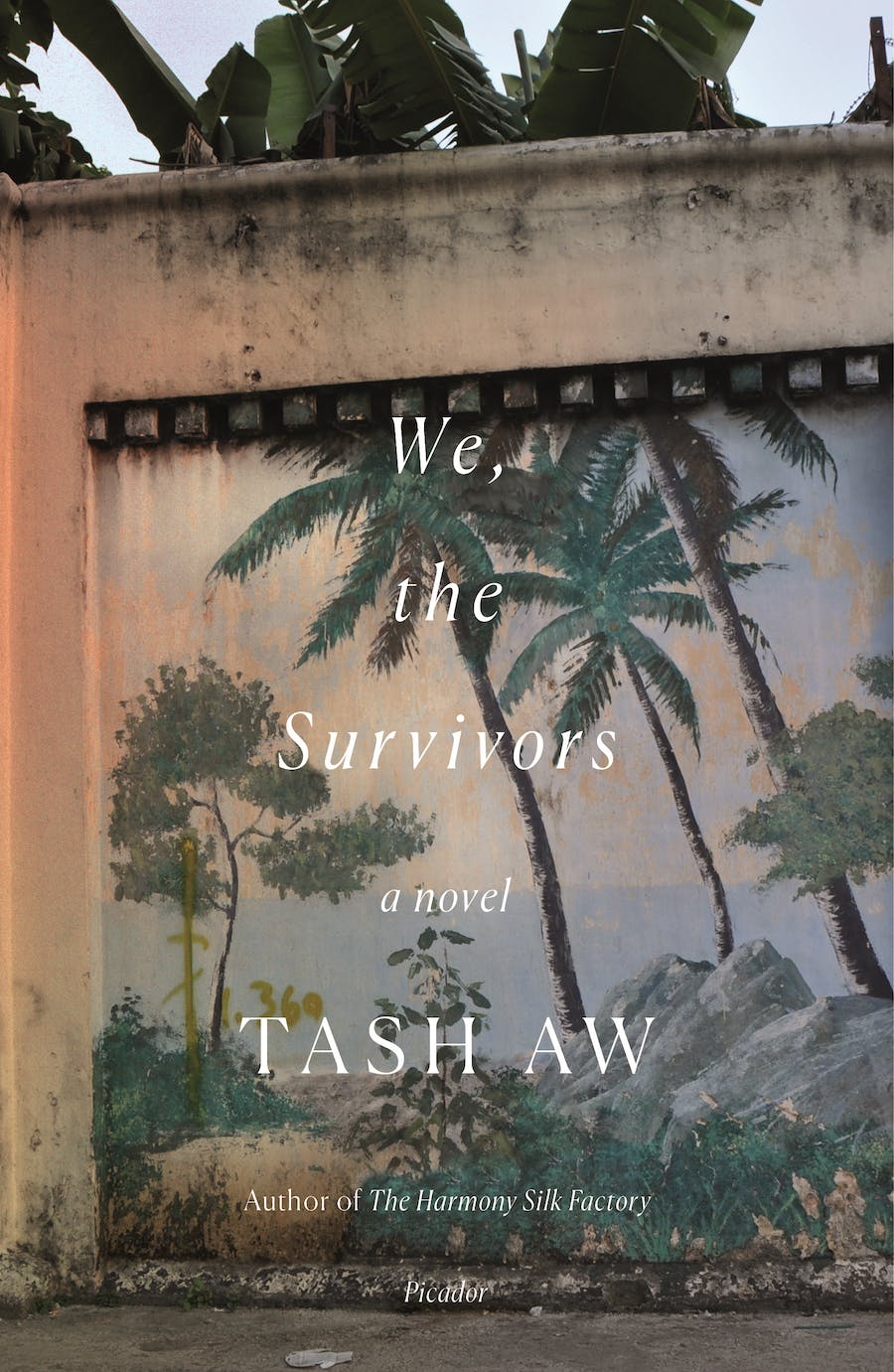
    SPOILERS FROM THE JUMP: This is a story of a man named Ah Hock, who grew up hard in the Kuala Lumpur exurbs, and who murders a Bangladeshi man who trades in the illegal migrant workers that are so important to making contemporary Malaysia’s economy work. This introduction to the book is stark and sudden, but that is the core of the plot, and Aw beautifully captures the starkness of modern life for poor Malaysians living in and around KL. As a reader, you learn that Ah Hock is a convicted murderer early on, but you learn the story of the crime—and of Ah Hock—over the course of the novel.

    The themes that Aw covers are central to modern Malaysian society and politics. One central theme is poverty: Ah Hock grows up in a broken home with a hardworking mother who fights to put food on the table. She and Ah Hock work a small plot of land in their village in the Klang Valley to make it productive enough to feed them, and to bring some farmed fish to market. Ah Hock spends some time in KL as well, selling pills and a bit of meth with Ah Keong, whom he knows from back in the village. Whereas Ah Hock is modest, Ah Keong is boastful: Ah Hock doesn’t take well to city life, but Ah Keong styles himself a gangster businessman, and he is quick to anger and to use physical violence to get his way.* Ah Hock works other, more legitimate jobs—at an outdoor seafood restaurant, on a fish farm—and he even marries a striving young woman named Jenny with her own dreams of wealth and prosperity.

    But Ah Hock never gets ahead. His mother dies young of a preventable cancer. His marriage with Jenny is unhappy (she finds herself pulled into an Amway-like scam) and they drift apart. Ah Hock works tirelessly, to little avail. Ah Keong is ultimately a destructive force in his life, bringing him opportunity but also danger. In the end, it is Ah Keong’s scheming to find Ah Hock some illegal immigrants to support Ah Hock’s work crew that leads to the murder that drives the plot.

    And yet what jumped out to me throughout the novel was Ah Hock’s insistence that he had a choice. This creates an interesting tension. On the one hand, the book describes social systems that are hard constraints. Poverty is poverty. The powerful will take what they can and the weak will suffer. The jungle and the sea will take back the land. And yet at key moments Ah Hock speculates—in first person, as the book is written—about his choices. What he might of done, the offramps he might have taken. Near the novel’s dramatic climax, it is therefore very poignant to read this passage:

    Another central theme in the book is the complex interaction of race, ethnicity, citizenship, and class. In the standard schematic of peninsular Malaysian ethnicity, there are Malays, Chinese, Indians, and others. Malays were historically marginalized during the period of early capitalist development under colonialism, leading to a ranked ethnic system at independence in which the average material prosperity of the Malay community lagged behind that of Indians and especially Chinese. That’s the story.**

    In We, The Survivors, the main characters are Chinese, and they are poor. They turn to petty crime to get ahead. They sell and take drugs, they work dirty and dangerous jobs outside, and they are exploited by a business class that is both Malay and Chinese. Their labor makes KL work. It thus inverts the standard narrative.

    But there is another layer to this story, which is post-independence immigration. From the very first time I set foot in Malaysia, I remember the open secret of illegal labor migration. I saw it in the dark corners of Bukit Bintang, in the lorries on the federal highway, in the mamak stalls in Shah Alam, in the palm oil plantations of Sabah. These laborers come to Malaysia to find work and to escape oppression: they are Bangladeshi, Nepali, Rohingya, Indonesian.*** The book describes so plainly how this illicit economy works. Everything is completely realistic and believable.

    There are also, at various points, descriptions of Black Africans living in Malaysia. This one stuck with me:
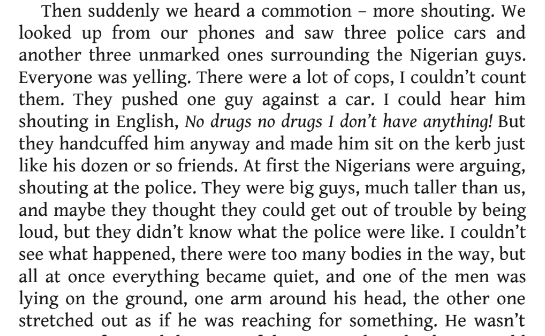
    Again, this rings completely true to me. I can imagine it with no trouble at all.

    As much as this is a story about poverty and inequality, it is also a story about migration and citizenship. Ah Hock’s father migrates to Singapore and disappears. Illegal migrant labor fuels the economy. Much depends on the ability to get papers, which establish a legal right to work, but which also establish a person as a legal and legible rights-bearing person. They can command higher wages and can call the police (even if, as the Nigerians demonstrate, there is no guarantee that a racialized Other will be protected). Those without papers are vulnerable, and so they are cheap.

    The ordinariness with which characters treat the desperate lives of illegal workers is striking. They are simply expendable, and this comes up explicitly. A Malaysian audience might remark on the additional fact that many of the migrants are Muslims, and the absence of pan-religious solidarity in the face of the boundaries of citizenship and the exigencies of capitalist development. In the end, Ah Hock’s murder of the Bangladeshi fixer brings this home for us.

    There is much more to enjoy in this book. Without spoiling the whole thing, I will mention that an important minor character is a young Malaysian PhD candidate writing a dissertation abroad, who has returned home to do her field research—which includes interviewing Ah Hock. She embodies everything cosmopolitan and modern: she doesn’t eat carbs (so no rice or biscuits, LOL), she finds the grocery store impossibly dirty, she is paralyzed by the injustice she sees, she is embarrassed for Ah Hock when he doesn’t know that she is in a same sex relationship, and so forth. She is a great foil for Ah Hock, and for any Western reader.

    But in the end, We, The Survivors is just a well-written novel. Here is a book by an author who knows what he is doing, and it’s plain from the very first page that you are in for a difficult but rewarding account of modern Malaysia.

    NOTES

    * I couldn’t help but remember Jason (Ah Loong) from Sepet, the poor yet earnest Chinese boy from Ipoh caught up in a web of petty crime to make ends meet.

    ** Reality is more complicated than that. Someday I will finish a book that describes that reality…

    *** I cannot count the number of times a Malay acquaintance back in the 2000s told me about urban crime in KL, only to clarify that the problem wasn’t Malaysians, it was Indonesians. Decolonize that.

  • Short Reviews of Modern SEA Fiction (3): Ayu Utami, Saman

    This is the third in a series of short reviews on modern Southeast Asian fiction. There will be spoilers. As always I’m pleased to have had the chance to develop these thoughts as part of a course, so credit is due to my student as well.

    Previous review:

    1. Short Reviews of Modern SEA Fiction (1): Rachel Heng, The Great Reclamation
    2. Short Reviews of Modern SEA Fiction (2): Gina Apostol, Insurrecto

    Ayu Utami, Saman

    Back in graduate school, I wrote a dissertation about the political economy of regime change in Indonesia and Malaysia. I was in college when the Soeharto regime fell and when Mahathir fought Anwar and the IMF; by the time I had decided that maritime Southeast Asia would be my subject of research, Soeharto was long gone and Mahathir had retired (which was a thing that Mahathir once did). This meant that I learned about the turbulent events of 1997-98 indirectly, by reading about them and asking people about them.

    The mid-2000s, when I was doing the field research that informed my argument, was an interesting time. The crisis was still very memorable—there were still burnt shopfronts in Glodok, and people would still scream at you in the KL exurbs about currency speculation—but things had changed in both countries. One thing that was most notable in 2004 was how much Indonesia’s political opening had led to an explosion of critical discussion of just about anything in the public space. Not just politics, not just history, but things like sex, gender, religion, the media, capitalism, and re(op)pression. Topics that had never been open for public discussion since at least the 1960s, if ever. It was a very open time.*

    That is why I am sorry that I never read Ayu Utami‘s Saman before now. It is a kaleidoscopic novel, discussing female sexuality in raw, provocative, and sometimes amusing ways.

    Four of the central characters are women in their 20s and early 30s, and we meet them in the context of direct conversations about desire, intimacy, and sex itself. One story line follows Laila, a 30 year old virgin, as she pines after a married man named Sihar, whom she plans to meet him for a tryst in New York City. Another follows Yasmin, who encounters the titular character, a man named Saman, after a chance encounter with Sihar and Laila (Yasmin and Saman later do meet in NYC; more about Saman later). Still another story line follows the female character Shakuntala, who is ravenous and unapologetic about her sexual appetite and experiences. There is an air of magical realism in the prose; when Shakuntala describes her youthful sexual encounters with “ogres” and her mother’s warning that she is “made of porcelain,” it seems obvious that this is a metaphor, but the prose is just magical enough to make you wonder.

    Like many younger Westerners in Jakarta in the mid-2000s, I was adjacent to (but not affiliated with, or participating in) the modern art, literature, and music scene. Most commentaries about Saman describe how it influenced the sastra wangi [= “fragrant” literature] movement. I remember this, and I remember events at TIM and so forth. Reading Saman brought me back to discussion groups, coffee- and kretek-fueled conversations about Julia Suryakusuma‘s Sex, Power, and Nation, and the air of possibility and critique, especially among the ritzier segments of Jakarta, Bandung, and Yogyakarta. The book is dedicated to Komunitas Utan Kayu, which intersected with Jaringan Islam Liberal [= Liberal Islam Network]. I was close with some of the key players among the latter, and they shaped my thinking about a lot of things.

    But I wasn’t in Indonesia for the release of Saman, which happened to coincide with the crisis of 1997-98. I don’t know Saman was released before or after Soeharto’s fall, but one does note that the exchange rates quoted in the book definitely imply that the book was written before the crash. I suspect that the acclaim that Saman received within Indonesia, becoming a true bestseller, was only possible because it coincided with a period of rapid political change, and an opening of civil society and intellectual space.

    Reading this book a quarter century after it was written, and with my own background in Indonesia as just described, I do notice how powerful the descriptions of sex and sexuality are. These women are not Suryakusuma’s State Ibus. But I equally notice that the title character is Saman, not the four women who dominate the English-language coverage of the book. And I note the themes of capitalist domination and ecological destruction as much as I do themes of sex and intimacy.

    Saman’s character is by far the most fully developed character in the book.** As we learn, he was born Athanasius Wisanggeni to a well-off Javanese Catholic family, and took holy orders to become Romo Wis [= father Wis]. He grew up outside of Prabumulih, in South Sumatra, and after schooling in Java returned home to become the priest in a local community.*** Once there he comes to confront the power of the extractive sector to control the local economy and society, and suffers accordingly. In the end, he leaves the faith. When we first meet him, it is many years later, and he has taken the name Saman.**** He is now an activist, and we meet him because Sihar (remember him?) contacts him after Sihar and Laila, who works as a reporter, witness a crime on a natural gas drilling platform off the Anambas Islands.

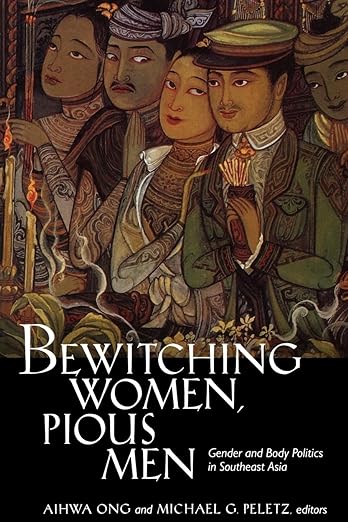
    These kinds of intersections among various story lines are what make Saman such an interesting read. In reading together with the student, we came to the view that Saman represents a vision of the ideal man: he is pure, he is pious, he is noble in thought and in deed, unlike all of the other women in the book. It led us to think about assumptions about gender and sexuality in Southeast Asia: in Western academia, there is a view the traditionally, women were relatively more powerful and autonomous in Southeast Asia than they are in other parts of the world. In fact, this led us to pick off my shelf an old book that I bought for my first undergraduate class in the anthropology of Southeast Asia, Aihwa Ong and Michael Peletz‘s Bewitching Women, Pious Men, which is where I first encountered this view. From page 1 of the volume:

    Dominant scholarly conceptions of gender in Southeast Asia focus on egalitarianism, complementarity, and the relative autonomy of women in relation to men—and are framed largely in local terms.

    My student quipped: “This should be the title of the book! Not Saman.” Good one!

    I’m conscious as well of just how cosmopolitan everyone in this book is. Much of the dramatic action takes place in New York City, which was all but unimaginable in the 1990s for anyone but Indonesia’s globe-trotting elites. And many passages in the book take the form of email exchanges, taking place—on the book’s own timeline—in 1994. I paused to think about this, because I did not receive send or receive an email until the summer of 1996, and the idea that two people could carry on trans-Pacific a romantic dialogue via email in 1994 is pretty interesting.***** I note that one minor background figure in the book, someone named Sidney with a New York apartment, is definitely someone I know.

    In all, these thoughts help me to place this thoroughly enjoyable book in its historical context. And, also, to think about the random series of fortuitous connections that link me indirectly to the times and places here.

    Notes

    * This is one reason why I firmly believe that democracy really does matter. Just the possibility of freedom of conscience in public spaces is irreplaceable, and this is truly impossible without the minimal protections on individual expression afforded by a minimal democracy.

    ** In my understanding of literary criticism, which dates from my high school English classes, Saman is a round character, and the others are flat.

    *** I took particular note in this part of the book that Utami describes how Prabumulih had changed in the intervening years:

    The name of the street had changed, from Kerinci to Sudirman, from the name of a mountain in Sumatra to that of a Javanese general.

    Seems like an important detail.

    **** Saman doesn’t mean anything in Indonesian. There is a part of the book where a character speculates about Saman’s name as having been chosen because it sounds leftist (e.g. like Stalin, Lenin, Trotsky, Aidit). I think it sounds like semen and that that’s the point.

    ***** It reminded me of Jim Siegel‘s essay on the student protests of May 1998; specifically, a comment about a young women who remarked that her Softlens prevented the tear gas from affecting her.