Author: tompepinsky

  • Benedict Anderson and the Etymology of Bule

    The great scholar Benedict Anderson‘s posthumous memoir, A Life Beyond Boundaries, is now available for purchase. It promises to be an exciting read by one of the most influential scholars of Asia of our time. I have not yet had the chance to read it, but already I have heard the stir caused by one of its most striking claims: that Anderson coined the term bule as an epithet for a Caucasian person.

    Bule is a slang pronunciation of the Indonesian word bulai, which means albino. You can see how it’s used by doing a Google image search for kerbau bule [= albino water buffalo]. In common parlance, bule is a semi-derogatory term for white person, akin to something like “whitey” in American English. At least it used to be an epithet: I think that for my generation, bule has lost most of its power as an insult. For example, there was an old bar in Jakarta called Bugil’s, which is both a portmanteau of bule gila [= crazy whitey] and also the Indonesian word for naked, and it was a famous expat haunt (I remember short pours of watered down bourbon). In this sense, bule is like queer in American English, a term that has been appropriated by the community against whom it was directed and thus has lost its ability to be an insult. Equivalent terms in Hong Kong (gwai loh), Singapore (ang mo), Malaysia (mat salleh), and Thailand (farang), to my knowledge, have not been so embraced by their target community.

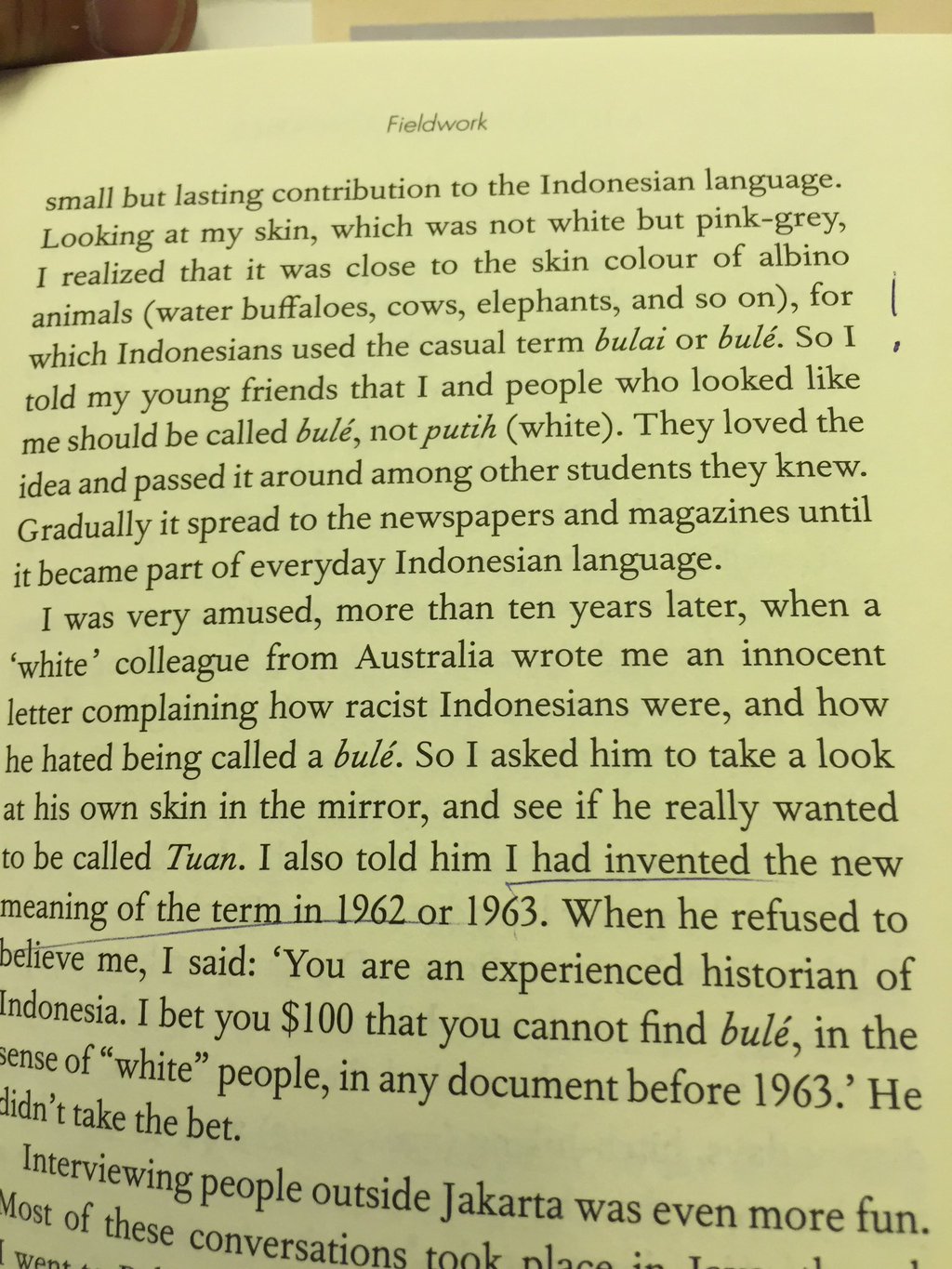
    Anyway, the etymology of such epithets is interesting. I always assumed that the link from bulai to bule to “whitey” was self-evident, not something that someone would be able to claim. But Anderson offers a strict challenge here (the picture is due to a friend of mine):
    CjP5hvdWsAAgGPo
    Not only does Anderson claim to have invented bule in the early 1960s, he challenges us to find an earlier use of the term.

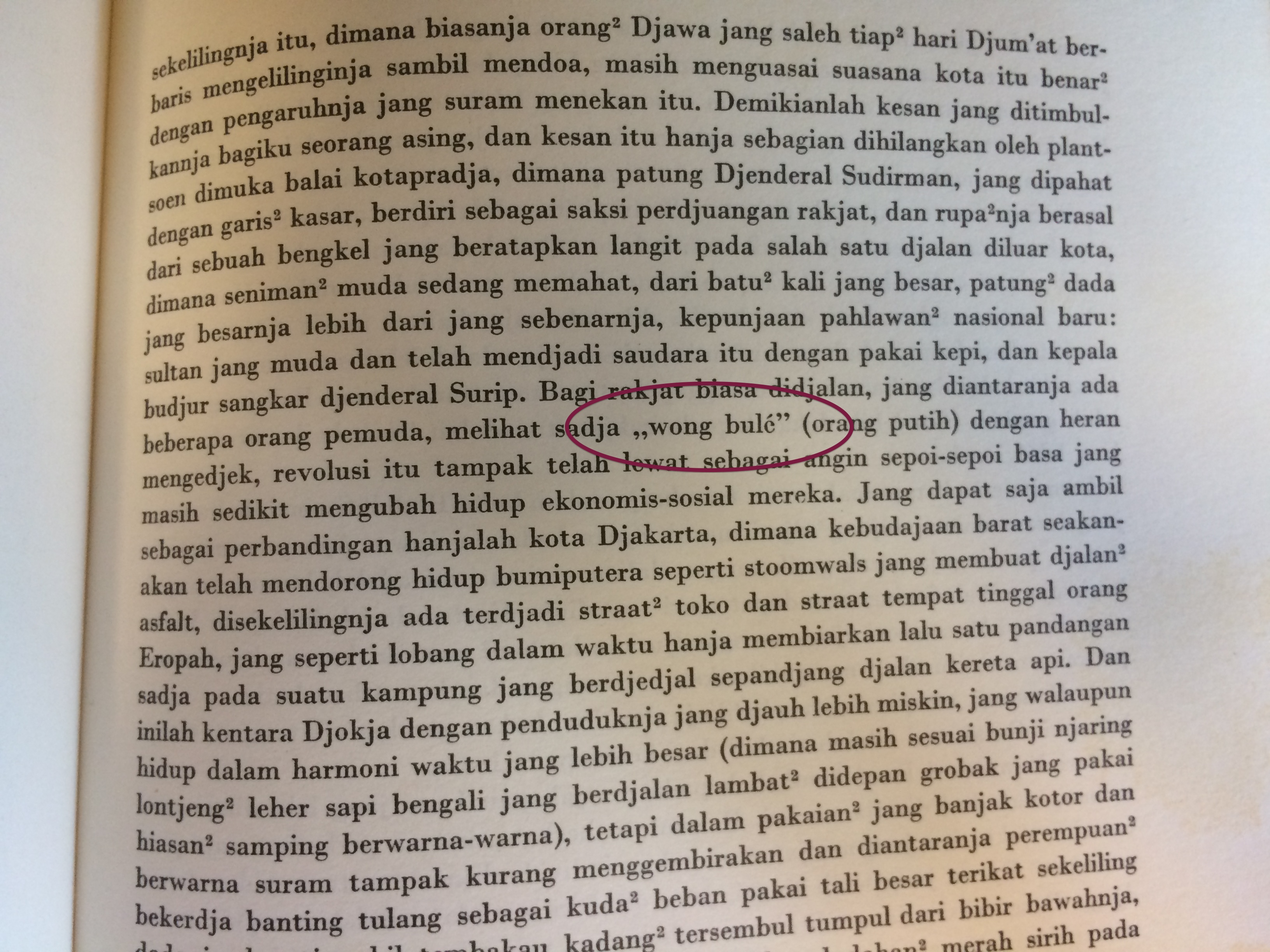
    I have found such an instance. I found it originally with a Google Books search for the words bule and Djakarta, restricted to anything published before 1965, on the intuition that if the term would be found it would be found in a book using the Dutch spelling. The source is a book by W. le Fèbre entitled Taman Siswa: Ialah Kepertjajaan kepada kekuatan sendiri untuk tumbuh…, published in 1952 by Balai Buku Indonesia. Happily, the Cornell library has the original book so I checked it out, and here’s what we find on page 17.
    IMG_3250-1
    The meaning is very clear: “wong bule” (orang putih) is best rendered as “honkeys” (white people) in American English.

    An interesting footnote to this find is the context of the quote: it is describing the sentiments of youth during the time of the Indonesian national revolution, seeing wong bule as confused and unsettled by the social upheaval at the time. That community and that time period is exactly the subject of Anderson’s Java in a Time of Revolution. A nice parallel, reinforcing the power of language in a time of revolutionary ferment.

    Now, my finding this quote does not reject the possibility that it was Anderson’s use of bule with his friends that is responsible for its prominence today. But it does directly challenge Anderson’s claim that “bule, in the sense of ‘white’ people” cannot be found prior to 1963.

  • On the Cuts to Asian Studies at ANU

    By now, many readers of this blog will be familiar with the recent decision to restructure Asian studies at the Australian National University, in particular through the elimination of professorial positions in the School of Culture, History, and Languages. These cuts have garnered wide attention, both because they include the shocking decision to fire giants in the field of Asian studies such as Professor Robert Cribb, and because they have stark implications for the ANU’s ability to be a world leader in fields such as Indonesian studies.

    Much of the commentary has focused on Professor Cribb. For example, the Southeast Asia Research Group (of which I am a part) recently released a statement about Professor Cribb, and there is an active trans-species movement to protest his “voluntary separation package”.[1] Personal stories surely abound as well. I count Professor Cribb as an inspiration, someone whose work I have read ever since graduate school, whose research has been foundational for my own professional journey. He has shared his time to talk about topics of mutual interest. Although our disciplines are different, I view us as engaged in a common intellectual enterprise.

    But to my mind, the entire package of proposed cuts is the problem. It amounts to a tragic mistake that will destroy Asian studies as we know it at one of the world’s leading centers for Asian studies. The implications go beyond just the elimination of faculty and teaching staff. Going forward, how can the ANU ever hope recruit top faculty without the rich intellectual resources that a deep area studies environment provides? Add to that the university’s inability to credibly commit, going forward, that faculty positions and academic units in Asian studies will be secure. Given the importance of undergraduate instruction as part of the revenue-generating model that the ANU seems to be following, it is surprising that academic leadership has concluded that cutting major faculty and teaching positions is a way to encourage enrollments. The proposed cuts to CHL set in motion a dynamic reactive sequence that can only undermine what was very recently considered a jewel in the ANU’s crown.

    Why would someone like me care so much about Asian studies at the ANU? After all, there is an interpretation in which another university, like Cornell, where I work, now has the opportunity to snap up some foreign talent. Maybe an opportunity to rise in some ranking scheme?[2]

    The answer is both personal and professional. Personally, I feel indebted to the ANU, a place that has generously accommodating me as a visiting researcher several times and which employs colleagues and friends with whom I can share my work. Many U.S.-based academics who work in Southeast Asian studies will tell similar stories. I have never visited CHL itself, but my goodness I don’t care which particular unit is which, it’s all ANU[3] to me. The proposed cuts to CHL mean that one leg upon which that community stands has been hobbled. It will have university-wide repercussions.

    Professionally, though, we all benefit from the ANU having a dominant position in Asian studies in general, and in Southeast Asian history, culture, and language in particular. The English speaking academic world does not pay enough attention to Southeast Asia. We need institutions such as the ANU that are bastions for cross-disciplinary, area-focused scholarship on this region. It’s hard to do this from North America. It ought not be so hard to do this from Australia, so long as university leaders are committed preserving existing areas of excellence. The proposed cuts to CHL will have repercussions beyond the ANU, and beyond Australia, for the production of knowledge about Asia. This is one area where the ANU really and truly leads.

    It is fine to be critical in this way, and to talk in the abstract about the consequences of deep cuts. But it does not offer solutions; and I have no reason to doubt that, as various published reports have indicated, CHL’s budget was ultimately unsustainable (although I’d want to see how that particular sausage is made). So what is the way forward? My expectation would be that those faculty and staff who themselves do the intellectual and pedagogical work within CHL would be tasked with developing a “change management” strategy. Were they to prove unable or unwilling to do so, then the case might be different. Perhaps this is an odd bit of American academic idealism, and U.S. universities are certainly capable of implementing big changes that have major effects on instructional staff [4]. Yet if the budget situation is dire, then CHL stakeholders have an incentive to work together to put the unit on a sounder footing. This is for the good of the faculty and teaching staff, as well as for the university and the wider academic community.

    NOTES

    [1] Which is Australian for “firing.”
    [2] To Americans reading this: as much as we are obsessed with rankings and metrics here in the U.S., our obsessions pale in comparison Australian and other university systems based on the British system (see e.g. Britain itself, Singapore). Seriously. I mean, the Australians ranked every f*cking journal in the world a couple years ago so that some bureaucracy could interpret research output. It’s part of the DNA of Australian academia.
    [3] Which is American for “the ANU.”
    [4] I know that you looked here because you thought I might have a comment on something specific. \Nelson{Ha Ha!}